
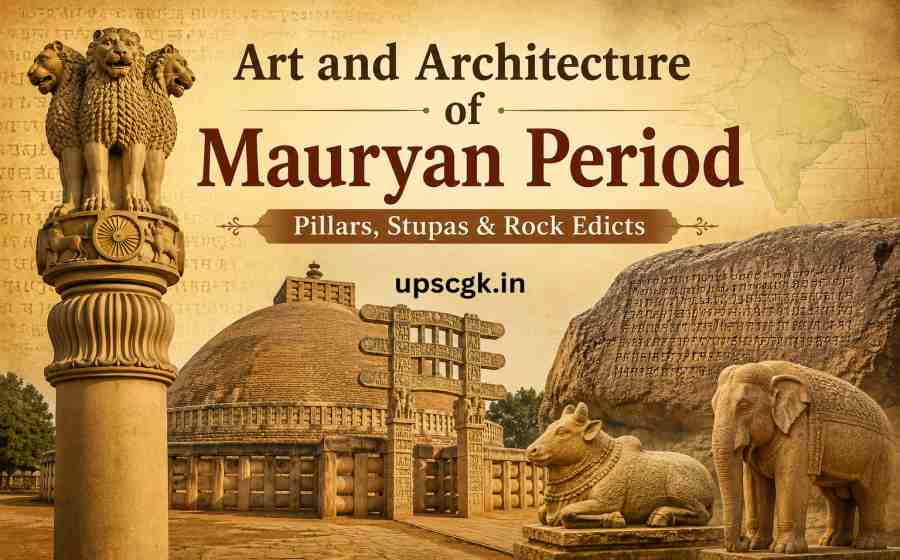
Explore Art and Architecture of Mauryan Period including Ashokan pillars, stupas, caves and rock edicts that shaped ancient Indian culture.
Art and Architecture of Mauryan Period
The Mauryan Empire was one of the greatest empires in ancient Indian history. Founded by Chandragupta Maurya in the 4th century BCE, the empire reached its peak under Ashoka. The Mauryan period is considered a golden phase for Indian art, architecture, administration, and culture. During this time, large monuments, beautifully polished pillars, stupas, and rock-cut caves were constructed across the empire.
Mauryan art and architecture reflected both political power and religious values. The spread of Buddhism after the Kalinga War greatly influenced the construction of stupas, pillars, and inscriptions. Most Mauryan monuments were built using stone, which marked a major change from earlier wooden structures.
Table of Contents
Features of Mauryan Art and Architecture
Mauryan architecture had several unique characteristics that made it different from earlier periods:
- Extensive use of stone for construction
- Highly polished surfaces known as Mauryan polish
- Influence of Buddhism and moral teachings
- Construction of stupas, pillars, caves and palaces
- Presence of inscriptions and edicts
- Artistic carvings of animals and symbols
The Mauryan rulers used architecture not only for beauty but also for administration and spreading religious messages.
Mauryan Pillars
The pillars of the Mauryan period are among the finest examples of ancient Indian art. These pillars were mainly built during the reign of Ashoka. They were erected in different parts of the empire to spread the teachings of Dhamma.
Features of Ashokan Pillars
The pillars were generally made from a single piece of sandstone and had a smooth polished surface. Their height ranged between 30 to 40 feet. The pillars consisted of:
- A tall cylindrical shaft
- A capital at the top
- Animal sculptures like lions, bulls, elephants, and horses
The animal figures symbolized strength, courage, peace, and royal authority.
One of the most famous pillars is the Sarnath Lion Capital. It has four lions standing back to back. Today, it is the National Emblem of India. The wheel below the lions, known as the Ashoka Chakra, is present on the Indian national flag.
Important Ashokan Pillars
Some important Mauryan pillars are:
- Sarnath Pillar
- Lauriya Nandangarh Pillar
- Rampurva Bull Capital
- Allahabad Pillar
- Sanchi Pillar
These pillars carried inscriptions called edicts, which contained Ashoka’s messages regarding morality, peace, non-violence, and good governance.
Stupas of the Mauryan Period
Stupas became an important feature of Buddhist architecture during the Mauryan age. A stupa is a dome-shaped structure built to preserve the relics of Buddha or Buddhist monks.
Ashoka is believed to have built thousands of stupas across his empire to spread Buddhism.
Structure of a Stupa
A stupa generally consisted of:
- A hemispherical dome called Anda
- A railing surrounding the structure
- A central pillar
- A square platform called Harmika
- A triple umbrella called Chatra on top
The stupa symbolized the spiritual path and teachings of Buddhism.
Famous Mauryan Stupas
1. Sanchi Stupa
The Great Stupa at Sanchi in present-day Madhya Pradesh is the most famous Buddhist monument of ancient India. Originally commissioned by Ashoka, it later underwent expansion during the Shunga period. The gateways and carvings of Sanchi reflect scenes from the life of Buddha.
2. Dhamek Stupa
Located at Sarnath, the Dhamek Stupa marks the place where Buddha delivered his first sermon. It became an important Buddhist pilgrimage site.
3. Bharhut Stupa
The Bharhut Stupa is known for its railings and sculptures depicting Buddhist stories and symbols. The construction of stupas helped in the spread of Buddhism not only in India but also in other Asian countries.
Rock Edicts and Inscriptions
One of the greatest contributions of Ashoka was the use of inscriptions to communicate with the people. These inscriptions were carved on rocks and pillars throughout the empire.
The inscriptions are known as Rock Edicts and Pillar Edicts.
Purpose of Rock Edicts
Ashoka used these edicts to:
- Spread the principles of Dhamma
- Promote non-violence and compassion
- Encourage religious tolerance
- Inform people about administrative policies
- Guide officials and citizens
The edicts were written in local languages and scripts so that common people could understand them easily.
Major Rock Edicts
The Major Rock Edicts discussed topics such as:
- Respect for parents and teachers
- Kindness towards animals
- Religious harmony
- Welfare measures
- Moral conduct
Languages and Scripts
The inscriptions were mainly written in:
- Prakrit language
- Brahmi script
- Kharosthi script in north-western regions
Some inscriptions were also found in Greek and Aramaic, showing the wide reach of the Mauryan Empire.
Rock Cut Caves of the Mauryan Age
The Mauryan rulers also built rock-cut caves for monks and ascetics. These caves are important examples of ancient Indian engineering and architecture.
Barabar Caves
The Barabar Hills caves in Bihar are among the oldest surviving rock-cut caves in India. These caves were donated by Ashoka and his grandson Dasharatha to the Ajivika sect.
he caves had highly polished interiors and remarkable acoustic design. The smooth finish of these caves reflects the advanced craftsmanship of Mauryan artists.
Importance of Mauryan Art and Architecture
Mauryan art and architecture hold immense importance in Indian history because:
- They marked the beginning of large-scale stone architecture in India
- They promoted Buddhism and moral values
- They reflected the political power of the Mauryan rulers
- They influenced later Indian architectural styles
- They showcased excellent craftsmanship and artistic skills
The Mauryan legacy continued to inspire later dynasties such as the Shungas, Satavahanas, and Guptas.
Summary
The Mauryan period was a landmark era in the development of Indian art and architecture. The magnificent pillars, stupas, rock edicts, and caves built during this time demonstrated both artistic excellence and administrative vision. Ashoka used architecture as a tool for spreading peace, morality, and Buddhism across the empire.
Even today, the remains of Mauryan monuments stand as symbols of India’s rich cultural heritage. The Lion Capital of Sarnath becoming the national emblem of India reflects the everlasting impact of Mauryan art and architecture on Indian identity and history.
Also Check: History