
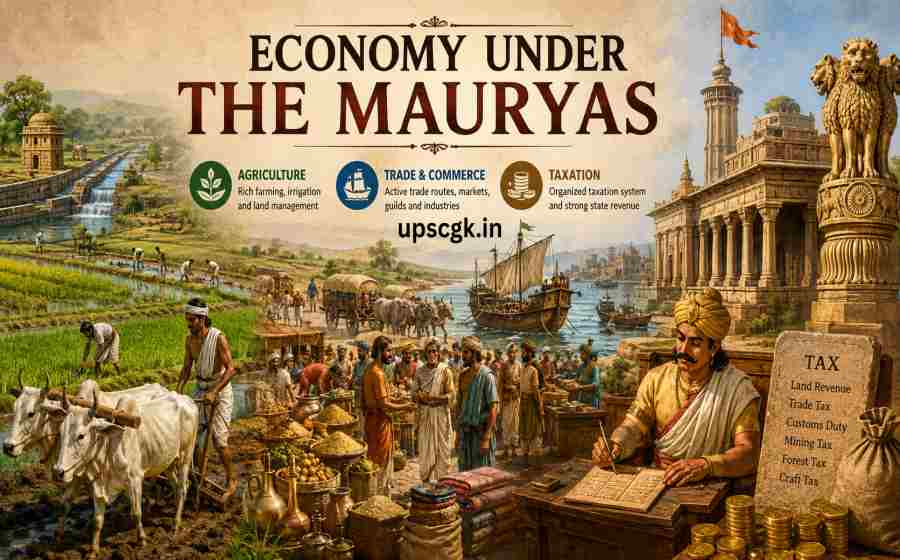
Explore the economy under the Mauryas, including agriculture, trade, taxation, industries and economic administration in ancient India during the Mauryan Empire
Economy under the Mauryas
The Mauryan Empire was one of the largest and most powerful empires in ancient India. Founded by Chandragupta Maurya in 322 BCE, the empire reached its greatest height under Ashoka. The Mauryan administration developed a strong economic system that supported political stability, military strength, and social development. Agriculture, trade, industries, and taxation formed the backbone of the Mauryan economy. Information about the Mauryan economic system is mainly available from the Arthashastra written by Kautilya and the accounts of the Greek ambassador Megasthenes.
The Mauryan rulers gave great importance to economic organization and state control. Efficient administration, proper tax collection, and promotion of agriculture and trade helped the empire become prosperous and stable.
Table of Contents
Agriculture under the Mauryas
Agriculture was the primary occupation of the people during the Mauryan period. Most of the population lived in villages and depended on farming for their livelihood. The state considered agriculture the most important source of revenue and took several steps to improve agricultural production.
Farmers cultivated crops such as rice, wheat, barley, sugarcane, cotton, pulses, and spices. Different regions specialized in different crops depending on climate and soil conditions. The fertile plains of the Ganga Valley became major centers of agricultural production.
The Mauryan government encouraged irrigation and construction of water reservoirs. Canals, wells, lakes, and dams were built to provide water to agricultural lands. One famous example was the Sudarshana Lake in Gujarat, which was constructed for irrigation purposes. Proper irrigation increased productivity and protected agriculture from irregular rainfall.
The state also maintained records of agricultural land and supervised farming activities through officials. The Arthashastra mentions officers responsible for agriculture, land measurement, and irrigation management. Farmers were generally free from unnecessary interference, but they had to pay taxes to the state.
The Mauryan rulers also encouraged the cultivation of wastelands and forests. New villages were established, and agricultural expansion increased the empire’s economic strength. Cattle breeding was another important economic activity because oxen were essential for ploughing fields and transportation.
Trade and Commerce under the Mauryas
Trade flourished greatly during the Mauryan period due to political unity, good administration, and improved transport facilities. Internal and external trade both contributed significantly to the economy.
Internal Trade
The Mauryan Empire had a vast network of roads connecting important cities and trading centers. Roads linked cities like Pataliputra, Taxila, Ujjain, and Tamralipti. The construction and maintenance of roads helped merchants transport goods safely across the empire.
Markets were regulated by the government. Officials supervised prices, weights, and measures to prevent cheating and maintain fairness in trade. Traders sold goods such as textiles, metals, pottery, jewelry, spices, salt, and agricultural products.
Guilds played an important role in economic life. Groups of craftsmen and merchants formed organizations called “shrenis” or guilds. These guilds controlled production, maintained quality, and protected the interests of workers and traders.
Foreign Trade
Foreign trade also expanded during the Mauryan period. India maintained trade relations with countries like Greece, Egypt, Persia, and regions of Central Asia. Ports on the eastern and western coasts facilitated maritime trade.
Indian merchants exported spices, silk, cotton textiles, ivory products, precious stones, and perfumes. In return, they imported horses, luxury goods, wine, and metals from foreign lands.
The Mauryan rulers maintained diplomatic relations with foreign kingdoms, which encouraged peaceful trade. Greek accounts mention the prosperity of Indian markets and the richness of Mauryan cities.
Industries and Crafts
Several industries developed during the Mauryan age. Textile production was one of the most important industries. Cotton and silk fabrics produced in India were famous for their quality. Metalwork, mining, pottery, carpentry, and shipbuilding were also highly developed.
The state exercised control over important industries such as mining, salt production, and forest resources. Mines produced gold, silver, copper, and iron, which were used for making tools, weapons, and ornaments.
Craftsmen enjoyed an important place in society. Skilled artisans produced luxury goods and everyday items for domestic use and trade. Urban centers became hubs of industrial and commercial activities.
Taxation System under the Mauryas
Taxation was the main source of state revenue during the Mauryan period. The Mauryan rulers developed an organized taxation system to finance administration, the army, public works, and welfare activities.
Land revenue was the most important tax. Farmers generally paid one-fourth or one-sixth of their agricultural produce to the state. Taxes varied according to the fertility of land and irrigation facilities.
Apart from land tax, the government collected taxes on trade, crafts, forests, mines, and cattle. Traders had to pay customs duties and toll taxes while transporting goods. Artisans and craftsmen also contributed taxes based on their profession.
The state maintained strict supervision over tax collection. Officials were appointed to ensure proper revenue administration and prevent corruption. According to the Arthashastra, tax collection should not burden the people excessively because the prosperity of the state depended on the prosperity of its citizens.
The Mauryan government also earned revenue from state-owned enterprises such as mines, forests, salt production, and liquor manufacturing. This helped strengthen the royal treasury.
Economic Administration
The Mauryan administration was highly centralized and efficient. Different departments managed agriculture, trade, taxation, mining, forests, and industries. Officials were appointed at central, provincial, and local levels to supervise economic activities.
The king played an active role in economic management. The Arthashastra describes detailed rules regarding administration, trade regulation, labor management, and financial control. Strict punishments were imposed on corrupt officials and dishonest traders.
A standardized system of weights and measures helped maintain uniformity in trade. The use of punch-marked coins also promoted commercial transactions and economic stability.
Summary
The economy under the Mauryas was well-organized, prosperous, and strongly controlled by the state. Agriculture formed the foundation of economic life, while trade and industries contributed to urban growth and wealth generation. Efficient taxation and administrative systems enabled the Mauryan rulers to maintain a vast empire successfully.
The Mauryan economic system reflects the advanced administrative and financial knowledge of ancient India. Its emphasis on agriculture, infrastructure, trade regulation, and revenue management made the Mauryan Empire one of the strongest economic powers of the ancient world.
Also Check: History