Explore Alexanders invasion of India, including its causes, major events like the Battle of Hydaspes and its political, cultural and historical consequences.
Alexanders Invasion of India
The invasion of India by Alexander the Great in 326 BCE stands as one of the most significant encounters between the East and the West in ancient history. Though brief, his campaign left a lasting imprint on the political and cultural landscape of northwestern India. This article examines the causes behind Alexander’s Indian expedition, the major events during his campaign, and its long-term consequences.
Table of Contents
Causes of Alexander’s Invasion of India
Several factors motivated Alexander to invade India:
1. Desire for World Conquest
Alexander had already conquered vast territories, including Persia, Egypt, and parts of Central Asia. Inspired by his ambition to become a universal ruler, he sought to expand his empire further east into the Indian subcontinent.
2. Wealth of India
India was widely known for its immense wealth, particularly in gold, spices, and precious stones. The stories of India’s riches attracted Alexander and his army, who were eager for plunder and glory.
3. Political Fragmentation in Northwest India
At the time of Alexander’s invasion, northwestern India was divided into several small kingdoms. This political disunity made it easier for a powerful and organized army like Alexander’s to penetrate the region.
4. Strategic Expansion
After defeating the Persian Empire under Darius III, Alexander inherited its eastern territories, which bordered India. Advancing into India was a natural extension of his military campaign.
Major Events of the Invasion
1. Entry into India (326 BCE)
Alexander entered India through the Khyber Pass after consolidating his control over regions like Bactria and Sogdiana. He first subdued tribes in the northwestern frontier.
2. Battle with King Ambhi of Taxila
The ruler of Taxila, Ambhi (also known as Omphis), chose to surrender without resistance and allied with Alexander. This alliance provided Alexander with strategic support and resources.
3. The Battle of Hydaspes (Jhelum River)
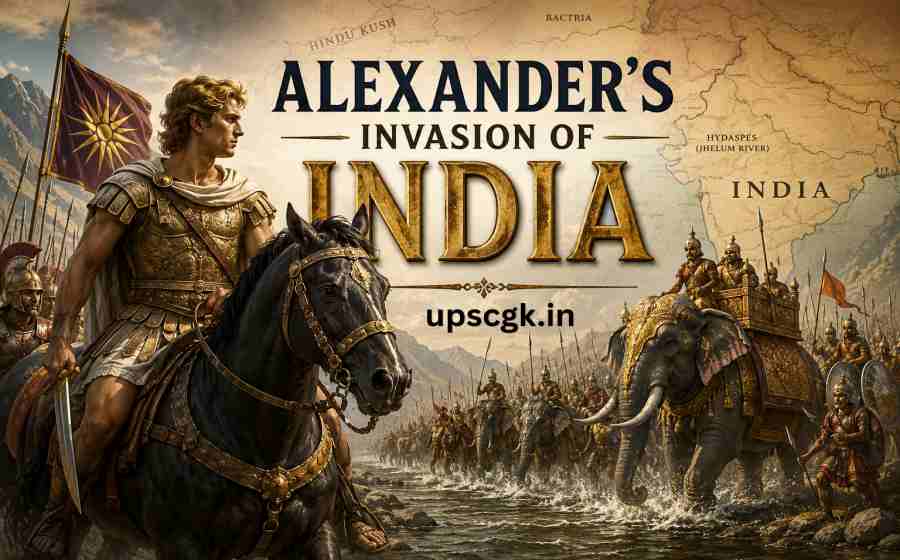
The most famous battle of Alexander’s Indian campaign was fought against Porus in 326 BCE near the Hydaspes River (modern Jhelum).
- Porus commanded a strong army with war elephants.
- Despite facing fierce resistance, Alexander emerged victorious due to superior tactics.
- Impressed by Porus’s bravery, Alexander reinstated him as a ruler and even expanded his territory.
4. Advance Towards the Beas River
After defeating Porus, Alexander marched eastward and reached the Beas River. However, his troops, exhausted from years of continuous warfare, refused to move further into India.
5. Retreat and Return Journey
Reluctantly, Alexander decided to turn back. He divided his army, sending part by sea under Nearchus and leading the rest through the harsh Gedrosian desert.
Consequences of Alexander’s Invasion
1. Opening of Indo-Greek Contacts
Alexander’s invasion established direct contact between India and the Greek world. This led to cultural exchanges in art, architecture, and philosophy.
2. Rise of the Mauryan Empire
The political vacuum created in northwestern India after Alexander’s withdrawal contributed to the rise of Chandragupta Maurya. With guidance from Chanakya, Chandragupta eventually established the powerful Mauryan Empire.
3. Spread of Hellenistic Culture
Greek influence, known as Hellenistic culture, began to blend with Indian traditions. This is particularly visible in the Gandhara school of art, which combined Greek and Indian styles.
4. Strengthening of Trade Routes
The invasion opened new trade routes between India and the Mediterranean world. This increased economic interactions and exchange of goods.
5. Military and Political Awareness
Indian kingdoms became more aware of the need for strong centralized power to resist foreign invasions. This realization contributed to the consolidation of larger empires.
6. Limited Territorial Impact
Despite his military success, Alexander’s control in India was short-lived. His empire fragmented soon after his death in 323 BCE, and his Indian territories were eventually lost.
Summary
Alexander’s invasion of India was a remarkable episode that highlighted both the strengths and limitations of ancient military campaigns. While he succeeded in defeating several rulers, he could not penetrate deep into the Indian subcontinent due to resistance and troop fatigue. Nevertheless, his invasion had lasting consequences, including the establishment of Indo-Greek relations, cultural exchange, and the rise of powerful Indian empires like the Mauryas.
Also Check: History