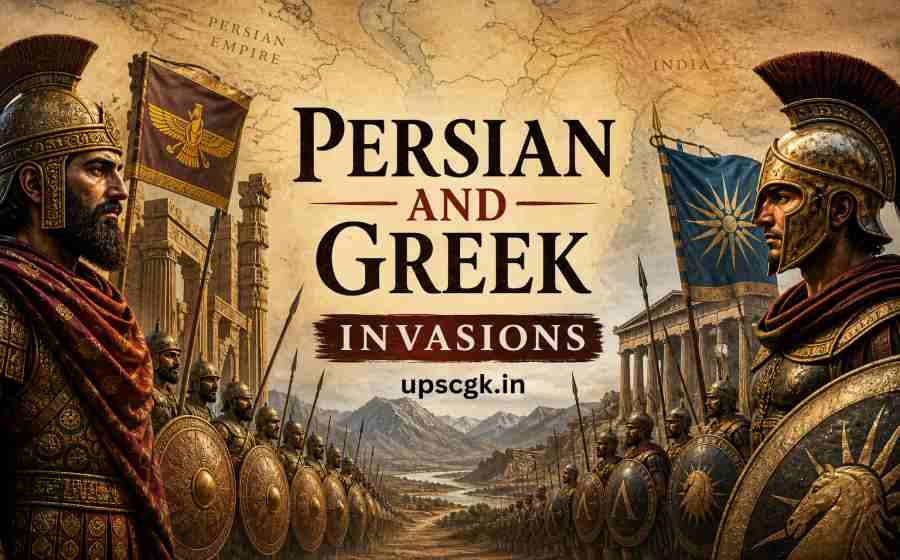
Explore the Persian and Greek invasions of India, causes, major events and lasting impact on Indian politics, culture and administration in ancient history.
Persian and Greek Invasions
The ancient history of India was significantly shaped by interactions with foreign powers. Among these, the Persian and Greek invasions played a crucial role in influencing political structures, cultural exchanges, and economic developments. These invasions were not merely military campaigns; they acted as bridges connecting India with the wider world.
Table of Contents
Persian Invasions of India
The first major foreign intrusion into the Indian subcontinent came from the Achaemenid Empire of Persia. Under rulers like Cyrus the Great and Darius I, parts of northwestern India were brought under Persian control during the 6th century BCE.
Extent of Persian Rule
Darius I expanded the empire to include regions such as Gandhara and parts of the Indus Valley. These areas became satrapies (provinces) of the Persian Empire. The inclusion of these territories marked the first instance of foreign political control over Indian land.
Impact of Persian Invasions
1. Administrative Influence:
The Persians introduced a well-organized administrative system. The concept of dividing regions into provinces governed by officials influenced later Indian rulers, particularly the Mauryas.
2. Economic and Trade Growth:
Integration into the Persian Empire opened new trade routes between India and Central Asia, West Asia, and the Mediterranean world. This boosted commerce and cultural exchange.
3. Introduction of Coinage and Script:
The use of standardized coins and the Aramaic script influenced Indian systems. The Kharosthi script, used in northwest India, developed under Persian influence.
4. Cultural Exchange:
Art, architecture, and administrative practices showed Persian elements. This cross-cultural interaction enriched Indian traditions.
Greek Invasion of India
The Greek invasion, led by Alexander the Great in 326 BCE, marked another significant phase in Indian history. Alexander’s campaign brought him to the northwestern frontiers of India after conquering Persia.
Alexander’s Campaign in India
Alexander defeated local rulers and advanced into the Punjab region. His most famous battle in India was against Porus at the Battle of the Hydaspes (Jhelum River). Despite Porus’s defeat, his bravery impressed Alexander, who allowed him to rule as a subordinate king.
However, Alexander’s troops, exhausted and unwilling to march further into India, forced him to retreat. His campaign in India was brief but impactful.
Impact of Greek Invasion
1. Political Unification:
Alexander’s invasion exposed the political fragmentation of India. This indirectly paved the way for the rise of strong centralized powers like the Maurya Empire.
2. Rise of Chandragupta Maurya:
After Alexander’s withdrawal, Chandragupta Maurya, guided by Chanakya, overthrew the Nanda dynasty and established the Mauryan Empire. Greek influence and the power vacuum left by Alexander contributed to this rise.
3. Indo-Greek Relations:
Greek settlements in northwestern India led to the establishment of Indo-Greek kingdoms. These kingdoms facilitated continuous cultural and economic interactions.
4. Cultural and Artistic Exchange:
Greek influence is evident in Gandhara art, which blends Indian and Hellenistic styles. This fusion is particularly visible in Buddhist sculptures.
5. Advancement in Knowledge:
Contact with Greeks introduced new ideas in astronomy, medicine, and philosophy. This intellectual exchange enriched Indian knowledge systems.
Comparison of Persian and Greek Impacts
While both invasions influenced Indian history, their nature and outcomes differed:
- Persians focused more on administration and integration into their empire.
- Greeks had a shorter military presence but left a deeper cultural and political impact.
Both contributed to expanding India’s connections with the outside world.
Long Term Significance
The Persian and Greek invasions were turning points in ancient Indian history. Their long-term impacts include:
- Development of efficient administrative systems
- Growth of trade networks
- Cultural and artistic exchanges
- Emergence of powerful empires like the Mauryas
- Strengthening of India’s global connections
These invasions also highlighted the need for political unity, which later rulers successfully achieved.
Summary
The Persian and Greek invasions were not just episodes of conquest but catalysts of transformation. They introduced new ideas, systems, and connections that reshaped the course of Indian history. While they began as foreign incursions, their legacy became deeply embedded in India’s political, cultural, and economic fabric.
Also Check: History