Explore Mauryan Administration with its central, provincial and local governance system under Chandragupta Maurya and Ashoka in ancient India.
Mauryan Administration
The Mauryan Empire was one of the greatest and most organized empires in ancient Indian history. Founded by Chandragupta Maurya in 322 BCE, the empire expanded across almost the entire Indian subcontinent. The Mauryan rulers, especially Ashoka, created a strong administrative system that helped maintain law, order, trade, taxation, and public welfare.
The administration of the Mauryan Empire is mainly known through the book Arthashastra written by Kautilya and the accounts of the Greek ambassador Megasthenes in his work Indica. The Mauryan administration became a model for later Indian kingdoms due to its efficiency and centralized governance.
Table of Contents
Features of Mauryan Administration
The Mauryan administration had several important characteristics:
- Highly centralized government
- Strong bureaucracy
- Efficient taxation system
- Well-organized army
- Provincial and local administration
- Spy system for intelligence gathering
- Public welfare measures
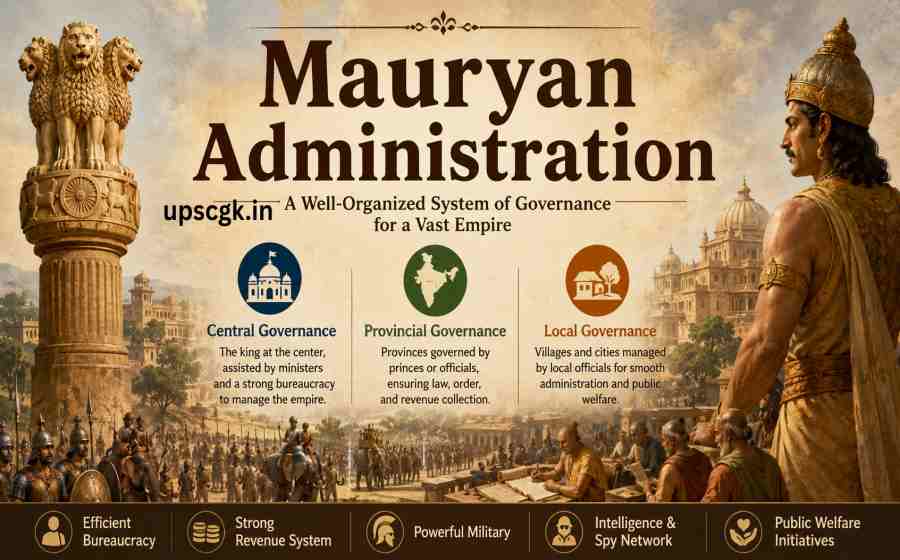
The empire was divided into different administrative units to ensure smooth governance.
Central Administration of the Mauryan Empire
The king was the supreme authority in the Mauryan administrative system. He controlled the executive, judiciary, military, and financial departments.
Role of the King
The king held the highest position in the empire. He was responsible for:
- Maintaining law and order
- Protecting the empire
- Appointing officials
- Collecting taxes
- Conducting foreign relations
Although the king possessed immense power, he was advised by ministers and officials. The Mauryan rulers believed that the welfare of the people was the duty of the king.
Council of Ministers
The king was assisted by a council known as the Mantriparishad. It included experienced ministers who advised the ruler on administration, military affairs, finance, and foreign policy.
Important officials included:
Purohita
The chief priest who guided the king in religious matters.
Senapati
The commander-in-chief of the army.
Samaharta
The chief revenue collector responsible for taxation.
Sannidhata
The treasurer who managed the royal treasury.
Amatyas
High-ranking officials who handled administration.
Mauryan Bureaucracy
The Mauryan Empire had a detailed bureaucratic structure. Officials were appointed based on merit and efficiency.
Departments of Administration
Different departments managed various activities such as:
- Agriculture
- Trade and commerce
- Mining
- Forests
- Irrigation
- Weights and measures
- Roads and transport
Government officers supervised each department carefully. Strict punishments existed for corruption and negligence.
Military Administration
The Mauryan Empire maintained one of the largest armies in ancient India.
The army consisted of:
- Infantry
- Cavalry
- Chariots
- Elephants
Greek accounts mention that the Mauryan military had lakhs of soldiers and thousands of war elephants.
A special military board managed defense matters. Separate committees looked after different branches of the army.
Spy System
One of the most unique features of Mauryan administration was the secret spy network.
Spies collected information about:
- Enemy kingdoms
- Corrupt officials
- Public opinion
- Internal rebellions
The spy system helped the rulers maintain control and stability throughout the vast empire.
Provincial Administration
Due to the large size of the empire, the Mauryans divided the kingdom into provinces for better governance.
Major Provinces
The empire was divided into important provinces such as:
- Taxila
- Ujjain
- Tosali
- Suvarnagiri
These provinces were usually governed by princes known as Kumaras or trusted officials appointed by the king.
Duties of Provincial Governors
Provincial governors were responsible for:
- Tax collection
- Maintenance of law and order
- Administration of justice
- Military supervision
- Public welfare
They reported directly to the central government.
District Administration
The provinces were further divided into districts.
Officials known as Rajukas and Pradeshikas supervised district administration.
Rajukas
They performed functions similar to modern district magistrates. Their duties included:
- Land measurement
- Revenue collection
- Judicial work
- Maintenance of records
Pradeshikas
They inspected administration and ensured proper functioning of officials.
Regular inspections helped reduce corruption and improved governance efficiency.
Local Administration
The Mauryan rulers gave importance to village administration because villages formed the foundation of the economy.
Village Administration
The village was the smallest administrative unit.
Gramani
The village headman was known as Gramani. He handled:
- Tax collection
- Settlement of disputes
- Maintenance of village records
- Coordination with higher authorities
Village elders also played an important role in decision-making.
Urban Administration
Cities were managed efficiently under the Mauryans.
According to Megasthenes, the administration of Pataliputra was highly organized.
A municipal board consisting of six committees looked after:
- Trade regulation
- Sanitation
- Public buildings
- Markets
- Birth and death records
- Foreign travelers
This shows that urban governance was advanced for its time.
Revenue System
The Mauryan Empire had a well-developed taxation system.
Main Sources of Revenue
- Land revenue
- Trade taxes
- Forest products
- Mining income
- Customs duties
Farmers generally paid one-fourth of their produce as tax.
The collected revenue was used for:
- Army maintenance
- Public welfare
- Roads and irrigation
- Administrative expenses
Judicial Administration
The Mauryan rulers established courts to maintain justice.
There were two main types of courts:
- Civil courts
- Criminal courts
The king acted as the highest judicial authority.
Punishments during the Mauryan period were often strict to maintain discipline and order.
Public Welfare Measures
The Mauryan rulers focused on public welfare.
Particularly during Ashoka’s reign, several welfare activities were promoted:
- Construction of roads
- Planting of trees
- Building rest houses
- Digging wells
- Medical facilities for humans and animals
Ashoka also spread the message of peace, morality, and non-violence through his edicts.
Importance of Mauryan Administration
The Mauryan administrative system holds great significance in Indian history because:
- It created political unity across large territories.
- It developed efficient governance methods.
- It promoted economic growth and trade.
- It influenced later Indian empires.
- It established the idea of centralized administration.
Many features of modern governance, such as district administration and revenue systems, have similarities with Mauryan practices.
Summary
The Mauryan administration was one of the most sophisticated systems of ancient India. With a powerful central government, organized provincial administration, efficient local governance, and a strong bureaucracy, the Mauryan rulers successfully controlled a vast empire.
The administrative policies of Chandragupta Maurya, guided by Kautilya, and the welfare-oriented governance of Ashoka made the Mauryan Empire a landmark in Indian political history. Even today, the Mauryan administrative model is studied for its discipline, organization, and vision of public welfare.
Also Check: History