
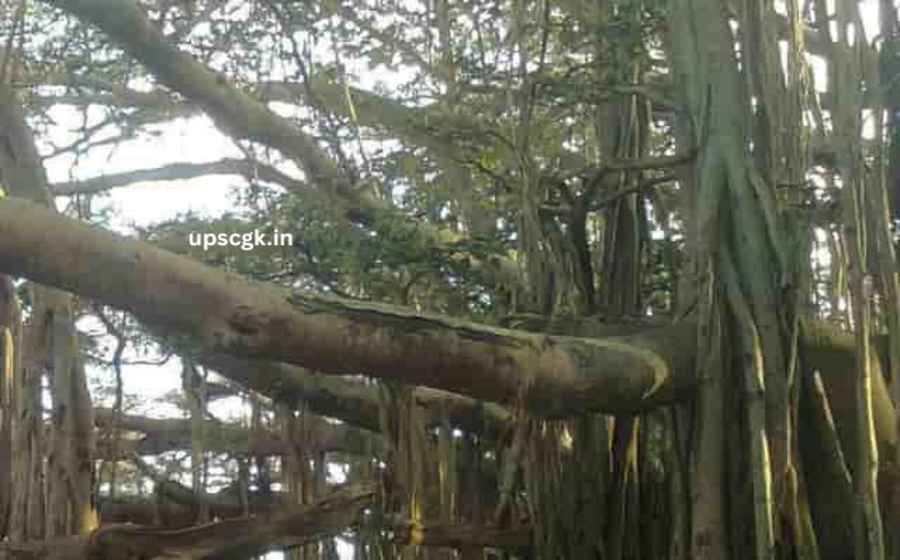
Worlds Oldest Dated Banyan Tree Discovered in Bihar: Discover the 700 year old banyan, its scientific dating, historical significance and ecological importance.
Worlds Oldest Dated Banyan Tree Discovered in Bihar
A remarkable scientific discovery has brought global attention to Bihar after researchers identified a 700-year-old banyan tree (Ficus benghalensis) in Munger as the world’s oldest accurately dated banyan tree. This finding is significant not only for environmental science but also for archaeology, palaeoscience, and heritage conservation. Unlike earlier estimates based on historical records or assumptions, scientists used advanced radiocarbon dating techniques to determine the tree’s age with high accuracy.
The discovery highlights India’s rich natural heritage and showcases how modern scientific methods can reveal the true history of ancient living organisms.
Table of Contents
A Historic Banyan Tree in Munger, Bihar
The ancient banyan tree is located on the campus of the Indian Tobacco Company (ITC) in Munger, Bihar, near the historic Burra Bunglow area. For many years, people believed that the tree was planted around the same time as the nearby colonial-era structure.
However, the latest scientific research has proved otherwise. The banyan tree is much older than the Burra Bunglow, suggesting that it existed long before the construction of the building. Researchers now believe the tree is a surviving remnant of the natural forests that once covered large parts of the region. This discovery changes the historical understanding of the area’s ecological and cultural landscape.
How Scientists Determined the Tree’s Age
Determining the age of tropical trees is often challenging because they usually do not produce clear annual growth rings, unlike trees found in temperate climates. Therefore, traditional methods such as dendrochronology cannot accurately estimate their age. To overcome this limitation, scientists adopted a highly reliable technique known as radiocarbon dating.
The researchers collected wood samples from the banyan tree and extracted alpha-cellulose, one of the most stable components of wood. This material preserves carbon content exceptionally well, making it ideal for scientific dating.
Using high-precision radiocarbon analysis, scientists measured the amount of carbon-14, a naturally occurring radioactive isotope that gradually decays over time. Based on the remaining carbon-14, they estimated the banyan tree’s age to be approximately 700 years, making it the oldest accurately dated banyan tree known in the world.
What is Radiocarbon Dating?
Radiocarbon dating is a scientific method used to determine the age of organic materials. All living organisms absorb carbon during their lifetime, including a small amount of radioactive carbon-14. After death or once plant tissues stop growing, carbon-14 begins to decay at a predictable rate.
By measuring the remaining carbon-14, scientists can estimate the age of wood, bones, charcoal, seeds, and other organic remains. This method is widely used in:
- Archaeology
- Geology
- Palaeoscience
- Environmental studies
- Climate research
The use of alpha-cellulose significantly improves the accuracy of radiocarbon dating because it is less affected by environmental contamination than other wood components.
Research Team Behind the Discovery
The research was led by Dr. Trina Bose of the Birbal Sahni Institute of Palaeosciences (BSIP), Lucknow, an autonomous institution functioning under the Department of Science and Technology (DST), Government of India.
The study also involved researchers Dr. Mayank Shekhar and Dr. Akhilesh K. Yadava, who contributed to the scientific analysis and interpretation of the findings.
The research was published in April 2026 in the internationally recognized peer-reviewed journal Quaternary Research, adding credibility and global recognition to the discovery.
Significance of the Discovery
The identification of this ancient banyan tree has several important implications.
Scientific Importance
It demonstrates that advanced radiocarbon dating techniques can accurately determine the age of tropical trees, overcoming limitations posed by the absence of growth rings.
Ecological Importance
The tree serves as a living record of environmental changes over several centuries and provides valuable information about historical forest ecosystems in eastern India.
Heritage Conservation
The discovery strengthens the importance of protecting ancient trees as natural heritage monuments. Such trees preserve biodiversity and offer insights into historical landscapes.
Educational Value
The research will be useful for future studies in botany, palaeoscience, archaeology, climate history, and conservation biology.
About the Banyan Tree (Ficus benghalensis)
The banyan tree, scientifically known as Ficus benghalensis, is one of India’s most iconic tree species and has immense ecological, cultural, and religious significance. It belongs to the Moraceae family, which also includes figs and mulberries.
One of its most unique characteristics is the development of aerial roots. These roots grow downward from branches, eventually reaching the ground and forming strong supporting trunks known as prop roots. This enables a single tree to spread across vast areas and survive for centuries.
The banyan tree provides shelter, food, and habitat for numerous birds, insects, mammals, and other wildlife. Because of its longevity and expansive canopy, it plays a crucial role in maintaining ecological balance.
Recognizing its cultural and ecological importance, Ficus benghalensis has been declared the National Tree of India.
About Quaternary Research Journal
The findings of this study were published in Quaternary Research, an internationally reputed peer-reviewed scientific journal.
The journal focuses on research related to the Quaternary Period, which spans the last 2.58 million years of Earth’s history. Studies published in the journal cover subjects such as:
- Climate change
- Evolution
- Ancient ecosystems
- Human history
- Geology
- Palaeontology
- Environmental science
Publication in such a reputed journal highlights the scientific importance of the research.
Importance for UPSC and Competitive Exams
This discovery is highly relevant for UPSC, State PCS, SSC, and other competitive examinations because it combines science, environment, biodiversity, and current affairs.
Questions may be asked on:
- Scientific name of the banyan tree
- Radiocarbon dating technique
- Alpha-cellulose in wood analysis
- Birbal Sahni Institute of Palaeosciences
- Quaternary Research journal
- National Tree of India
- Carbon-14 dating method
Key Facts to Remember
- Scientific Name: Ficus benghalensis
- Location: Munger, Bihar
- Estimated Age: Approximately 700 years
- Recognition: World’s oldest accurately dated banyan tree
- Dating Method: High-precision radiocarbon dating
- Material Used: Alpha-cellulose extracted from wood
- Research Institute: Birbal Sahni Institute of Palaeosciences (Lucknow)
- Published In: Quaternary Research (April 2026)
- National Tree of India: Banyan (Ficus benghalensis)
- Tree Family: Moraceae
Summary
The identification of the 700-year-old banyan tree in Munger, Bihar, as the world’s oldest accurately dated banyan tree represents a remarkable achievement in modern scientific research. By combining advanced radiocarbon dating with the analysis of alpha-cellulose, researchers have provided reliable evidence of the tree’s extraordinary age. Beyond its scientific importance, the discovery reinforces the need to conserve India’s ancient trees as valuable ecological and cultural treasures. It also demonstrates how modern technology can uncover hidden chapters of natural history, making this finding an important milestone for environmental science, heritage conservation, and competitive exam preparation.
Also Check: Current Affairs