Discover the history of Jain Councils, their major decisions, preservation of scriptures and their lasting influence on the development of Jainism.
Jain Councils
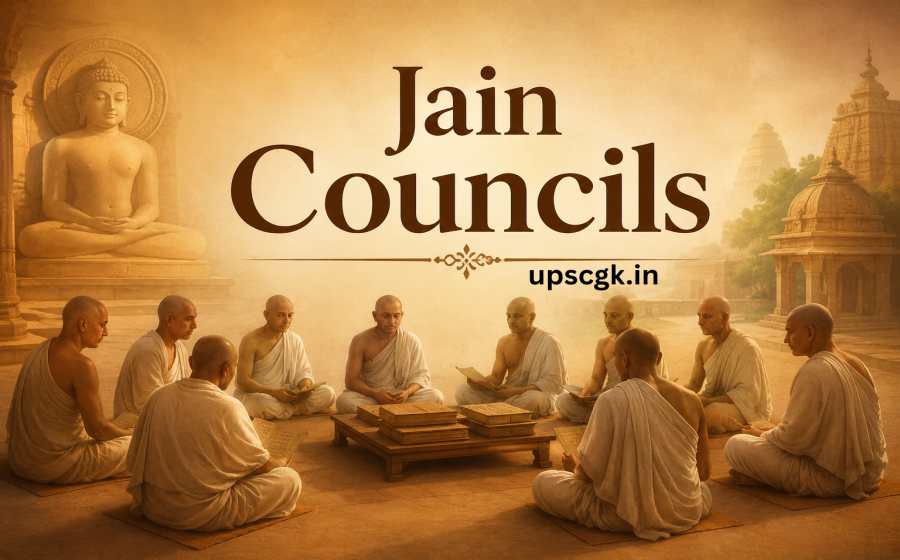
The Jain Councils were significant assemblies of Jain monks and scholars organized to preserve, compile, and standardize the teachings of Lord Mahavira after his nirvana. These councils played a crucial role in safeguarding Jain scriptures, resolving doctrinal differences, and ensuring the continuity of Jain philosophy across generations. They also contributed to the development of the two major sects of Jainism, Digambara and Shvetambara, whose differences partly emerged due to varying interpretations of scriptures and religious practices.
Unlike political councils, the Jain Councils focused primarily on religious matters. Their efforts ensured that the core principles of Jainism, such as Ahimsa (non-violence), Satya (truth), Aparigraha (non-possession), Asteya (non-stealing), and Brahmacharya (celibacy), remained preserved despite changing social and political circumstances.
Table of Contents
Need for Jain Councils
Following the death of Lord Mahavira around the 6th century BCE, Jain teachings were transmitted orally by monks. Over time, several challenges emerged:
- Many learned monks passed away without documenting the teachings.
- Severe famines forced monks to migrate to different regions.
- Oral traditions led to variations in the interpretation of religious texts.
- Differences arose regarding monastic discipline and practices.
To address these concerns, Jain leaders convened councils where scholars discussed, organized, and preserved the sacred teachings.
First Jain Council
The First Jain Council was held at Pataliputra around the 3rd century BCE, during the reign of the Mauryan rulers.
Background
A severe famine lasting nearly twelve years affected the Magadha region. During this period, the respected Jain teacher Bhadrabahu migrated to southern India along with a group of monks. Another prominent monk, Sthulabhadra, remained in Magadha to guide the remaining Jain community.
The migration resulted in differences in religious practices between the monks who stayed in the north and those who settled in the south.
Objectives
The council aimed to:
- Preserve Mahavira’s teachings.
- Compile the orally transmitted scriptures.
- Maintain uniformity in religious practices.
- Prevent the loss of sacred knowledge.
Major Outcomes
The First Council successfully compiled many Jain teachings into organized collections. However, not all monks accepted these compilations.
The southern monks, led by Bhadrabahu’s followers, believed that the original scriptures had been lost and therefore rejected the newly compiled texts. This disagreement eventually laid the foundation for differences between the Digambara and Shvetambara traditions.
Emergence of Digambara and Shvetambara Sects
Although the formal division developed gradually, the First Council accelerated the process.
Digambara Tradition
The Digambaras believed that:
- Complete renunciation required monks to remain without clothing.
- The original scriptures had disappeared over time.
- New compilations could not be considered authentic.
- Women could not attain liberation without first being reborn as men.
Shvetambara Tradition
The Shvetambaras believed that:
- Monks could wear simple white robes.
- The preserved scriptures remained authentic.
- Women were capable of attaining liberation.
- Religious discipline could adapt to changing circumstances while preserving core principles.
These differences continue to exist today while both sects uphold the essential teachings of Jainism.
Second Jain Council
The Second Jain Council was held at Vallabhi in present-day Gujarat during the 5th or 6th century CE.
Leadership
The council was presided over by Acharya Devardhigani Kshamashramana, a highly respected Jain scholar.
Reasons for Convening
Over several centuries, many scriptures had become fragmented or were remembered differently by various monastic groups. There was concern that valuable teachings might disappear permanently.
The Vallabhi Council sought to:
- Collect all available scriptures.
- Standardize religious texts.
- Preserve them in written form.
- Ensure consistency in religious education.
Compilation of Jain Scriptures
One of the most significant achievements of the Second Council was the systematic writing of Jain scriptures.
The Shvetambara monks compiled and arranged the Agamas, the sacred canonical texts believed to contain Mahavira’s teachings as preserved through the monastic tradition.
These texts covered various subjects, including:
- Religious philosophy
- Ethics
- Monastic rules
- Meditation
- Conduct for householders
- Cosmology
- Spiritual discipline
Writing the scriptures greatly reduced the risk of losing important religious knowledge.
Major Outcomes of the Second Council
The Vallabhi Council produced several lasting contributions.
Preservation of Scriptures
The Agamas were officially compiled and written down, ensuring that future generations could study them accurately.
Religious Uniformity
The council established accepted versions of the scriptures within the Shvetambara tradition, reducing confusion caused by multiple oral versions.
Growth of Jain Literature
The written canon inspired scholars to produce numerous commentaries, philosophical works, and educational texts, enriching Jain intellectual traditions.
Expansion of Jain Education
Monasteries and educational institutions began using standardized texts for teaching monks and lay followers.
Importance of Jain Councils
The Jain Councils made lasting contributions to Indian religious history.
Protection of Religious Heritage
Without these councils, many teachings of Mahavira could have disappeared due to the limitations of oral transmission.
Development of Jain Philosophy
The councils encouraged systematic study and interpretation of Jain doctrines, leading to the growth of sophisticated philosophical traditions.
Promotion of Religious Discipline
The councils clarified rules for monks and nuns, strengthening the organization of the Jain monastic community.
Encouragement of Literary Activity
The preservation of scriptures inspired generations of Jain scholars to compose commentaries, biographies, grammar texts, and philosophical treatises.
Influence on Indian Culture
The emphasis on non-violence, compassion, truthfulness, and ethical living preserved through these councils continued to influence Indian society, literature, art, and political thought.
Differences in Acceptance of the Councils
The two principal Jain sects differ regarding the authority of the councils.
- Shvetambaras generally accept the Agamas compiled during the councils as authentic.
- Digambaras believe the original scriptures were lost long before the councils and therefore rely on later authoritative works composed by revered Jain scholars.
Despite these differences, both traditions remain committed to Mahavira’s central teachings of non-violence, self-discipline, and spiritual liberation.
Legacy of the Jain Councils
The Jain Councils remain landmark events in the history of Jainism. Their efforts preserved one of the world’s oldest religious traditions through periods of famine, migration, and social change. The councils not only safeguarded sacred knowledge but also strengthened the organizational structure of the Jain community.
Today, Jain scriptures, philosophical works, and ethical teachings continue to inspire millions of followers around the world. The preservation of these traditions owes much to the dedication and scholarship demonstrated during the Jain Councils. Their legacy highlights the importance of preserving knowledge, maintaining religious unity, and adapting responsibly to changing historical circumstances while remaining faithful to foundational principles.
Summary
The Jain Councils were pivotal milestones in the evolution of Jainism. The First Council at Pataliputra sought to preserve Mahavira’s teachings during a period of crisis, while the Second Council at Vallabhi ensured the systematic compilation and preservation of sacred scriptures. Although differences over scriptural authority contributed to the emergence of the Digambara and Shvetambara traditions, both continue to uphold the fundamental ideals of Jain philosophy. The councils’ enduring contribution lies in preserving Jain heritage, promoting ethical values, and ensuring the continuity of one of India’s most influential religious traditions.
Also Check: History