Learn about Republic States Ganas and Sanghas in Ancient India, their administration, governance, major republics and historical significance in Indian history.
Republic States Ganas and Sanghas in Ancient India
The political landscape of Ancient India was far more diverse than simple monarchies. Alongside powerful kingdoms ruled by kings, there existed several republican states known as Ganas and Sanghas, where governance was carried out collectively by groups of leaders instead of a single monarch. These republics flourished mainly during the 6th century BCE, the same period that witnessed the rise of the Sixteen Mahajanapadas, the emergence of Buddhism and Jainism, and significant social and economic transformations.
The republican tradition of Ancient India represents one of the earliest known examples of collective governance in world history. Although these republics differed considerably from modern democratic systems, they introduced principles such as deliberation, consultation, collective decision-making, and shared political authority. The study of Ganas and Sanghas offers valuable insight into the evolution of political institutions in ancient India.
Table of Contents
What Were Ganas and Sanghas?
The terms Gana and Sangha refer to republican or oligarchic forms of government.
- Gana generally meant a political community or assembly of clans.
- Sangha referred to an organized association or confederation of several clans or tribes.
Unlike monarchies, these states were governed by assemblies consisting mainly of members from influential Kshatriya families. Leadership was usually collective, although one individual was often elected as the chief or president for administrative purposes.
Most republican states were concentrated in the Himalayan foothills and the middle Gangetic plains, particularly in present-day Bihar, eastern Uttar Pradesh, and Nepal.
Historical Background
The republican tradition developed during the later Vedic period when tribal societies gradually transformed into organized political units. Some tribes preferred maintaining collective leadership instead of accepting hereditary monarchy.
By the 6th century BCE, these republics had become prominent political entities. Buddhist texts such as the Mahaparinibbana Sutta and Jain literature provide detailed accounts of their governance, assemblies, and political customs. Greek writers accompanying Alexander’s campaigns also recorded the existence of republican states in northwestern India.
Major Republican States
Several important republics existed during this period.
1. Vajji Confederacy
The Vajji Confederacy was one of the most powerful republican unions in Ancient India. It consisted of several clans, including the famous Licchavis and Videhas.
Its capital was Vaishali, one of the earliest prosperous urban centres in India. The Vajji Confederacy followed a confederate system where representatives of different clans participated in governance.
2. Licchavis
The Licchavis were among the most influential republican clans. They played a leading role within the Vajji Confederacy and became renowned for their efficient administration and disciplined political organization. Buddhist literature frequently praises their orderly conduct, regular assemblies, and respect for established laws.
3. Shakyas
The Shakyas governed the region around Kapilavastu and are especially significant because Gautama Buddha belonged to this clan.
The Shakyas maintained an assembly that collectively discussed administrative and political matters, while selecting a chief from among the ruling families.
4. Mallas
The Mallas controlled territories around Kusinara and Pava. They are historically important because Buddha attained Mahaparinirvana at Kusinara, while Mahavira also spent considerable time in their territory.
5. Koliyas
The Koliyas lived near the Shakyas and governed themselves through republican institutions. Historical sources mention disputes between the Shakyas and Koliyas over the sharing of river water, highlighting their organized political structures.
6. Moriyas
The Moriyas of Pipphalivana were another republican clan. Some historians believe that the Maurya dynasty may have originated from this republican community before establishing one of India’s greatest empires.
Administrative Structure
The republican states possessed a well-organized administrative system that functioned through collective institutions.
General Assembly
The most important governing body was the General Assembly, consisting of representatives from prominent clans or noble families. It acted as the supreme authority for political, military, and judicial decisions.
Important matters such as war, peace, treaties, taxation, and administration were discussed collectively before decisions were taken.
Chief Executive
Although republics did not have hereditary kings, they often selected a chief known by titles such as Raja, Ganapati, or Pramukha.
This leader functioned as the executive head but remained accountable to the assembly and could not exercise unlimited authority.
Council of Elders
Many republics maintained a smaller executive council composed of experienced members. This body managed routine administration and prepared issues for discussion before the larger assembly.
Officials
Various officials looked after taxation, military organization, justice, diplomacy, and public works. Their appointments were generally approved by the assembly.
Decision-Making Process
One remarkable feature of these republics was their emphasis on consultation.
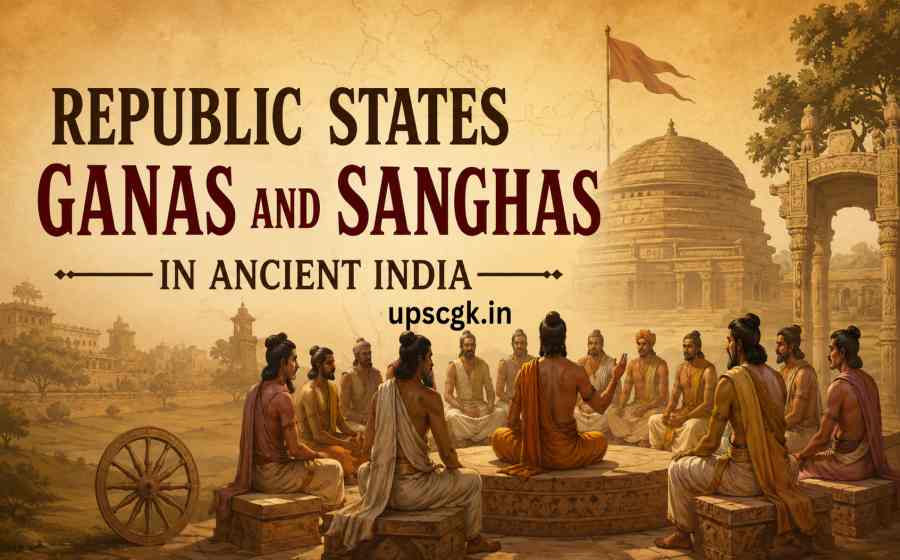
Meetings were held in specially designated assembly halls where representatives debated important issues. Decisions were often reached through consensus, though voting was also practiced in certain situations.
The procedures followed during meetings reflected discipline, respect for established customs, and adherence to constitutional traditions.
Features of Republican Government
The Ganas and Sanghas possessed several distinctive characteristics:
- Collective rather than hereditary rule.
- Decision-making through assemblies.
- Representation of influential clans.
- Selection of leaders instead of absolute monarchy.
- Regular meetings for governance.
- Shared responsibility in administration.
- Well-defined legal and customary traditions.
- Greater participation of the ruling elite in politics.
However, participation remained largely restricted to aristocratic families rather than the entire population.
Comparison with Monarchies
Republican states differed significantly from monarchies.
| Republic States | Monarchies |
|---|---|
| Collective leadership | Single hereditary ruler |
| Decisions through assemblies | Decisions by the king |
| Leaders often elected | Kings inherited power |
| Shared political authority | Centralized administration |
| Greater consultation | Strong royal control |
Despite these differences, both systems maintained organized administrations, armies, taxation, and diplomatic relations.
Decline of Republican States
Several factors contributed to the decline of the republican system. Powerful monarchies such as Magadha gradually expanded through conquest and diplomacy. Republics often lacked centralized military leadership, making them vulnerable to larger kingdoms.
Internal rivalries among ruling clans weakened political unity. Economic competition, territorial disputes, and changing political conditions further reduced their strength.
Eventually, many republics were incorporated into expanding empires, particularly during the rise of Magadha under rulers like Bimbisara and Ajatashatru.
Historical Importance
The republican states occupy an important place in Indian political history. They demonstrate that Ancient India experimented with multiple forms of governance rather than relying solely on monarchy. Their systems encouraged discussion, consultation, and collective responsibility in public affairs.
The republican tradition also influenced Buddhist monastic organizations, whose decision-making procedures closely resembled those followed by contemporary republican assemblies.
Modern historians regard the Ganas and Sanghas as valuable examples of early constitutional governance, even though they represented aristocratic republics rather than modern democracies.
Legacy
The republican institutions of Ancient India reveal a sophisticated understanding of governance, political participation, and institutional administration. While they eventually disappeared under the pressure of expanding empires, their contribution to political thought remains significant.
The traditions of debate, consensus-building, elected leadership, and organized assemblies established by the Ganas and Sanghas continue to attract historians studying the origins of representative governance. These republics illustrate that Ancient India possessed a rich and varied political heritage, where collective decision-making coexisted alongside powerful monarchies, enriching the subcontinent’s historical and constitutional development.
Summary
The Republic States or Ganas and Sanghas were remarkable political experiments in Ancient India that emphasized collective governance over hereditary monarchy. Through representative assemblies, elected leaders, and consultative decision-making, these republics introduced distinctive administrative practices that set them apart from contemporary kingdoms. Although eventually absorbed by expanding monarchies such as Magadha, their legacy endures as an important chapter in the evolution of political institutions in Indian history. Understanding these republics provides valuable insight into the diversity, innovation, and sophistication of governance during the ancient period.
Also Check: History