Learn the key differences between Hinayana and Mahayana Buddhism, including their beliefs, practices, philosophy, scriptures and historical significance.
Hinayana and Mahayana Buddhism
Buddhism, one of the world’s oldest religions, originated in India during the 6th century BCE with the teachings of Gautama Buddha. After the Buddha’s Mahaparinirvana, his followers preserved and spread his teachings across different regions. Over time, differences in interpretation, philosophy, and religious practices led to the emergence of two major traditions of Buddhism, Hinayana and Mahayana.
These two schools played a crucial role in the spread of Buddhism across Asia. While both follow the core teachings of the Buddha, they differ significantly in their beliefs regarding salvation, the nature of the Buddha, religious practices, scriptures, and philosophical outlook.
Table of Contents
Origin of Hinayana and Mahayana
The division within Buddhism gradually developed several centuries after the Buddha’s death. During the Fourth Buddhist Council, differences among Buddhist monks became more pronounced.
Hinayana, meaning “Lesser Vehicle,” was a term later used by Mahayana followers and is considered inappropriate by many modern scholars. Today, this tradition is commonly referred to as Theravada Buddhism, meaning “Doctrine of the Elders.”
Mahayana, meaning “Greater Vehicle,” emerged around the 1st century BCE and introduced new philosophical ideas, devotional practices, and broader accessibility for followers.
Although both traditions share the fundamental teachings of Buddhism, their interpretations evolved differently over time.
Meaning of Hinayana and Mahayana
Hinayana (Theravada)
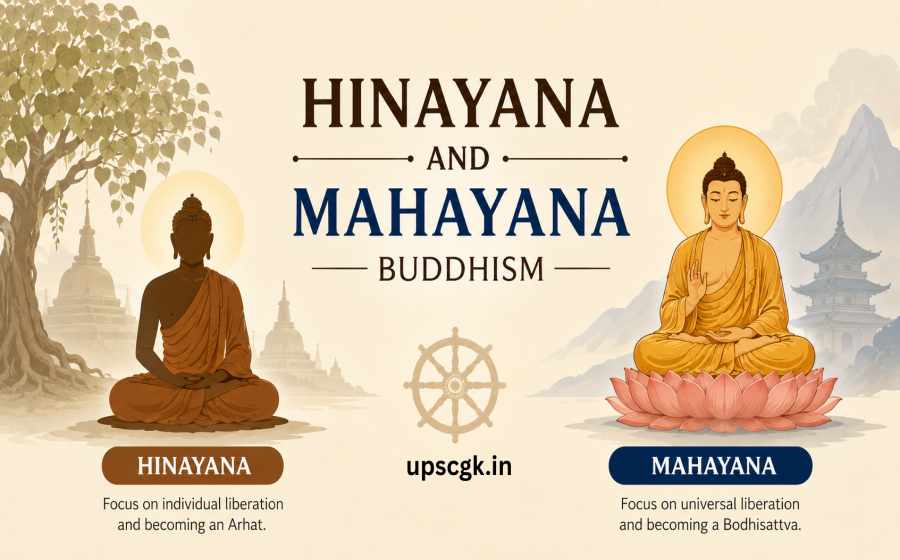
Hinayana emphasizes individual effort in achieving Nirvana. It teaches that every individual is responsible for attaining liberation through strict discipline, meditation, ethical conduct, and wisdom. The highest spiritual goal is becoming an Arhat, a person who has achieved enlightenment.
Mahayana
Mahayana emphasizes universal salvation. It teaches that enlightened beings should postpone their own final liberation to help others attain enlightenment. Followers aim to become Bodhisattvas, who dedicate themselves to the welfare of all living beings.
Philosophical Foundations
The philosophical differences between the two schools are among their most significant distinctions. Hinayana closely follows the original teachings of the Buddha and focuses on the Four Noble Truths, the Eightfold Path, and personal liberation from suffering.
Mahayana expands Buddhist philosophy by introducing concepts such as Sunyata (Emptiness), compassion, and the Bodhisattva ideal. It views enlightenment as a collective journey rather than an individual achievement.
Concept of Buddha
One of the major distinctions lies in how each tradition views the Buddha.
In Hinayana, Buddha is regarded as an extraordinary human teacher who attained enlightenment through personal effort. He serves as an ideal role model whose teachings guide others toward liberation.
Mahayana, however, considers Buddha a divine and eternal being with multiple manifestations. Numerous celestial Buddhas and Bodhisattvas are worshipped as compassionate guides who assist devotees on the path to enlightenment.
Religious Practices
Hinayana Practices
Hinayana emphasizes:
- Meditation
- Self-discipline
- Monastic life
- Ethical conduct
- Personal spiritual development
Prayer and rituals play a relatively minor role compared to meditation and self-realization.
Mahayana Practices
Mahayana encourages:
- Devotional worship
- Prayers
- Ritual ceremonies
- Worship of Buddhas and Bodhisattvas
- Compassionate service to society
Its teachings are generally considered more accessible for ordinary householders.
Scriptures
The two traditions also differ in their religious texts.
Hinayana Scriptures
Hinayana primarily follows the Pali Canon (Tipitaka), consisting of:
- Vinaya Pitaka (Monastic rules)
- Sutta Pitaka (Teachings of Buddha)
- Abhidhamma Pitaka (Philosophical analysis)
These texts are written in the Pali language.
Mahayana Scriptures
Mahayana accepts numerous additional scriptures, including:
- Prajnaparamita Sutras
- Lotus Sutra
- Avatamsaka Sutra
- Heart Sutra
These texts were composed mainly in Sanskrit and later translated into Chinese, Tibetan, Korean, and Japanese.
Ideal Spiritual Goal
The ultimate goal differs significantly between the two schools.
Hinayana
The ideal follower seeks to become an Arhat, achieving personal liberation from the cycle of birth and death.
Mahayana
The ideal follower aspires to become a Bodhisattva, delaying personal Nirvana until all beings attain enlightenment.
Geographical Spread
Hinayana (Theravada)
Theravada Buddhism spread mainly across:
- Sri Lanka
- Myanmar
- Thailand
- Laos
- Cambodia
It remains the dominant Buddhist tradition in these countries today.
Mahayana
Mahayana spread extensively throughout:
- China
- Japan
- Korea
- Vietnam
- Nepal
- Mongolia
It later evolved into several important schools, including Zen, Pure Land, and Nichiren Buddhism.
Art and Architecture
Both traditions contributed immensely to Buddhist art.
Hinayana art initially avoided depicting the Buddha in human form. Instead, symbols such as:
- Bodhi Tree
- Footprints
- Empty Throne
- Dharma Wheel
represented the Buddha.
Mahayana introduced the worship of Buddha images and statues. This led to the flourishing of magnificent Buddhist sculptures, monasteries, cave temples, and paintings throughout Asia.
Comparative Table
| Feature | Hinayana (Theravada) | Mahayana |
|---|---|---|
| Meaning | Lesser Vehicle (traditional term) | Greater Vehicle |
| Main Goal | Personal liberation | Universal liberation |
| Ideal Figure | Arhat | Bodhisattva |
| View of Buddha | Great human teacher | Divine and eternal being |
| Scriptures | Pali Canon | Sanskrit Sutras and additional texts |
| Language | Pali | Sanskrit |
| Worship | Limited rituals | Extensive devotional practices |
| Salvation | Individual effort | Compassion for all beings |
| Spread | Sri Lanka, Myanmar, Thailand, Laos, Cambodia | China, Japan, Korea, Vietnam, Nepal, Mongolia |
| Religious Focus | Meditation and discipline | Devotion and compassion |
Similarities Between Hinayana and Mahayana
Despite their differences, both traditions share several common principles:
- Both accept Gautama Buddha as the founder of Buddhism.
- Both believe in the Four Noble Truths.
- Both emphasize the Noble Eightfold Path.
- Both seek liberation from suffering.
- Both uphold moral conduct, meditation, and wisdom.
- Both reject caste discrimination and ritualistic sacrifices.
- Both believe in karma and rebirth.
Historical Importance
The emergence of Hinayana and Mahayana significantly influenced the development of Buddhism across Asia. Theravada preserved many early Buddhist teachings and monastic traditions, while Mahayana expanded Buddhism’s appeal through devotional practices and philosophical innovation.
These traditions also inspired remarkable achievements in literature, philosophy, education, sculpture, architecture, and international cultural exchange. Great Buddhist universities such as Nalanda and Vikramashila became centers for Mahayana learning, attracting scholars from across Asia.
Summary
Hinayana and Mahayana represent two important paths within Buddhism that developed from a shared spiritual foundation. Hinayana emphasizes self-discipline, meditation, and personal enlightenment, whereas Mahayana focuses on compassion, universal salvation, and devotion to Buddhas and Bodhisattvas. Although their approaches differ, both traditions seek to eliminate suffering and guide humanity toward enlightenment.
Their contributions have shaped religious thought, philosophy, art, and culture across Asia for over two thousand years. Understanding the similarities and differences between these two schools provides valuable insight into the evolution of Buddhism and its enduring influence on world civilization.
Also Check: History