Explore the Post Mauryan Period with the rise of Sungas, Kanvas, and Satavahanas, their culture, administration, trade and contributions.
Post Mauryan Period
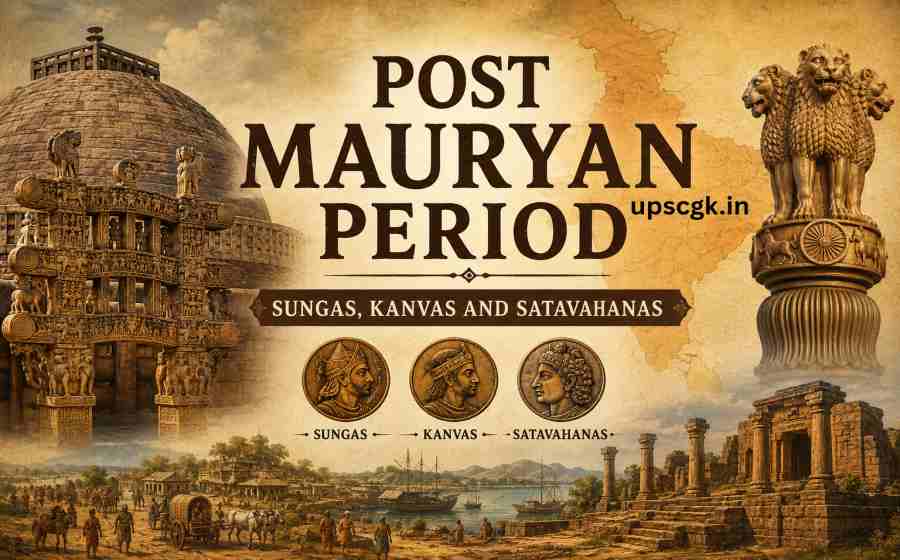
The decline of the Mauryan Empire after the death of Ashoka led to political fragmentation in India. This phase, known as the Post-Mauryan Period, witnessed the rise of several regional dynasties that played an important role in preserving Indian culture, administration, trade, and religion. Among these dynasties, the Sungas, Kanvas, and Satavahanas were the most significant powers.
The Post-Mauryan Period marked a transition from a centralized empire to regional kingdoms. Despite political instability, this era contributed greatly to Indian art, literature, religion, and trade. It also laid the foundation for future Indian empires.
Table of Contents
Decline of the Mauryan Empire
After Ashoka’s death around 232 BCE, the Mauryan Empire gradually weakened due to several reasons:
- Weak successors after Ashoka
- Administrative inefficiency
- Large empire becoming difficult to control
- Economic burden due to huge military expenditure
- Provincial revolts and foreign invasions
The last Mauryan ruler, Brihadratha, was assassinated by his commander-in-chief Pushyamitra Sunga, leading to the establishment of the Sunga Dynasty.
Sunga Dynasty (185 BCE – 73 BCE)
The Sunga Dynasty was founded by Pushyamitra Sunga in 185 BCE.
Important Features of the Sunga Dynasty
1. Revival of Brahmanism
The Sungas supported Brahmanical traditions and performed Vedic rituals such as the Ashvamedha Yajna. This period saw the revival of Hindu religious practices after the dominance of Buddhism during Ashoka’s reign.
2. Resistance Against Foreign Invasions
Pushyamitra successfully resisted invasions by the Indo-Greeks, helping protect northern India from foreign control.
3. Contribution to Art and Architecture
Although the Sungas promoted Brahmanism, they also supported Buddhist monuments. Important developments included:
- Enlargement of the Sanchi Stupa
- Development of Bharhut Stupa sculptures
- Growth of stone railings and gateways
4. Administration
The administration remained similar to the Mauryan system but with reduced central control. Regional governors gained greater authority.
Decline of the Sungas
The last Sunga ruler, Devabhuti, was killed by his minister Vasudeva Kanva, who established the Kanva Dynasty.
Kanva Dynasty (73 BCE – 28 BCE)
The Kanva Dynasty replaced the Sungas in Magadha.
Major Characteristics of the Kanvas
- Founded by Vasudeva Kanva
- Followed Brahmanical traditions
- Ruled mainly over central and eastern India
- Continued some Sunga administrative policies
The Kanva rulers were comparatively weak and ruled for only about 45 years. Eventually, they were overthrown by the Satavahanas.
Though politically less significant, the Kanvas helped maintain continuity in governance during a transitional period in Indian history.
Satavahana Dynasty (1st Century BCE – 3rd Century CE)
The Satavahana Dynasty emerged as the most powerful dynasty in the Deccan region after the Mauryas.
They are also known as the Andhras in several ancient texts.
Founder of the Satavahana Dynasty
The dynasty was founded by Simuka. However, the greatest ruler of the dynasty was Gautamiputra Satakarni.
Important Rulers of the Satavahana Dynasty
1. Gautamiputra Satakarni
He is considered the greatest Satavahana ruler because:
- He defeated the Shakas
- Expanded the empire significantly
- Protected Indian culture and traditions
- Strengthened administration and economy
His achievements are mentioned in the Nashik Prashasti written by his mother Gautami Balashri.
2. Vashishthiputra Pulumavi
He promoted trade and maritime activities. Under his rule, the Satavahanas maintained commercial relations with the Roman Empire.
Administration of the Satavahanas
The Satavahanas developed an efficient administrative system.
Key Features
- Kingdom divided into provinces
- Local administration handled by officials
- Importance given to village administration
- Use of Prakrit language in inscriptions
The rulers adopted titles like “Dakshinapathapati,” meaning Lord of the Deccan.
Economy and Trade
The Satavahana economy flourished due to agriculture, trade, and crafts.
Trade Relations
The Satavahanas had active trade relations with:
- Roman Empire
- Southeast Asia
- Western Asia
Important trade items included:
- Spices
- Cotton textiles
- Pearls
- Ivory
Roman gold coins found in South India indicate strong overseas trade connections.
Religion During the Post Mauryan Period
The Post-Mauryan Period witnessed religious diversity.
Brahmanism
The Sungas and Kanvas strongly supported Brahmanical traditions and Vedic rituals.
Buddhism
Despite Brahmanical revival, Buddhism continued to flourish. Buddhist stupas and monasteries received patronage from merchants and rulers.
Jainism
Jainism also spread during this period, especially in western and southern India.
This coexistence of religions reflects the tolerant nature of ancient Indian society.
Art and Culture
The Post-Mauryan Period saw remarkable artistic progress.
Major Contributions
- Development of Stupa architecture
- Stone carvings and sculptures
- Growth of cave architecture
- Use of Prakrit literature and inscriptions
The famous Amaravati School of Art developed during the Satavahana period and became known for its beautiful Buddhist sculptures.
Importance of the Post Mauryan Period
The Post-Mauryan Period holds great importance in Indian history because:
- It preserved Indian culture after the fall of the Mauryas.
- Regional kingdoms emerged and strengthened local administration.
- Trade and commerce expanded rapidly.
- Art, architecture, and literature flourished.
- Religious tolerance and diversity increased.
This period acted as a bridge between the Mauryan Empire and later powerful dynasties like the Guptas.
Summary
The Post-Mauryan Period was a crucial phase in Ancient Indian History. The Sungas revived Brahmanical traditions, the Kanvas maintained political continuity, and the Satavahanas established a strong regional empire in the Deccan. Together, these dynasties contributed significantly to Indian administration, religion, trade, art, and culture.
Their achievements helped shape the political and cultural foundation of India for centuries to come, making the Post-Mauryan Period an essential topic for understanding Ancient Indian civilization and for preparation in competitive examinations like UPSC, BPSC, SSC and state PCS exams.
Also Check: History