Explore the Painted Grey Ware Culture (PGW), its features, sites, pottery and its close connection with the Later Vedic Society in ancient India.
Painted Grey Ware Culture
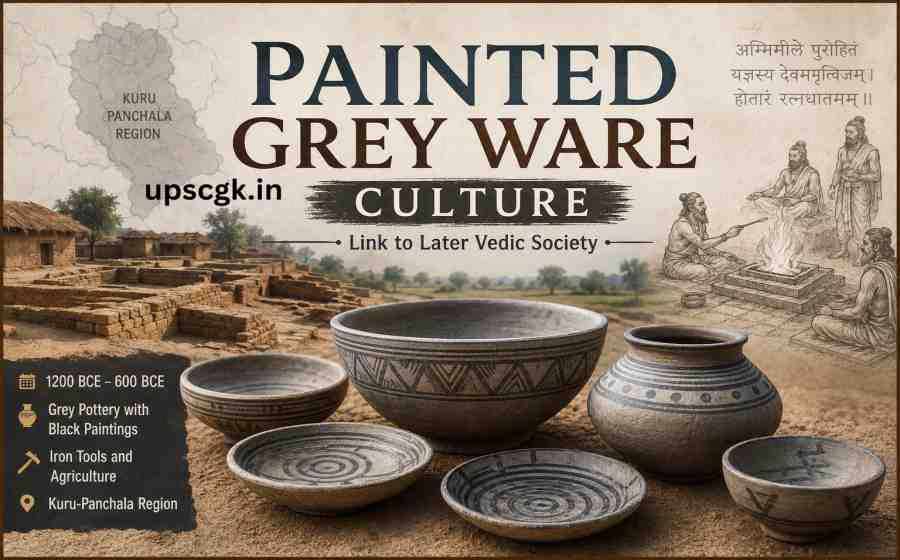
The Painted Grey Ware (PGW) Culture represents one of the most significant archaeological cultures of ancient India. It bridges the gap between the Late Harappan period and the emergence of the early historic age. Dating roughly from 1200 BCE to 600 BCE, the PGW Culture is widely associated with the Later Vedic Period, making it an essential topic for understanding the transition of Indian society from pastoral communities to settled agricultural kingdoms.
The name “Painted Grey Ware” comes from the distinctive grey-colored pottery decorated with simple black geometric designs. Archaeologists have discovered PGW sites mainly in the Indo-Gangetic plains, where many important kingdoms mentioned in the Later Vedic texts eventually flourished.
Table of Contents
Origin and Time Period
The Painted Grey Ware Culture developed after the decline of the Late Harappan settlements and before the rise of the Northern Black Polished Ware (NBPW) Culture. Most historians date it between 1200 BCE and 600 BCE, although some sites indicate regional variations.
The culture spread across present-day:
- Punjab
- Haryana
- Delhi
- Western Uttar Pradesh
- Rajasthan
- Parts of Madhya Pradesh
Its geographical distribution closely matches the region described in the Later Vedic literature, especially the area known as the Kuru-Panchala region.
Characteristic Features of PGW Pottery
The most distinguishing feature of this culture is its unique pottery.
Main Characteristics
- Fine grey pottery fired at high temperatures.
- Painted with black geometric patterns such as:
- Circles
- Lines
- Swastikas
- Dots
- Spirals
- Thin and lightweight compared to earlier pottery.
- Mostly bowls, dishes, and small storage vessels.
Although PGW pottery constituted only a small percentage of total pottery found at excavation sites, its superior quality indicates that it may have been used by the elite sections of society.
Major Archaeological Sites
Several important archaeological sites have yielded Painted Grey Ware remains.
Some of the major PGW sites include:
- Hastinapur (Uttar Pradesh)
- Ahichchhatra (Uttar Pradesh)
- Atranjikhera (Uttar Pradesh)
- Alamgirpur (Uttar Pradesh)
- Bhagwanpura (Haryana)
- Kurukshetra (Haryana)
- Noh (Rajasthan)
- Jakhera (Uttar Pradesh)
Many of these sites are associated with places mentioned in the Mahabharata, although archaeological evidence does not conclusively prove the historicity of the epic.
Settlement Pattern
The PGW people lived in permanent villages and emerging towns.
Common features of settlements include:
- Mud houses supported by wooden posts.
- Wattle-and-daub construction.
- Circular and rectangular huts.
- Planned habitation areas.
- Storage pits for grains.
Some settlements gradually expanded into regional centres, indicating increasing political and economic complexity.
Economy of the PGW People
The economy combined agriculture, animal husbandry, and craft production.
Agriculture
Agriculture became more advanced during this period.
Main crops included:
- Rice
- Wheat
- Barley
- Lentils
- Millets
Excavations reveal improved farming techniques supported by iron tools.
Animal Husbandry
Domesticated animals included:
- Cattle
- Horses
- Sheep
- Goats
- Buffaloes
Cattle remained the primary measure of wealth, while horses gained military importance.
Crafts
The people produced:
- Pottery
- Beads
- Bone tools
- Copper ornaments
- Iron implements
Iron technology expanded significantly during this period and contributed to agricultural growth.
Use of Iron
One of the defining characteristics of the PGW Culture is the increasing use of iron.
Iron tools discovered include:
- Ploughshares
- Axes
- Sickles
- Spears
- Arrowheads
- Knives
The widespread use of iron enabled:
- Forest clearance
- Expansion of agriculture
- Better weapons
- Growth of settlements
Because of this, the PGW period is often regarded as the beginning of the Iron Age in northern India.
Social Life
Society became increasingly organized compared to earlier periods.
Important social features include:
- Growth of settled villages.
- Emergence of social hierarchy.
- Increasing importance of family ownership.
- Expansion of agriculture-based communities.
- Development of occupational specialization.
These developments correspond closely with descriptions found in the Later Vedic texts.
Political Organization
The PGW period witnessed the formation of larger political units.
Instead of small tribal groups, larger kingdoms began to emerge, particularly:
- Kuru
- Panchala
These kingdoms are frequently mentioned in the Later Vedic Samhitas, Brahmanas, and Upanishads.
The king’s authority increased, while assemblies such as the Sabha and Samiti gradually became less influential.
Religious Beliefs
Although archaeology provides limited direct evidence regarding religion, scholars connect the PGW Culture with the religious practices described in the Later Vedic texts.
Important features include:
- Fire sacrifices (Yajnas)
- Worship of Vedic deities
- Growing role of priests
- Performance of elaborate rituals
- Royal sacrifices such as Rajasuya and Ashvamedha in later phases
Religion became increasingly ritualistic, strengthening the authority of the Brahmin class.
Link Between PGW Culture and Later Vedic Society
The strongest significance of the Painted Grey Ware Culture lies in its close association with the Later Vedic Civilization. Several factors support this connection:
Geographical Similarity
Most PGW sites are located in the Kuru-Panchala region, the political centre described in the Later Vedic literature.
Chronological Match
The dating of PGW (1200–600 BCE) closely corresponds with the estimated period of the Later Vedic Age.
Iron Technology
The Later Vedic texts mention the growing use of iron (referred to as Shyama Ayas), matching archaeological discoveries at PGW sites.
Agricultural Expansion
Both archaeological evidence and Vedic literature indicate the expansion of settled agriculture and forest clearance during this period.
Rise of Kingdoms
The emergence of territorial states such as Kuru and Panchala in the PGW region aligns with descriptions in the Vedic texts.
Social Transformation
The development of the varna system, stronger monarchy, and increasingly settled communities described in the Later Vedic period reflects the material culture uncovered at PGW sites.
Difference Between Harappan and PGW Culture
| Feature | Harappan Civilization | Painted Grey Ware Culture |
|---|---|---|
| Time | 2600–1900 BCE | 1200–600 BCE |
| Town Planning | Highly planned cities | Small villages and towns |
| Metal | Bronze | Iron |
| Script | Developed script | No known script |
| Pottery | Red Ware | Grey painted pottery |
| Economy | Urban trade-based | Agriculture-based |
Significance of Painted Grey Ware Culture
The Painted Grey Ware Culture occupies a crucial place in Indian history because it marks the transition from tribal societies to organized kingdoms. It reflects the spread of iron technology, agricultural expansion, permanent settlements, and the emergence of political institutions that later shaped the Mahajanapada period. The close correspondence between archaeological findings and the Later Vedic texts makes PGW an important source for reconstructing ancient Indian history.
Summary
The Painted Grey Ware Culture represents a transformative phase in India’s ancient past. Its distinctive pottery, iron technology, settled agricultural economy, and expanding political structures provide strong archaeological support for the Later Vedic Society described in ancient texts. By connecting material evidence with literary traditions, the PGW Culture helps historians understand how early Vedic communities evolved into powerful kingdoms, laying the foundation for the rise of the Mahajanapadas and the subsequent growth of Indian civilization.
Also Check: History