Explore the Megalithic Culture in India, its burial practices, social structure, iron technology, important sites and archaeological significance in the detail.
Megalithic Culture in India
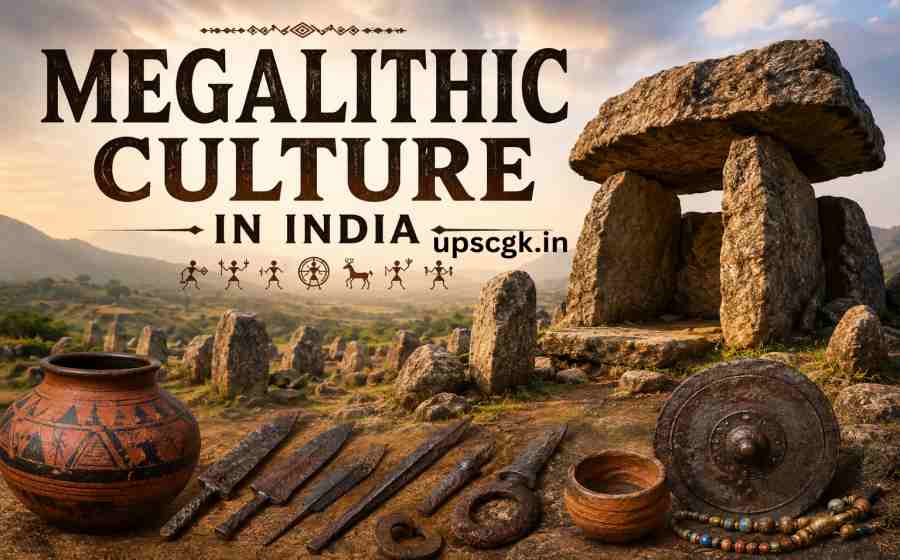
The Megalithic Culture represents one of the most fascinating phases of ancient Indian history. The term megalith is derived from the Greek words ‘mega’ (large) and ‘lithos’ (stone), meaning “large stone.” These large stones were used to construct monuments, primarily associated with burials. The Megalithic Culture flourished in different parts of India, particularly in the Deccan Plateau and South India, between 1200 BCE and 300 CE, although some megalithic traditions continued even later.
This culture marks the transition from the Chalcolithic (Copper Age) to the Iron Age, reflecting significant developments in technology, agriculture, trade, and social organization. The impressive stone burial monuments provide valuable insights into the beliefs, customs, and lifestyle of early Iron Age communities.
Table of Contents
What is Megalithic Culture?
The Megalithic Culture refers to communities that buried their dead using large stone structures or monuments. These burial sites often contained iron tools, pottery, ornaments, weapons, and even animal remains, suggesting that people believed in life after death.
Unlike urban civilizations such as the Indus Valley Civilization, the Megalithic Culture consisted mainly of village-based societies with developing agricultural and pastoral economies.
The culture is widely distributed across India, with the highest concentration of megalithic monuments found in Karnataka, Tamil Nadu, Kerala, Andhra Pradesh, Telangana, Maharashtra, Odisha, Vidarbha, and parts of Central India.
Origin and Development
Scholars have proposed different theories regarding the origin of the Megalithic Culture. Some historians believe that megalithic traditions developed independently within India, while others suggest that cultural influences came from West Asia or the Mediterranean. However, archaeological evidence indicates that local communities adapted these practices according to regional traditions.
The widespread use of iron technology during this period greatly improved agricultural productivity and facilitated forest clearance, allowing settlements to expand into new regions.
Geographical Distribution
Megalithic sites have been discovered across various parts of India.
Major regions include:
- South India (Tamil Nadu, Karnataka, Kerala, Andhra Pradesh, Telangana)
- Maharashtra (especially Vidarbha)
- Odisha
- Chhattisgarh
- Madhya Pradesh
- Parts of Uttar Pradesh
- Northeastern India
More than 2,000 megalithic sites have been identified, making it one of the most widespread archaeological cultures in the Indian subcontinent.
Types of Megalithic Burials
One of the defining features of this culture is its diverse burial practices. Archaeologists have classified megalithic burials into several categories.
1. Stone Circles
Large stones were arranged in circular formations around burial pits. These are among the most common megalithic monuments in India.
2. Dolmens
Dolmens consisted of large flat stone slabs placed over upright stones, creating a chamber-like structure for burials.
3. Cists
Cists were rectangular stone-lined burial chambers built underground. The deceased, along with grave goods, was placed inside before sealing the chamber.
4. Cairns
Cairns were heaps of stones piled over graves, serving as memorial markers.
5. Menhirs
A menhir is a single upright stone erected either to mark a burial or commemorate an important individual.
6. Sarcophagi
In certain regions, the dead were buried in terracotta coffins supported by stone or clay legs.
Burial Practices
Burial customs reveal much about the beliefs of Megalithic communities.
Some important features include:
- Primary and secondary burials were both practiced.
- Graves often contained iron weapons, agricultural tools, pottery, ornaments, beads, and food offerings.
- Animal bones found in burials indicate ritual sacrifices.
- Some graves contained multiple individuals, possibly representing family burials.
- Richer burials suggest differences in wealth and social status.
The inclusion of personal belongings indicates a belief that life continued after death and that the deceased would require these objects in the afterlife.
Society and Social Structure
Archaeological discoveries suggest that Megalithic society was becoming increasingly organized and stratified.
Agricultural Economy
Agriculture formed the backbone of the economy. Crops such as:
- Rice
- Millet
- Wheat
- Barley
- Pulses
were cultivated using improved iron tools.
Animal Husbandry
People domesticated cattle, sheep, goats, pigs, and horses. Livestock played an important role in agriculture and trade.
Iron Technology
The extensive use of iron distinguishes this culture from earlier Chalcolithic societies.
Iron was used to manufacture:
- Axes
- Ploughshares
- Sickles
- Spears
- Swords
- Arrowheads
- Knives
The widespread use of iron significantly increased agricultural production and military capability.
Crafts and Trade
Megalithic people produced:
- Black-and-red ware pottery
- Bead ornaments
- Copper objects
- Gold ornaments
- Iron implements
Trade networks connected different regions, enabling the exchange of raw materials and finished products.
Religious Beliefs
Although no written records survive, burial practices provide clues about their religious beliefs.
The people likely believed in:
- Life after death
- Ancestor worship
- Ritual offerings
- Funeral ceremonies
- Sacred significance of stones
The elaborate construction of burial monuments demonstrates respect for the deceased and suggests that funeral rituals held great social importance.
Important Megalithic Sites in India
Several archaeological sites have yielded valuable evidence regarding the Megalithic Culture.
Brahmagiri (Karnataka)
Excavated by Sir Mortimer Wheeler, Brahmagiri revealed stone circles, iron tools, pottery, and burial chambers.
Adichanallur (Tamil Nadu)
One of India’s richest Iron Age sites, Adichanallur has produced urn burials, bronze objects, iron weapons, ornaments, and human skeletons.
Hallur (Karnataka)
Hallur provides evidence for the transition from the Neolithic period to the Iron Age.
Maski (Karnataka)
Known for megalithic burials and iron artefacts.
Junapani (Maharashtra)
Famous for numerous stone circles and burial monuments.
Nagarjunakonda (Andhra Pradesh)
Contains several megalithic burial remains and evidence of later historical developments.
Archaeological Significance
The Megalithic Culture occupies a crucial place in Indian archaeology because it bridges prehistoric and early historic periods.
It provides evidence of:
- Early Iron Age technology
- Organized village settlements
- Agricultural expansion
- Social differentiation
- Trade networks
- Religious beliefs
- Funeral customs
Excavations continue to reveal new information about regional variations and cultural interactions.
Significance for UPSC and Competitive Examinations
The Megalithic Culture is an important topic in Ancient Indian History and frequently appears in UPSC, State PCS, SSC, and other competitive examinations.
Important examination points include:
- Time period of the Megalithic Culture
- Meaning of the term “megalith”
- Types of burial monuments
- Iron technology
- Black-and-red ware pottery
- Major archaeological sites
- Burial practices
- Social and economic life
- Religious beliefs
A comparative understanding of the Neolithic, Chalcolithic, and Megalithic cultures is particularly useful for objective and descriptive questions.
Summary
The Megalithic Culture in India represents a significant chapter in the country’s ancient past, marking the rise of Iron Age societies characterized by improved agriculture, advanced metallurgy, and complex burial traditions. The impressive stone monuments, rich grave goods, and widespread archaeological remains demonstrate that these communities possessed well-developed social structures, technological skills, and spiritual beliefs. Their legacy not only bridges the gap between prehistoric and historic India but also provides invaluable insights into the cultural evolution of the Indian subcontinent. Continued archaeological research at megalithic sites continues to deepen our understanding of these remarkable early societies.
Also Check: History