
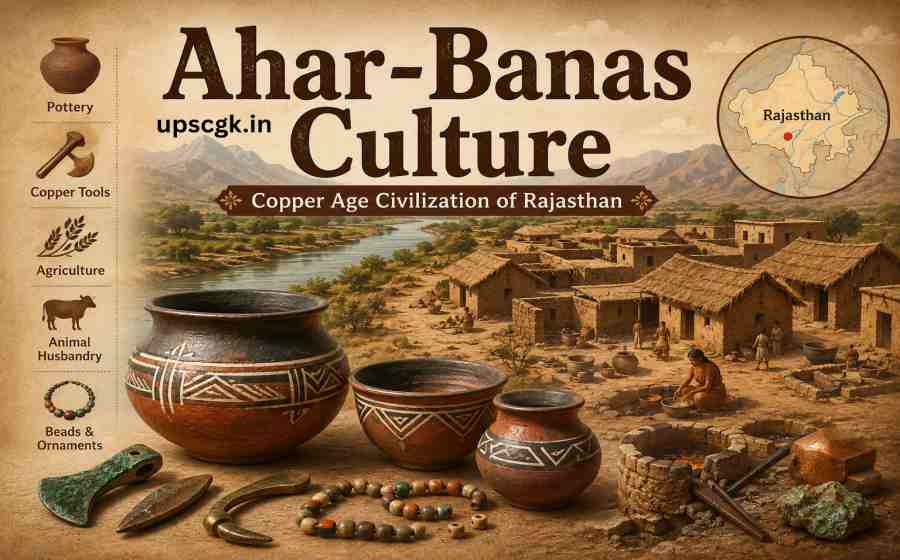
Explore the Ahar-Banas Culture, Rajasthan’s Copper Age civilization. Learn about its features, major sites, pottery, economy and historical significance.
Ahar-Banas Culture
The Ahar-Banas Culture was one of the most significant Chalcolithic (Copper Age) cultures of ancient India. It flourished in the southeastern region of present-day Rajasthan between 3000 BCE and 1500 BCE, with its peak development occurring around 2000 BCE. Named after the archaeological site of Ahar near Udaipur and the Banas River, this culture represents an important phase in India’s prehistoric development.
The people of the Ahar-Banas Culture were among the earliest communities to use copper tools alongside stone implements. They practiced agriculture, animal husbandry, pottery, and metallurgy, laying the foundation for settled village life in western India. The culture also maintained trade contacts with the contemporary Indus Valley Civilization, making it an essential chapter in Indian history.
Table of Contents
Discovery of the Ahar-Banas Culture
The Ahar-Banas Culture came to light through archaeological excavations conducted in the mid-20th century. The site of Ahar, located near Udaipur in Rajasthan, was excavated by archaeologists who uncovered evidence of a well-organized Chalcolithic settlement.
Subsequent excavations at sites such as Gilund, Balathal, and Ojiyana revealed that this culture extended across the valleys of the Banas and its tributaries. More than 90 archaeological sites associated with this culture have been identified in Rajasthan.
Geographical Extent
The Ahar-Banas Culture was mainly concentrated in southeastern Rajasthan, particularly in the districts of:
- Udaipur
- Chittorgarh
- Bhilwara
- Rajsamand
- Mandsaur (parts of present-day Madhya Pradesh)
The civilization developed along the fertile plains of the Banas River and its tributaries, which supported agriculture and human settlement.
Time Period
The Ahar-Banas Culture is generally dated between:
- Early Phase: Around 3000 BCE
- Mature Phase: 2500 BCE–1800 BCE
- Late Phase: Up to approximately 1500 BCE
It existed alongside the Harappan Civilization, although it developed independently with its own distinctive cultural traits.
Major Archaeological Sites
Several important sites have been excavated under the Ahar-Banas Cultural tradition.
1. Ahar (Udaipur)
- Type site of the culture
- Large settlement with mud houses
- Evidence of copper smelting
- Distinctive Black-and-Red Ware pottery
2. Gilund
One of the largest Chalcolithic settlements in Rajasthan, Gilund has yielded:
- Large storage structures
- Terracotta objects
- Stone tools
- Evidence of organized planning
3. Balathal
Balathal is notable for:
- Fortified settlement
- Agricultural remains
- Human burials
- Copper artifacts
4. Ojiyana
Excavations at Ojiyana revealed pottery, copper implements, beads, and evidence of permanent habitation.
Settlement Pattern
The settlements of the Ahar-Banas Culture were generally located near rivers and fertile agricultural land.
Their houses were built using:
- Mud walls
- Stone foundations
- Bamboo and wooden poles
- Thatched roofs
Most villages consisted of rectangular or circular houses with hearths used for cooking.
Economy of the Ahar-Banas Culture
The economy was based on a combination of agriculture, animal husbandry, metallurgy, and trade.
Agriculture
The inhabitants cultivated several crops, including:
- Wheat
- Barley
- Lentils
- Peas
- Millets
The fertile river valleys enabled successful farming, while seasonal rainfall supported crop cultivation.
Animal Husbandry
Domesticated animals included:
- Cattle
- Sheep
- Goats
- Buffaloes
- Pigs
Animal bones discovered at excavation sites indicate that livestock played a vital role in food production and agriculture.
Copper Metallurgy
One of the defining features of the Ahar-Banas Culture was its advanced use of copper.
Archaeologists have discovered:
- Copper axes
- Knives
- Arrowheads
- Fish hooks
- Bangles
- Pins
The nearby Aravalli Hills were rich in copper ores, allowing the inhabitants to develop early metallurgical skills. Evidence of furnaces and copper-smelting workshops has also been found.
Pottery
The Ahar-Banas Culture is especially famous for its distinctive pottery.
The most characteristic type was:
Black-and-Red Ware (BRW)
Features include:
- Black interior and rim
- Red exterior
- White painted geometric designs
- Bowls, dishes, jars, and storage vessels
This pottery style is considered one of the identifying features of the culture and reflects the high level of craftsmanship achieved by its artisans.
Tools and Crafts
Apart from copper tools, people also used:
- Stone blades
- Bone tools
- Terracotta toys
- Beads made of semi-precious stones
- Shell ornaments
Craft production appears to have been an important economic activity.
Trade and Exchange
Archaeological findings suggest that the Ahar-Banas people maintained trade relations with neighboring regions.
Items exchanged likely included:
- Copper objects
- Pottery
- Beads
- Agricultural products
- Semi-precious stones
Trade links with the Harappan Civilization are indicated by similarities in artifacts and the discovery of Harappan-style objects at some sites.
Food Habits
Archaeobotanical and faunal evidence suggests a mixed diet.
The people consumed:
- Wheat
- Barley
- Rice (in limited quantities)
- Pulses
- Milk products
- Meat from domesticated animals
- Fish
Cooking was carried out using earthen hearths found inside houses.
Burial Practices
Excavations have revealed different burial traditions.
The dead were generally buried in pits, often accompanied by:
- Pottery
- Personal ornaments
- Everyday objects
These grave goods indicate beliefs regarding life after death and social customs.
Important Features of the Ahar-Banas Culture
Some distinguishing characteristics include:
- Early use of copper metallurgy.
- Permanent village settlements.
- Distinctive Black-and-Red Ware pottery with white painted designs.
- Agriculture supported by river valleys.
- Animal domestication.
- Skilled craftsmanship in pottery, beads, and copper tools.
- Trade connections with neighboring Chalcolithic cultures and the Harappans.
- Well-developed storage and habitation structures.
Difference Between Ahar-Banas Culture and Harappan Civilization
| Feature | Ahar-Banas Culture | Harappan Civilization |
|---|---|---|
| Region | Southeastern Rajasthan | Northwestern Indian subcontinent |
| Period | 3000–1500 BCE | 2600–1900 BCE |
| Economy | Agriculture and copper metallurgy | Agriculture, trade, and urban economy |
| Settlements | Villages | Planned cities |
| Metal Used | Mainly copper | Copper and bronze |
| Pottery | Black-and-Red Ware | Red Ware with black designs |
| Urban Planning | Limited | Highly advanced |
Historical Significance
The Ahar-Banas Culture occupies an important place in Indian prehistory because it demonstrates the gradual transition from Neolithic farming communities to more advanced Chalcolithic societies. Its expertise in copper metallurgy reflects the technological innovations of early settlers in Rajasthan.
The culture also highlights the diversity of India’s prehistoric civilizations. While the Harappan Civilization developed sophisticated urban centers, the Ahar-Banas communities established prosperous rural settlements that contributed to regional trade, agriculture, and craft production. Their interaction with neighboring cultures enriched the cultural landscape of ancient India.
Today, the archaeological remains of the Ahar-Banas Culture provide valuable insights into the social, economic, and technological developments of the Copper Age and continue to be an important subject of study for historians and archaeologists.
Summary
The Ahar-Banas Culture represents one of the earliest Copper Age civilizations in India and showcases the remarkable achievements of prehistoric communities in Rajasthan. Its expertise in copper metallurgy, distinctive Black-and-Red Ware pottery, agricultural economy, and well-planned settlements reflect a society that was both innovative and well-organized. As an important contemporary of the Harappan Civilization, the Ahar-Banas Culture enriches our understanding of India’s ancient heritage and the evolution of early human settlements on the subcontinent.
Also Check: History