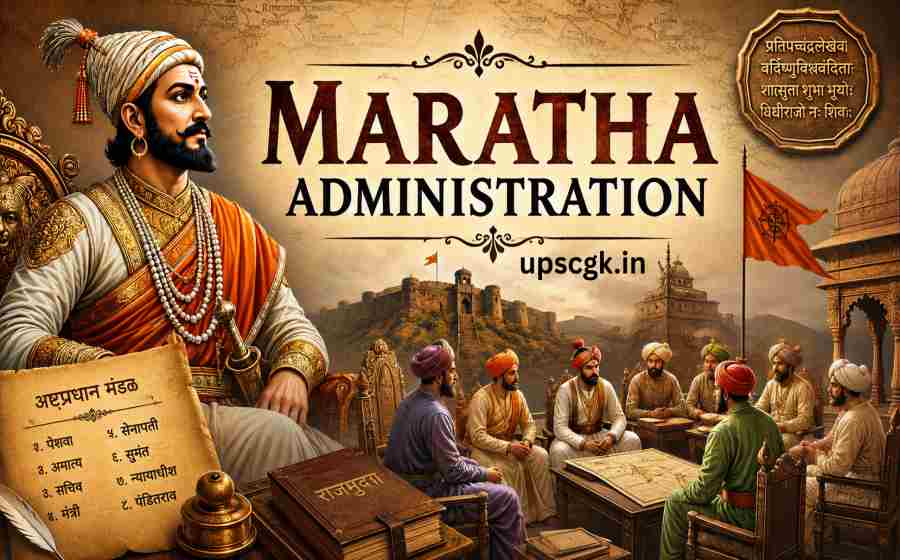
Maratha Administration under Shivaji featured the Ashtapradhan Council, strong governance, revenue reforms, military power and justice system.
Maratha Administration
The rise of the Maratha Empire in the 17th century marked a turning point in Indian history. Under the leadership of Chhatrapati Shivaji Maharaj, the Marathas established a powerful kingdom that challenged the dominance of the Mughal Empire in India. Shivaji was not only a brave warrior and military strategist but also an excellent administrator. He created a strong and organized administrative system that ensured stability, justice, discipline, and efficient governance throughout his empire.
One of the most important features of Maratha administration was the Ashtapradhan Council, a group of eight ministers appointed by Shivaji to assist him in governing the state. This council played a major role in maintaining law and order, handling finances, military affairs, foreign relations, and judicial administration. The Maratha administrative system reflected Shivaji’s vision of a disciplined and welfare-oriented kingdom. It combined traditional Indian principles with practical military and political strategies.
Table of Contents
Features of Maratha Administration
The administration of the Maratha Empire had several important characteristics:
- Centralized administration under the king
- Efficient revenue collection system
- Strong military organization
- Proper judicial administration
- Promotion of local self-governance
- Religious tolerance and protection of people
- Strict discipline among officials
Shivaji believed that the king was the supreme authority, but he also understood the importance of expert advice and organized governance. Therefore, he formed the Ashtapradhan Council to help in administration.
The Ashtapradhan Council
The word Ashtapradhan means “Council of Eight Ministers.” This council was established by Shivaji after his coronation in 1674. Each minister had a fixed department and specific responsibilities.
The ministers were directly appointed by Shivaji and remained accountable to him. They were expected to work honestly and efficiently for the welfare of the state.
Members of the Ashtapradhan Council
1. Peshwa (Prime Minister)
The Peshwa was the head of the council and the chief advisor to the king. He looked after the general administration of the kingdom and coordinated the work of other ministers.
The Peshwa became extremely powerful in later years, especially after Shivaji’s death. Eventually, the Peshwas became the real rulers of the Maratha Empire.
2. Amatya or Mazumdar (Finance Minister)
The Amatya was responsible for maintaining state accounts and managing revenue and expenditure. He supervised financial records and ensured proper use of public money.
This position was important for maintaining economic stability in the empire.
3. Sachiv (Chief Secretary)
The Sachiv handled official documents, royal letters, and state correspondence. He maintained records of government orders and supervised administrative paperwork.
4. Mantri (Interior Minister)
The Mantri kept information about the daily activities of the king and monitored internal affairs. He also maintained intelligence reports and court records.
5. Senapati (Commander-in-Chief)
The Senapati was the head of the military. He organized the army, managed military campaigns, and protected the kingdom from enemies.
The Maratha army under Shivaji was known for its discipline, mobility, and guerrilla warfare tactics.
6. Sumant or Dabir (Foreign Minister)
The Sumant managed foreign relations and diplomatic affairs. He maintained communication with neighboring kingdoms and handled treaties and negotiations.
7. Nyayadhish (Chief Justice)
The Nyayadhish was responsible for the judicial system. He ensured justice according to Hindu laws and customs.
Shivaji’s administration focused on fair justice and punishment for corruption and crimes.
8. Panditrao (Religious Minister)
The Panditrao looked after religious matters, charities, and moral guidance. He supervised religious ceremonies and supported scholars and priests.
Despite being a Hindu ruler, Shivaji respected all religions and did not encourage religious discrimination.
Revenue Administration
Revenue collection was one of the strongest aspects of Maratha administration. Shivaji introduced reforms to reduce exploitation of peasants.
Main Features of Revenue System
- Land revenue was the primary source of income.
- Taxes were collected directly from farmers.
- Middlemen and jagirdars were controlled.
- Land measurement was conducted carefully.
- Usually, around one-third of the produce was collected as tax.
Shivaji also introduced Chauth and Sardeshmukhi.
Chauth
It was a tax equal to one-fourth of the revenue collected from territories outside the Maratha kingdom in return for protection.
Sardeshmukhi
It was an additional tax of 10% claimed by the Marathas as hereditary rights.
These taxes became major sources of Maratha income later.
Military Administration
Shivaji built a strong and disciplined military system.
Important Features
- Well-trained cavalry and infantry
- Efficient navy for coastal protection
- Use of guerrilla warfare
- Strong forts across the kingdom
- Strict discipline among soldiers
Shivaji understood the importance of forts and developed many strategically located forts such as Raigad, Pratapgad, and Sindhudurg.
The Maratha navy protected the western coast from foreign invasions and pirate attacks.
Judicial Administration
Justice was an important part of Maratha governance. The judicial system was based on Hindu traditions and local customs.
- Village panchayats solved local disputes.
- Serious cases were handled by higher courts.
- Punishments were strict for corruption and crimes.
The Nyayadhish supervised the legal system and ensured fairness in administration.
Local Administration
Villages formed the basic unit of administration.
Village Officials
- Patil – Head of the village
- Kulkarni – Maintained village records
- Deshmukh – Supervised groups of villages
Local officials played an important role in tax collection and maintaining law and order.
Importance of Maratha Administration
The Maratha administrative system was highly organized and practical for its time. Shivaji successfully created a balance between military power and civil administration.
Significance
- Strengthened the Maratha Empire
- Reduced corruption and misuse of power
- Protected peasants and local people
- Encouraged discipline and efficiency
- Inspired later Indian rulers
The Ashtapradhan Council became one of the most famous administrative systems in medieval Indian history.
Summary
The Maratha administration under Shivaji was a remarkable example of efficient governance in medieval India. Through the Ashtapradhan Council, Shivaji created a well-structured administrative system that managed finance, justice, military affairs, and diplomacy effectively.
His policies reflected intelligence, discipline and concern for public welfare. The success of the Maratha Empire was not based only on military strength but also on strong administration and organized governance. Even today, Shivaji’s administrative reforms are remembered as an important contribution to Indian history and statecraft.
Also Check: History