Learn about the Peshwas, their role in the expansion of Maratha power, major achievements and the reasons behind the decline of the Maratha Empire.
Peshwas
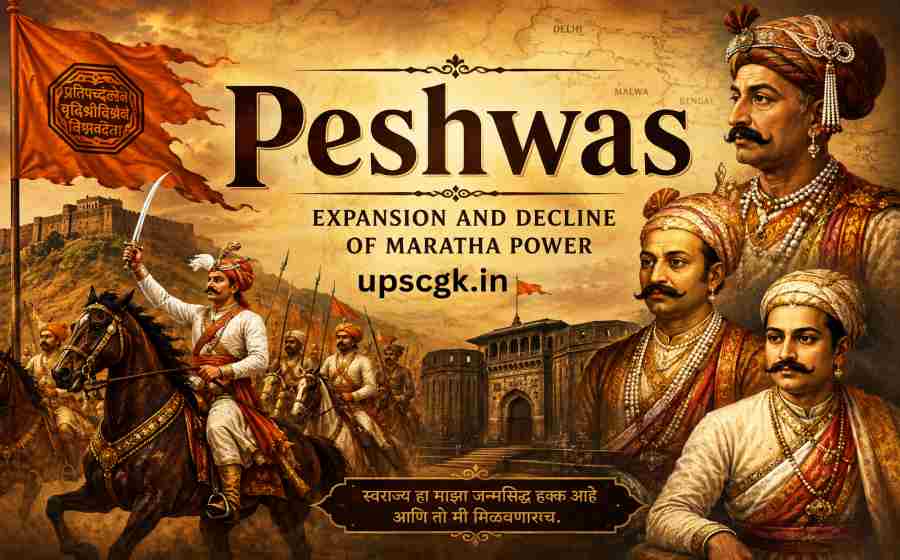
The Peshwas played a crucial role in transforming the Maratha kingdom into one of the most powerful empires in India during the 18th century. Originally appointed as prime ministers under the Maratha rulers, the Peshwas gradually became the real authority behind the administration and military expansion of the Maratha Empire. Under their leadership, the Marathas expanded their influence across large parts of India and emerged as a major political force after the decline of the Mughal Empire. The period of the Peshwas is considered one of the most important phases in Indian history because it witnessed both the rise of Maratha supremacy and the eventual decline of their power.
Table of Contents
Origin of the Peshwa System
The term “Peshwa” means Prime Minister. The position gained importance during the reign of Chhatrapati Shivaji Maharaj, the founder of the Maratha Empire. Shivaji had established the Ashtapradhan Council, a group of eight ministers, in which the Peshwa handled administrative duties.
However, the office became hereditary during the reign of Chhatrapati Shahu. In 1713, Shahu appointed Balaji Vishwanath as the Peshwa. This marked the beginning of Peshwa dominance in Maratha politics.
Balaji Vishwanath (1713–1720)
Balaji Vishwanath is regarded as the founder of Peshwa power. He was a skilled diplomat and administrator who strengthened the Maratha state after years of internal conflict.
His major achievements included:
- Uniting various Maratha chiefs under the authority of Shahu
- Securing the right to collect Chauth and Sardeshmukhi from the Mughal territories in the Deccan
- Increasing the political influence of the Marathas
Balaji Vishwanath laid the foundation for future Maratha expansion and made the Peshwa position highly influential.
Baji Rao I (1720–1740)
Baji Rao I is considered the greatest among all Peshwas. A brilliant military commander, he believed that the Mughal Empire was weakening rapidly and that the Marathas should expand towards northern India.
He famously said that the Marathas should “strike at the trunk of the withering Mughal tree.”
Expansion Under Baji Rao I
Under his leadership, the Maratha Empire expanded significantly:
- Malwa and Gujarat came under Maratha influence
- The Marathas defeated the Nizam of Hyderabad
- Maratha power reached Delhi
- Several Rajput and Bundela rulers accepted Maratha authority
Baji Rao I never lost a battle in his military career. His fast-moving cavalry tactics made the Maratha army highly effective.
He also established Pune as the center of Peshwa administration, which later became the political capital of the Marathas.
Balaji Baji Rao (Nana Saheb) (1740–1761)
After the death of Baji Rao I, his son Balaji Baji Rao, also known as Nana Saheb, became the Peshwa. During his rule, the Maratha Empire reached its maximum territorial expansion.
The Marathas controlled large areas from the Deccan to northern India. They became the dominant political force in India and even influenced Mughal court politics in Delhi.
Third Battle of Panipat (1761)
The most significant event during Nana Saheb’s rule was the Third Battle of Panipat fought in 1761 between the Marathas and Ahmad Shah Abdali of Afghanistan.
The Marathas suffered a massive defeat due to:
- Lack of strong alliances with Rajputs and other Indian rulers
- Supply shortages during the campaign
- Strategic mistakes by the Maratha commanders
Thousands of Maratha soldiers died in the battle, including important leaders. The defeat at Panipat severely weakened Maratha power and morale.
Madhav Rao I (1761–1772)
After the disaster at Panipat, Madhav Rao I revived the Maratha Empire. He was an efficient administrator and capable leader.
His achievements included:
- Restoring Maratha authority in northern and southern India
- Defeating the Nizam and Hyder Ali
- Improving administration and financial management
Many historians consider Madhav Rao I the last great Peshwa because he successfully restored the prestige of the Marathas after Panipat.
Decline of Maratha Power
After the death of Madhav Rao I, internal conflicts and political instability weakened the Maratha Empire.
Main Causes of Decline
1. Internal Rivalries
The Maratha chiefs such as the Scindias, Holkars, Bhonsles, and Gaekwads often fought among themselves for power and influence.
2. Weak Leadership
Later Peshwas lacked the military and administrative abilities of earlier leaders like Baji Rao I and Madhav Rao I.
3. Impact of Panipat
The Third Battle of Panipat caused heavy loss of manpower, wealth, and confidence.
4. Rise of the British
The British East India Company gradually expanded its control in India and took advantage of Maratha disunity.
5. Anglo-Maratha Wars
The three Anglo-Maratha Wars between 1775 and 1818 ended Maratha independence.
The final defeat came in 1818 when Peshwa Baji Rao II surrendered to the British. This marked the end of the Maratha Empire and the beginning of British supremacy in India.
Contribution of the Peshwas
Despite their decline, the Peshwas made important contributions to Indian history:
- Expanded Maratha influence across India
- Challenged the declining Mughal Empire
- Promoted administration, trade, and revenue systems
- Developed Pune as an important cultural and political center
- Preserved Hindu political power during a period of instability
The Peshwas transformed the Marathas from a regional kingdom into a major Indian empire.
Summary
The Peshwas were central figures in the rise and expansion of the Maratha Empire. Leaders like Balaji Vishwanath, Baji Rao I, and Madhav Rao I strengthened Maratha power and extended their influence across India. However, internal divisions, weak leadership, and the growing strength of the British led to the decline of the Marathas.
The history of the Peshwas remains an important chapter in Indian history because it highlights both the achievements and challenges of one of the strongest native powers before British rule.
Also Check: History