
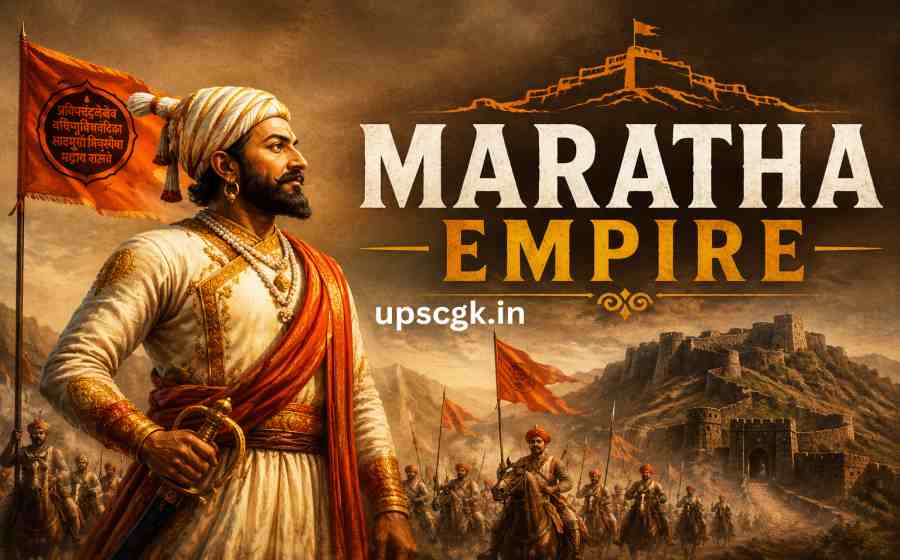
Discover the rise of the Maratha Empire under Shivaji, its military strength, administration and how it emerged as a major power in Indian history.
Maratha Empire
The Maratha Empire was one of the strongest and most influential empires in Indian history. It emerged during a period when large parts of India were under the rule of the Mughal Empire and several regional kingdoms. The rise of the Maratha Empire under the leadership of Shivaji Maharaj marked an important turning point in Indian history. Through his courage, military skills, and administrative abilities, Shivaji laid the foundation of a powerful kingdom that later expanded across much of India.
Table of Contents
Background of the Maratha Empire
During the 17th century, the Mughal Empire had become one of the largest empires in India. However, many regions experienced political instability and dissatisfaction under local rulers and foreign administrations. In western India, especially in the Deccan region, the people faced several challenges including heavy taxation and political conflicts.
The Marathas were a group of people mainly living in present-day Maharashtra and surrounding regions. They had a strong warrior tradition and deep attachment to their land and culture. The hilly terrain of the Western Ghats also played an important role in shaping their military tactics.
Birth and Early Life of Shivaji
Shivaji was born in 1630 at Shivneri Fort. He was the son of Shahaji Bhosale and Jijabai. His mother Jijabai greatly influenced his values and character. She inspired him through stories from Indian epics and teachings about bravery, justice, and good governance.
Shivaji grew up learning military techniques, horse riding, sword fighting, and administration. From an early age, he dreamed of establishing an independent kingdom based on self-rule, often known as “Swarajya.”
Beginning of Shivaji’s Expansion
Shivaji began his political and military activities at a young age. He started by capturing small forts in the Deccan region. One of his earliest important victories was the capture of Torna Fort in 1646.
After gaining control over several forts, Shivaji gradually expanded his influence. Instead of relying only on large battles, he focused on planning, intelligence gathering, and strategic movements.
His early successes increased his popularity among local people and soldiers. Many warriors joined him because they believed in his leadership and vision.
Guerrilla Warfare Strategy
One of the most important reasons for Shivaji’s rise was his use of guerrilla warfare tactics. This military method involved quick attacks, surprise movements, and using geographical advantages against stronger enemies.
Instead of fighting large armies directly in open fields, Shivaji used forests, mountains, and forts for defense and attack. His soldiers were highly mobile and familiar with local terrain.
These tactics allowed him to challenge much larger powers such as the Mughal Empire and regional sultanates. His innovative military strategy became one of the defining features of Maratha warfare.
Conflict with Regional Powers
Shivaji’s growing influence brought him into conflict with neighboring powers such as the Bijapur Sultanate and the Mughal Empire.
A major event in Shivaji’s career was his encounter with Afzal Khan. Afzal Khan was sent to defeat Shivaji. However, Shivaji carefully planned the meeting and successfully defended himself during the confrontation.
Another significant challenge came from Aurangzeb. As the Mughal Empire expanded into the Deccan, conflicts between Shivaji and Mughal forces increased.
Despite facing stronger enemies, Shivaji continued to resist and expand his kingdom.
Coronation of Shivaji
One of the most important moments in Maratha history was Shivaji’s coronation in 1674 at Raigad Fort.
The coronation officially declared him as the king and founder of an independent Maratha kingdom. It symbolized political freedom and strengthened the identity of the Maratha people.
After becoming king, Shivaji focused not only on military expansion but also on administration and governance.
Administration and Governance
Shivaji was not only a great warrior but also an effective administrator. He established a well-organized system of government.
He created the “Ashtapradhan,” a council of eight ministers who assisted in managing different departments of the state. These departments handled finance, military affairs, justice, foreign relations, and administration.
Shivaji also introduced several reforms:
- Efficient revenue collection system
- Strong military organization
- Protection of farmers and local communities
- Development of forts and naval power
- Maintenance of law and order
He respected women and religious places and promoted fair governance among his subjects.
Importance of Naval Power
Shivaji understood the importance of sea routes and coastal security. He established a strong naval force to protect the western coast from foreign attacks and pirates.
This was a significant step because very few Indian rulers during that period focused on naval strength. His navy helped secure trade routes and strengthened the kingdom’s economy.
Legacy of Shivaji and the Maratha Empire
Shivaji passed away in 1680, but the foundation he created continued to grow. The Maratha Empire later expanded significantly and became one of the strongest powers in India during the 18th century.
His leadership inspired future generations. Shivaji is remembered for his bravery, strategic thinking, and commitment to self-rule.
The rise of the Maratha Empire under Shivaji demonstrated how determination, effective leadership, and public support could transform a regional movement into a major political power. His contribution remains an important chapter in Indian history and continues to inspire people even today.
Summary
The Maratha Empire emerged as a powerful force in India under the leadership of Shivaji Maharaj during the 17th century. Through military intelligence, guerrilla warfare tactics, efficient administration, and the vision of Swarajya, Shivaji built a strong and independent kingdom. His victories against larger powers, development of forts and naval strength, and focus on good governance laid the foundation for the future expansion of the Maratha Empire. Shivaji’s leadership and contributions remain a significant part of Indian history and continue to inspire generations.
Also Check: History