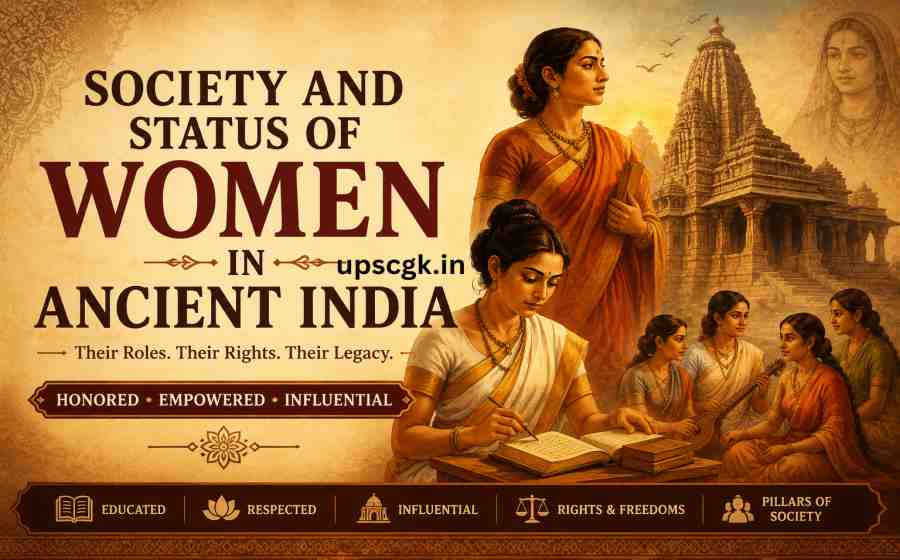
Explore the society and status of women in Ancient India, their education, rights, marriage, religion and changing position across different historical periods.
Society and Status of Women in Ancient India
The status of women in Ancient India has been a subject of great historical interest and scholarly debate. Contrary to the common perception that women always occupied a subordinate position, historical evidence reveals that their status varied significantly across different periods. In the early Vedic age, women enjoyed considerable respect, educational opportunities, and social freedom. However, over time, especially during the Later Vedic and post-Vedic periods, their position gradually declined due to changing social, religious, and economic factors.
Ancient Indian society was not static but evolved continuously. The roles, rights, and responsibilities of women changed according to political developments, religious practices, and social customs. Understanding the position of women in Ancient India provides valuable insight into the evolution of Indian civilization and its social institutions.
Table of Contents
Women in the Early Vedic Period
The Early Vedic Period (c. 1500–1000 BCE) is often regarded as the golden age for women in Ancient India. Women enjoyed a relatively high social status and participated actively in family, religious, and intellectual life.
Some important features of this period include:
- Women had access to education and studied the Vedas.
- They participated in religious ceremonies alongside men.
- Marriage generally took place after attaining maturity.
- Women could choose their husbands through practices like Swayamvara.
- Widow remarriage was socially acceptable.
- There was no widespread practice of child marriage or purdah.
Women scholars known as Brahmavadinis devoted themselves to learning and philosophy. Several women composed hymns found in the Rigveda, reflecting their intellectual contributions.
Education and Intellectual Contributions
Education was considered important for both men and women during the Vedic age. Girls from learned families underwent the Upanayana ceremony and studied religious texts, grammar, philosophy, music, and literature.
Some famous women scholars include:
- Gargi Vachaknavi – Renowned philosopher who participated in debates at King Janaka’s court.
- Maitreyi – Celebrated for her philosophical discussions with the sage Yajnavalkya.
- Lopamudra – Composer of Vedic hymns.
- Apala and Ghosha – Female sages credited with hymns in the Rigveda.
These examples demonstrate that women played an active role in shaping early Indian philosophical and literary traditions.
Role in Family and Society
The family formed the basic unit of Ancient Indian society, and women occupied an important position within it. They managed household affairs, raised children, and contributed to agricultural and domestic activities.
Women were regarded as:
- Partners in religious rituals.
- Caretakers of family traditions.
- Advisors in household matters.
- Contributors to the economic well-being of the family.
Ancient texts often describe the wife as the “Ardhangini” (better half), emphasizing her complementary role in family life.
Marriage and Family Life
Marriage was considered a sacred institution in Ancient India. Various forms of marriage existed, although some were regarded as more respectable than others.
The classical texts mention eight forms of marriage, including:
- Brahma Marriage – Considered the most respected form.
- Daiva Marriage
- Arsha Marriage
- Prajapatya Marriage
- Gandharva Marriage – Marriage based on mutual consent.
- Asura Marriage
- Rakshasa Marriage
- Paisacha Marriage – Considered the least acceptable.
During the Early Vedic period, women enjoyed greater freedom in choosing their life partners. Over time, arranged marriages became more common, and restrictions increased.
Property and Economic Rights
Women in Ancient India possessed certain property rights, though these varied across different periods.
The concept of Stridhana referred to the property received by a woman through gifts during marriage or from her parents and relatives. This property generally remained under her ownership.
In the Early Vedic age:
- Women could own personal property.
- They participated in agricultural and household production.
- Some women inherited property under specific circumstances.
However, inheritance rights gradually became more limited during later periods as patriarchal norms strengthened.
Religious Status of Women
Women occupied an important position in religious life during the Vedic period. They actively participated in rituals, sacrifices, and festivals alongside their husbands.
Several goddesses symbolized different aspects of knowledge, prosperity, and power:
- Saraswati – Goddess of learning.
- Lakshmi – Goddess of wealth and prosperity.
- Ushas – Goddess of dawn.
- Aditi – Mother of the gods.
The worship of powerful female deities reflected the high spiritual regard accorded to women in early Indian traditions.
Decline in the Status of Women During the Later Vedic Period
The Later Vedic Period (c. 1000–600 BCE) witnessed significant social changes that gradually reduced the status of women.
Major reasons for this decline included:
- Increasing importance of patriarchal family structures.
- Growth of private property and inheritance concerns.
- Rise of rigid social hierarchies.
- Greater influence of conservative religious interpretations.
As a result:
- Women’s access to formal education declined.
- Participation in religious rituals became restricted.
- Child marriage gradually became more common in later centuries.
- Widow remarriage became less acceptable in many communities.
- Women’s independence in choosing marriage partners decreased.
Although these changes were gradual and varied across regions, they marked a shift from the comparatively liberal Vedic society.
Women During the Age of Buddhism and Jainism
The rise of Buddhism and Jainism around the 6th century BCE created new opportunities for women.
Both religions allowed women to join monastic communities.
Notable examples include:
- Mahapajapati Gotami, the first Buddhist nun.
- Amrapali, who became a follower of the Buddha.
- Several Jain nuns who contributed to religious teachings.
Although certain restrictions remained, these religious movements provided women with greater opportunities for spiritual development beyond household life.
Women in Politics and Administration
Historical records mention several influential women who exercised political authority or provided important counsel.
Examples include:
- Queens participating in royal administration.
- Women serving as advisors to kings.
- Royal women performing diplomatic roles.
- Female patrons supporting education, temples, and charitable works.
While political leadership was largely dominated by men, women from royal families occasionally played significant administrative roles.
Occupations and Economic Activities
Women contributed to various occupations depending on their social background.
Common activities included:
- Agriculture
- Weaving and spinning
- Pottery
- Animal husbandry
- Trade assistance
- Music and dance
- Teaching and scholarship
These contributions formed an essential part of the ancient economy and household production.
Factors Influencing Women’s Status
Several factors shaped the changing position of women in Ancient India:
- Economic transformation from pastoral to agricultural society.
- Development of private property.
- Growth of caste-based social organization.
- Religious and legal interpretations.
- Political centralization.
- Evolution of family structures.
These influences collectively determined the opportunities and limitations experienced by women over different historical periods.
Legacy of Women in Ancient India
The legacy of women in Ancient India remains significant in Indian history. Female philosophers, poets, religious leaders, and queens made lasting contributions to literature, philosophy, governance, and spirituality.
The lives of Gargi, Maitreyi, Lopamudra, and other learned women continue to inspire discussions on gender equality and education. Their achievements demonstrate that women were active participants in shaping India’s intellectual and cultural heritage.
Summary
The status of women in Ancient India was dynamic rather than uniform. During the Early Vedic period, women enjoyed education, religious participation, property rights, and considerable social respect. However, the Later Vedic period witnessed a gradual decline in these freedoms due to changing social, economic, and religious developments. Despite these challenges, many women continued to contribute significantly to philosophy, literature, religion, politics, and society. Studying the society and status of women in Ancient India offers a deeper understanding of India’s evolving social structure and highlights the important role women played in building one of the world’s oldest civilizations.
Also Check: History