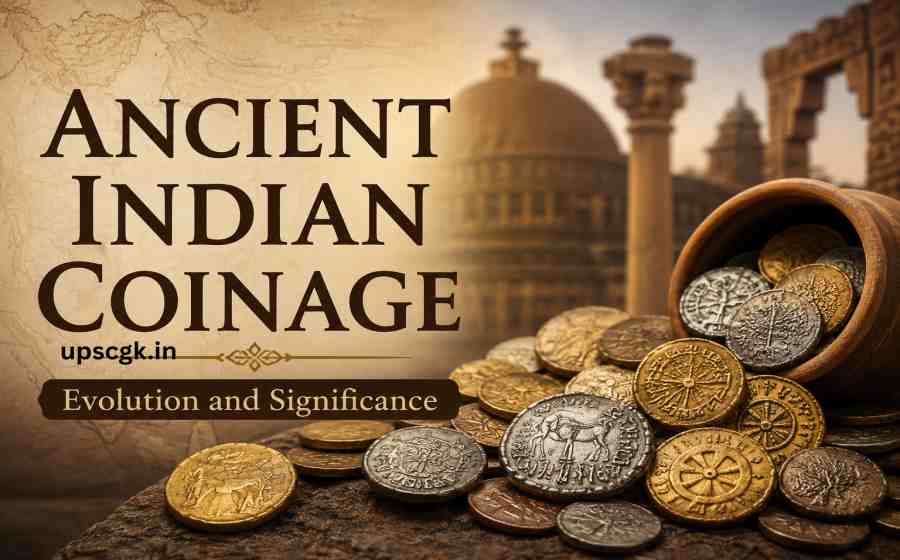
Explore the evolution of Ancient Indian coinage, its major types, dynasties, symbols and historical significance in trade, economy, politics and culture.
Ancient Indian Coinage
Coins are among the most valuable archaeological sources for understanding the history of ancient civilizations. In India, the evolution of coinage reflects the development of trade, political authority, economy, religion, and art over several centuries. Ancient Indian coins not only served as a medium of exchange but also acted as symbols of royal power and cultural identity. From the earliest punch-marked coins to the beautifully crafted gold coins of the Gupta Empire, Indian coinage witnessed remarkable changes in design, metal, and manufacturing techniques.
The study of ancient coins, known as Numismatics, plays a crucial role in reconstructing Indian history, especially for periods where literary evidence is limited.
Table of Contents
Beginning of Coinage in Ancient India
The earliest coins in India appeared around the 6th century BCE, during the period of the Mahajanapadas. Before the introduction of coins, trade was largely based on barter or the exchange of commodities. With the expansion of commerce, urbanization, and long-distance trade, a standardized medium of exchange became necessary.
These earliest coins are known as Punch-Marked Coins (PMC) because symbols were punched onto metal pieces using separate punches rather than engraved dies.
Punch-Marked Coins
Punch-marked coins are considered India’s oldest coins and were mainly made of silver, though copper examples also existed.
Features
- Irregular in shape and size.
- Usually made of silver.
- Carried multiple punched symbols instead of inscriptions.
- Did not bear the names or portraits of rulers.
- Issued by Mahajanapadas, merchants, guilds, and later by the Mauryan Empire.
Common Symbols
The symbols found on punch-marked coins included:
- Sun
- Trees
- Hills
- Animals
- Swastika
- Wheel
- Geometric figures
These symbols often represented political authority, religious beliefs, or administrative marks.
Mauryan Coinage
The Mauryan Empire (4th–2nd century BCE) standardized the punch-marked coin system across much of the Indian subcontinent.
The state controlled the minting process, ensuring uniformity in weight and purity. Silver Karshapanas became the principal currency. The Arthashastra of Kautilya mentions government officials responsible for minting and regulating coins, highlighting the importance of monetary administration in the Mauryan economy. Mauryan coins greatly facilitated trade, tax collection, and state administration.
Post-Mauryan Coinage
After the decline of the Mauryan Empire, many regional kingdoms introduced their own coinage. During this period, coins became more artistic and informative.
Indo-Greek Coins
The Indo-Greek rulers introduced several innovations.
Their coins featured:
- Portraits of kings.
- Names and titles of rulers.
- Greek and Kharosthi inscriptions.
- Images of Greek and Indian deities.
These coins reflected the fusion of Greek and Indian artistic traditions and provide valuable information about rulers and chronology.
Coins of the Shakas and Kushanas
The Shakas and Kushanas further advanced Indian coinage.
Kushana Coins
The Kushanas issued large numbers of gold coins, demonstrating the prosperity of their empire.
Their coins featured:
- Portraits of kings in royal attire.
- Greek, Iranian, and Indian gods.
- Bactrian inscriptions.
- High artistic quality.
King Kanishka’s coins are particularly famous for depicting deities belonging to multiple religious traditions, reflecting the empire’s cultural diversity.
Satavahana Coinage
The Satavahanas, who ruled the Deccan region, primarily issued coins made of lead, copper, and potin (an alloy).
Distinctive features included:
- Symbols such as ships, elephants, lions, and chaityas.
- Prakrit inscriptions written in Brahmi script.
- Regional artistic styles.
The ship symbol on several Satavahana coins indicates active maritime trade with Southeast Asia and the Roman Empire.
Gupta Coinage – The Golden Age of Indian Coins
The Gupta Empire (4th–6th century CE) produced some of the finest coins in ancient India. Their gold coins are renowned for their artistic excellence and historical value.
Characteristics
- High-quality gold.
- Detailed portraits of kings.
- Sanskrit inscriptions.
- Images depicting military victories, religious ceremonies, hunting, music, and horse sacrifices.
Samudragupta’s famous Lyrist Type coin portrays him playing a veena, showcasing not only his military achievements but also his patronage of music and culture.
Chandragupta II issued coins depicting him as a victorious warrior, reinforcing royal authority. The Gupta coins reveal the empire’s prosperity, political stability, and artistic achievements.
South Indian Coinage
Several South Indian dynasties also developed rich coinage traditions.
Cholas
The Cholas issued gold, silver, and copper coins featuring:
- Tiger emblem.
- Fish and bow symbols representing conquered kingdoms.
- Tamil and Nagari inscriptions.
Cheras
Chera coins frequently carried the bow and arrow emblem.
Pandyas
Pandya coins displayed the famous twin-fish symbol and reflected extensive trade with Sri Lanka and Southeast Asia.
These coins demonstrate the flourishing maritime trade of South India.
Metals Used in Ancient Indian Coins
Ancient Indian coins were produced using various metals depending on the period and economic conditions.
The major metals included:
- Silver
- Gold
- Copper
- Lead
- Bronze
- Potin (mixed alloy)
Gold coins generally symbolized wealth and imperial power, while copper and lead coins were widely used for everyday transactions.
Manufacturing Techniques
The techniques of coin production evolved over time.
Punch-Marking
Separate symbols were punched onto metal sheets.
Die-Striking
Images were engraved on dies and struck onto coins, producing detailed designs and inscriptions.
Casting
Some regional kingdoms used moulds to cast coins.
These technological improvements contributed to greater uniformity and artistic refinement.
Historical Significance of Ancient Indian Coins
Ancient coins are among the most reliable historical sources because they provide direct evidence from the period in which they were issued.
Political History
Coins help identify rulers, dynasties, royal titles, and territorial expansion. They often preserve the names of kings who are absent from literary sources.
Economic Development
The circulation of coins indicates the growth of markets, urban centers, taxation systems, and commercial activities.
Trade Relations
Roman gold coins discovered in southern India demonstrate extensive trade between India and the Roman Empire. Similarly, coins found along trade routes reveal commercial links with Central Asia and Southeast Asia.
Religious History
Coins depict Hindu, Buddhist, Jain, Greek, and Iranian deities, illustrating the religious diversity and tolerance of different periods.
Art and Culture
Ancient Indian coins showcase remarkable artistic achievements through detailed portraits, symbols, inscriptions, and decorative motifs. They reflect changing styles in sculpture, dress, ornaments, and royal iconography.
Chronology
Coins help historians establish accurate dates and reconstruct political sequences, especially when inscriptions or literary records are unavailable.
Importance of Numismatics
Numismatics is the scientific study of coins, currency, and medals. It has become an essential branch of historical research.
Numismatists study:
- Metal composition
- Weight standards
- Inscriptions
- Symbols
- Portraits
- Minting techniques
Their findings help historians understand ancient economies, political systems, trade networks, and cultural developments.
Summary
The evolution of ancient Indian coinage mirrors the broader development of Indian civilization. From the simple punch-marked coins of the Mahajanapadas to the magnificent gold coins of the Gupta Empire, each stage reflects advances in administration, trade, technology, and artistic expression. Coins served not only as instruments of commerce but also as powerful symbols of sovereignty, religion, and culture. Today, they remain one of the most dependable sources for reconstructing India’s ancient past, offering invaluable insights into its political history, economic prosperity, and rich cultural heritage.
Also Check: History