Explore Karl Marx’s ideas on class struggle, the state, capitalism and revolution and understand his lasting influence on political thought.
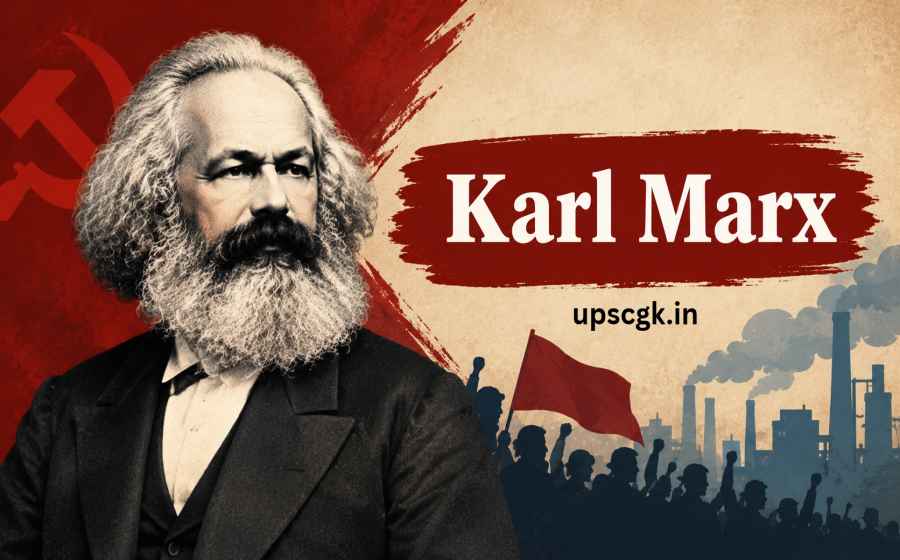
Karl Marx
Karl Marx (1818–1883) was a German philosopher, economist, historian and political thinker whose ideas profoundly influenced modern political theory, economics and social movements. Along with Friedrich Engels, he developed Marxism, a theoretical framework for understanding society through economic relations, class divisions and historical change.
Marx examined how the ownership of wealth and productive resources shapes social relationships and political power. His major works, including The Communist Manifesto (1848) and Das Kapital (Volume I, 1867), discuss capitalism, class conflict and the possibility of transforming society. Three central themes in his political thought are class struggle, the state and revolution.
Table of Contents
Class Struggle: The Foundation of Marxist Theory
Class struggle is one of the most important concepts in Marx’s understanding of history. He argued that societies are shaped by conflicts between social classes whose economic interests differ.
Under capitalism, Marx identified two principal classes:
- Bourgeoisie: The owners of factories, machinery, capital and other means of production.
- Proletariat: Workers who sell their labour power to earn wages because they generally do not own the productive resources they need to make a living.
According to Marx, these classes have conflicting interests. Business owners seek to maintain profits, while workers seek better wages, working conditions and control over their labour.
Marx believed that the capitalist system allows owners to appropriate surplus value—the value created by workers beyond the value represented by their wages and other production costs. He regarded this relationship as a central source of exploitation and class conflict.
Historical Materialism
Marx’s concept of historical materialism explains historical change through the development of productive forces and the economic relationships through which production takes place.
He analysed different historical forms of society, including ancient slave societies, feudalism and capitalism. In his view, contradictions within an economic system can produce social conflicts and contribute to its transformation.
Marx did not simply argue that every historical event results from economic factors alone. His broader framework emphasised the relationship between material conditions, social institutions, political struggles and ideas.
Marx’s Theory of the State
Marx viewed the state in relation to the economic structure and class divisions of society. He argued that political institutions, laws and government policies cannot always be understood separately from the distribution of economic power.
The State as an Instrument of Class Power
In The Communist Manifesto, Marx and Engels presented the modern state as closely connected to the interests of the capitalist class. From this perspective, the state may protect private property and maintain the economic arrangements that benefit those who own productive resources.
Marx’s approach challenged the idea that the state always acts as a completely neutral institution standing above competing social interests. However, his writings do not offer one simple, uniform explanation of every state. His analysis of particular historical situations also recognised that governments could possess some independence from individual capitalist groups.
The State in a Classless Society
Marx associated the long-term transformation of society with the end of class divisions. In his theoretical framework, if economic classes and their conflicting interests disappeared, the state as an instrument of class domination would eventually lose its traditional function.
This idea is often described as the withering away of the state, although the expression is particularly associated with Friedrich Engels and later Marxist interpretations. Marx did not provide a detailed institutional blueprint explaining exactly how a future classless society would govern itself.
Marx’s Theory of Revolution
Marx believed that capitalism contained contradictions that could generate economic crises, class conflict and pressure for social transformation. He regarded revolutionary change as a possible outcome of these tensions rather than simply a consequence of individual dissatisfaction.
Role of the Proletariat
Marx considered the working class central to the transformation of capitalist society. As workers recognised their shared economic interests and developed collective political organisation, they could challenge the existing distribution of economic and political power.
He distinguished, in effect, between workers who share similar economic conditions and a working class capable of organised political action. Collective awareness and organisation were therefore important to the revolutionary process.
Proletarian Revolution
Marx argued that a transition beyond capitalism would require the working class to challenge capitalist class power. In The Communist Manifesto, he and Engels called for workers to organise politically and outlined a programme aimed at transforming property relations.
Marx also discussed the dictatorship of the proletariat, meaning a transitional period in which the working class would hold political power during the movement away from capitalism. The term has subsequently received different interpretations and has been used by political movements in different ways.
Marx’s writings do not establish that every revolution must follow an identical path. His analysis of historical events, particularly in The Eighteenth Brumaire of Louis Bonaparte, demonstrates his attention to political institutions, class alliances and specific historical circumstances.
Communism as the Long-Term Goal
Marx envisioned a communist society in which class divisions and private ownership of the means of production would no longer structure economic life as they did under capitalism.
His ultimate objective was a society in which people could develop their abilities without being constrained by class exploitation. However, Marx deliberately left many details of the future society unspecified, rather than presenting a complete plan for its political and economic institutions.
Criticism and Influence of Marx’s Political Thought
Marx’s theories have influenced socialist parties, labour movements, revolutionary organisations and academic approaches to politics and economics. His analysis also contributed to debates about inequality, ownership, workers’ rights and the relationship between economic power and political institutions.
Nevertheless, his ideas have faced significant criticism.
- Economic emphasis: Critics argue that Marxist interpretations can give excessive importance to economic structures while underestimating culture, religion, nationalism and individual agency.
- Revolutionary predictions: Capitalist societies have developed reforms, welfare systems and democratic institutions in ways that complicate some predictions associated with classical Marxism.
- Political power: Governments established in the name of Marxism have followed different paths, and some developed authoritarian systems. The relationship between these historical regimes and Marx’s own writings remains a subject of debate.
These criticisms do not erase Marx’s influence, but they highlight why his ideas continue to be studied, questioned and interpreted differently.
Summary
Karl Marx’s political thought centres on the relationship between economic power, class struggle, the state and social transformation. He argued that class divisions shape political institutions and that conflicts within capitalism could create conditions for revolutionary change. His vision of a classless communist society offered a fundamental challenge to existing property relations and social hierarchies.
Although many of his arguments remain contested, Marx continues to influence discussions of inequality, labour, capitalism and political power. Studying his ideas provides a foundation for understanding Marxism and its enduring role in modern political theory.
Also Check: Political Science