Explore John Locke’s ideas on natural rights, consent and limited government and discover how his political philosophy shaped modern democracy.
John Locke
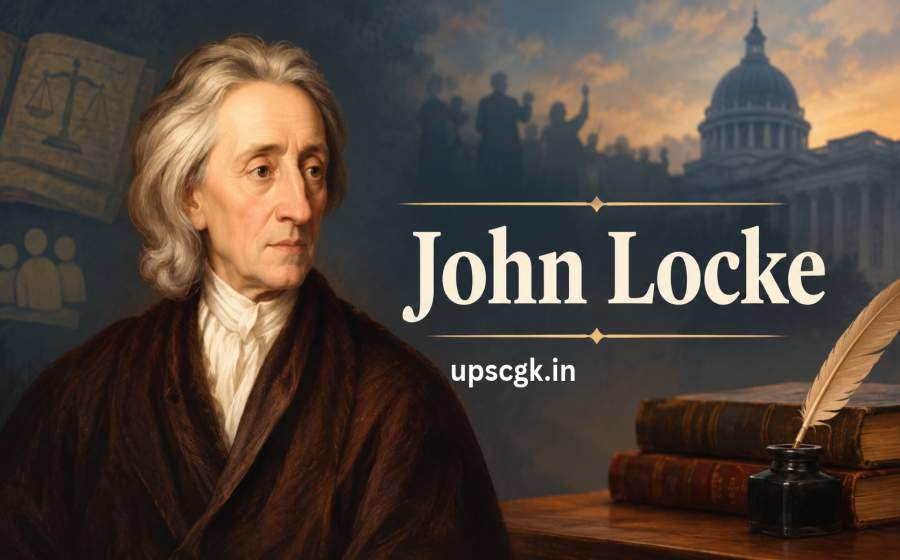
John Locke was one of the most influential political philosophers of the seventeenth century. Often regarded as a key thinker in the development of liberalism, he argued that individuals possess natural rights and that legitimate political authority depends on the consent of the governed. His ideas challenged the belief that kings had an unquestionable right to rule and helped establish the intellectual foundations of constitutional government, individual liberty, and modern democracy.
Locke presented his major political arguments in Two Treatises of Government, published in 1689, although the work is commonly dated 1690 in some editions. His political philosophy focuses on the protection of individual rights, the purpose of government, the limits of political power, and the people’s right to resist tyranny.
Table of Contents
Early Life and Intellectual Background
John Locke was born on 29 August 1632 in Wrington, Somerset, England. He studied at the University of Oxford and developed interests in philosophy, medicine, politics, and human understanding. He lived during a period of intense political and religious conflict in England, including disputes over royal authority and Parliament.
The English Civil Wars and the Glorious Revolution of 1688 influenced the political environment in which Locke developed his ideas. His writings supported the argument that political authority should be justified by the rights and interests of the people rather than by divine right or hereditary status alone.
Locke’s political thought became particularly important to the development of classical liberalism, constitutionalism, and representative government.
The State of Nature
The state of nature is a central concept in Locke’s political philosophy. It describes a hypothetical condition in which individuals live without an established political government.
According to Locke, people in the state of nature are naturally free and equal. They are not automatically subject to another person’s authority simply because of differences in wealth, strength, or social position.
However, Locke did not consider the state of nature a condition of complete lawlessness. Human beings are governed by the law of nature, which can be understood through reason. This law teaches that individuals should not harm others in their life, health, liberty, or possessions.
Despite this natural freedom, problems arise because there is no common, impartial authority to settle disputes consistently. Individuals may interpret natural law in their own favour or punish wrongdoing unfairly. These difficulties encourage people to establish a political society.
Natural Rights: Life, Liberty and Property
One of Locke’s most important contributions to political thought is his theory of natural rights. He argued that certain rights belong to individuals by nature and do not originate from government.
The three central interests commonly associated with his theory are:
- Life: Every individual has a right to preserve their own life and should not be subjected to arbitrary violence.
- Liberty: Individuals should enjoy freedom within the limits of natural law, without being placed under another person’s arbitrary control.
- Property: Individuals have a right to acquire and possess property under the principles Locke develops in his political writings.
Locke’s theory of property is particularly significant. He argued that people can establish a claim to resources by mixing their labour with what nature provides. However, his original account also included qualifications concerning waste and the availability of resources for others. His later discussion of money explains how the development of monetary exchange changed the accumulation of wealth.
For Locke, the main purpose of political society is to protect people’s rights more effectively. Government does not create these fundamental rights; rather, it is established to safeguard them.
Social Contract and Consent of the Governed
Locke’s theory of the social contract explains how political society is formed and why government has legitimate authority. He argued that individuals voluntarily agree to establish a political community to protect their natural rights and resolve disputes through established laws.
Unlike a system based on the divine right of kings, Locke’s theory places the source of political authority in the people. Government is not the natural master of individuals; it is an institution created to serve their common interests.
Consent is therefore essential to legitimate government. By agreeing to form a political community, individuals accept the authority of its institutions and the decisions made through the political system.
Locke also distinguished between the formation of a political community and the establishment of a particular government. Once people form a community, the majority generally has the authority to make collective decisions, because unanimous agreement on every matter would be impractical.
His theory of consent became an important foundation for democratic government, popular sovereignty, and the principle that rulers must be accountable to the people.
Limited Government and the Rule of Law
Locke believed that government must have sufficient authority to maintain order and protect rights, but its powers must not be unlimited. This idea is known as limited government.
According to Locke, political power is a trust granted by the people for specific purposes. Government cannot legitimately exercise arbitrary power or disregard the rights it was created to protect.
The main principles of limited government in Locke’s political theory include:
- Rule of law: Government must operate according to established laws rather than the arbitrary wishes of rulers.
- Protection of natural rights: Political institutions must safeguard life, liberty, and property.
- Restricted authority: Government may exercise only the powers entrusted to it for the public good.
- Accountability: Political authorities must remain answerable to the community whose interests they are supposed to serve.
Locke also argued that the legislature, although the supreme lawmaking authority within the political system, is not above the law of nature and cannot exercise unlimited power. Its authority is constrained by the purposes for which political society was established.
These ideas influenced later constitutional systems, in which written constitutions, legal safeguards, and institutional checks are used to prevent the misuse of political power.
Sovereignty and Separation of Powers
Locke’s understanding of sovereignty differs from the idea that a ruler possesses absolute and unquestionable authority. For him, ultimate political legitimacy rests with the people, while government institutions exercise powers entrusted to them.
In his Two Treatises of Government, Locke distinguished between legislative and executive powers and also discussed federative power, which concerns relations with other political communities, including war, peace, and diplomacy.
He considered legislative power the supreme governing power, but insisted that it must act within the limits of its trust. The executive implements the laws, while federative power handles external affairs. Locke recognised that these powers could be exercised by the same person or institution in practice, even though they perform different functions.
Locke’s ideas contributed to later discussions of the separation of powers. However, his framework should not be confused with the more fully developed system of separation among legislative, executive, and judicial branches associated with later political thinkers.
Right to Resist Tyranny
One of the most significant features of Locke’s political philosophy is the people’s right to resist a government that violates its trust.
Locke argued that when rulers systematically undermine natural rights, disregard the law, or attempt to place the people under arbitrary power, they breach the purpose for which government was established.
In such circumstances, the government loses its legitimate claim to obedience, and the people may resist or replace it. This is not simply a justification for opposing every unpopular decision. Locke’s argument concerns serious abuses that threaten the rights and political authority of the community.
This principle challenges absolute monarchy and supports the idea that rulers are accountable for their actions. It also influenced later arguments for constitutional government and resistance to oppressive political systems.
Influence on Modern Political Thought
Locke’s political philosophy had a lasting influence on liberalism, constitutionalism, and democratic movements. His emphasis on natural rights, consent, and limited government helped shape political debates during the Enlightenment.
His ideas are particularly associated with the American Revolution and the Declaration of Independence of 1776. The declaration’s language about equality and unalienable rights reflects themes closely connected to Locke’s philosophy, although the document also emerged from other intellectual and political traditions.
Locke’s legacy remains important in contemporary debates about individual freedom, the limits of state authority, property rights, constitutional safeguards, and democratic accountability.
Nevertheless, his theory has also attracted criticism. Scholars have questioned his account of property, the practical meaning of consent, and the historical exclusion of many people from political participation. Locke’s own society did not provide equal political rights to everyone, and his writings must be examined alongside these historical contradictions.
Summary
John Locke made a lasting contribution to political science by arguing that individuals possess natural rights and that government derives its legitimate authority from the consent of the governed. His defence of limited government, the rule of law, and the right to resist tyranny challenged absolute political authority and helped shape modern liberal thought.
Although aspects of his philosophy remain open to debate, Locke’s ideas continue to influence discussions about democracy, constitutional government, individual liberty, and the responsibilities of political institutions. His work remains essential for understanding the foundations of modern liberalism and the relationship between citizens and the state.
Also Check: Political Science