Explore Jeremy Bentham’s utilitarianism, greatest happiness principle, legal reforms and political philosophy, including key ideas, influence and criticism.
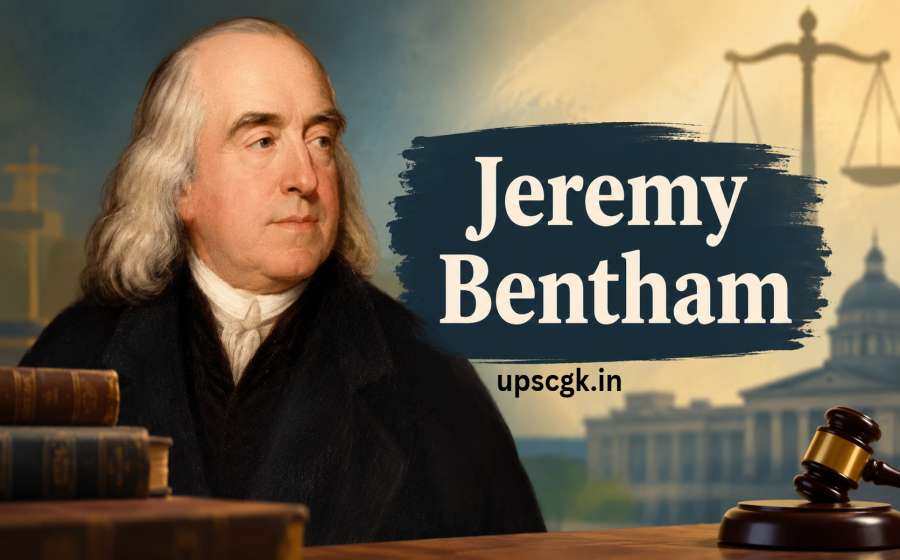
Jeremy Bentham
Jeremy Bentham (1748–1832) was an English philosopher, jurist and political reformer who played a major role in developing modern utilitarianism. His ideas influenced discussions on ethics, law, government, punishment and public policy. Bentham believed that laws and government institutions should be evaluated according to their effects on human happiness and suffering.
His central principle was that actions and laws should promote the greatest happiness of the greatest number. By applying this idea to political institutions and legal systems, Bentham challenged traditional practices and encouraged reforms based on reason, evidence and social welfare.
Table of Contents
Early Life and Major Works
Jeremy Bentham was born in London, England, on 15 February 1748. He studied at Oxford University and trained in law, but he became more interested in examining and reforming legal institutions than in practising as a lawyer.
Bentham criticised complicated legal procedures, outdated laws and punishments that caused unnecessary suffering. He argued that legal systems should serve society rather than preserve established privileges.
His important works include:
- A Fragment on Government (1776)
- An Introduction to the Principles of Morals and Legislation (1789)
- Constitutional Code (published in parts during the nineteenth century)
These writings established his reputation as an influential thinker in moral philosophy, jurisprudence and political theory.
What is Utilitarianism?
Utilitarianism is a moral and political philosophy that evaluates actions, laws and policies according to their consequences. In classical utilitarianism, pleasure and the avoidance of pain are central to determining whether something is beneficial.
Bentham developed a systematic approach to this philosophy. He argued that an action should be assessed by considering whether it increases happiness or produces suffering among the people affected by it.
For Bentham, the interests of every individual mattered. The happiness of one person should not automatically receive greater importance than the happiness of another simply because of their social position or status.
Utilitarianism therefore introduced a practical standard for evaluating decisions: consider their overall effects on human well-being.
The Greatest Happiness Principle
The greatest happiness principle is the foundation of Bentham’s philosophy. According to this principle, actions and government policies should aim to maximise overall happiness while reducing pain and suffering.
Bentham applied this idea to both personal conduct and public institutions. A law should not be considered good merely because it is old, traditional or supported by powerful groups. Its value should be judged by its consequences for society.
For example, a government policy that improves public health, reduces crime and expands access to education may be justified when its overall benefits outweigh its harmful effects.
However, this principle also raises an important question: can the happiness of a majority justify serious harm to a minority? This concern remains one of the major criticisms of utilitarian political thought.
The Principle of Utility and the Felicific Calculus
Bentham’s principle of utility provides a standard for judging actions according to their tendency to increase or diminish happiness.
He also proposed a method commonly known as the felicific calculus, or hedonic calculus, to assess the pleasures and pains associated with an action.
Bentham identified several considerations:
- Intensity: How strong is the pleasure or pain?
- Duration: How long will it last?
- Certainty: How likely is it to occur?
- Propinquity: How soon will it occur?
- Fecundity: Is it likely to produce further pleasure?
- Purity: Is it likely to remain free from pain?
- Extent: How many people will be affected?
These considerations were intended to make moral and political decisions more systematic. Although human happiness cannot be measured precisely in every situation, the approach encouraged decision-makers to examine consequences rather than rely only on tradition or personal preference.
Bentham’s Political Philosophy
1. Government and Public Welfare
Bentham believed that the primary purpose of government was to promote the welfare of the people. Political institutions should be judged by how effectively they protect security, support well-being and prevent avoidable suffering.
He rejected the idea that government arrangements were justified simply because they had existed for a long time. Instead, he favoured examining institutions critically and reforming those that failed to serve the public interest.
2. Democracy and Accountability
Bentham supported political reforms designed to make rulers more accountable to the people. He recognised that officials might pursue their own interests instead of the interests of society.
To reduce this problem, he advocated measures including broader political participation, secret ballots, frequent elections, public discussion and transparency in government.
He also emphasised the importance of a free press and public scrutiny. These mechanisms could help citizens examine government decisions and expose abuses of power.
3. Legal Reform and Codification
Legal reform was central to Bentham’s political philosophy. He criticised laws that were unnecessarily complicated, inconsistent or difficult for ordinary people to understand.
He supported clearer and more systematic legal codes, arguing that laws should be accessible, predictable and directed towards public welfare.
Bentham also challenged legal traditions that relied heavily on inherited authority. He wanted legislation to be assessed according to its practical consequences rather than accepted merely because of its historical origins.
4. Punishment and Criminal Justice
Bentham argued that punishment should serve a useful social purpose, such as preventing crime and protecting the public. Because punishment itself causes suffering, it should not be imposed without sufficient justification.
He opposed punishments that were unnecessary, excessive or ineffective. In his view, the severity of a penalty should be considered in relation to the harm caused by an offence and the expected benefits of preventing future offences.
His approach helped shape later discussions about proportional punishment, deterrence and criminal justice reform.
Bentham’s Panopticon
One of Bentham’s best-known proposals was the Panopticon, a prison design intended to allow a central observer to monitor inmates from a position where the observer might remain unseen.
The arrangement was intended to make supervision more efficient and potentially reduce the need for constant direct intervention. Bentham believed that its design could support institutional discipline while reducing administrative costs.
However, the Panopticon also became important in later debates about surveillance, privacy and the relationship between institutional power and individual freedom. The concept was subsequently examined by thinkers such as Michel Foucault.
Criticism of Bentham’s Utilitarianism
Despite its influence, Bentham’s philosophy has faced several criticisms.
First, the problem of minority rights: Maximising overall happiness may sometimes appear to justify policies that harm a smaller group. Critics argue that individual rights require protection even when violating them might benefit a majority.
Second, measuring happiness: Pleasure and suffering are difficult to compare accurately between individuals. Bentham’s calculus provides a framework for analysis, but it cannot eliminate every uncertainty in public decision-making.
Third, distribution of benefits: A policy may increase total happiness while distributing its benefits and burdens unfairly. Critics therefore question whether aggregate welfare alone provides a sufficient standard of justice.
Later utilitarian thinkers, particularly John Stuart Mill, developed modified approaches that addressed some of these concerns, including the distinction between different qualities of pleasure.
Influence and Legacy
Bentham’s ideas contributed to the development of utilitarian ethics, modern legal theory, public administration and debates about democratic accountability. His emphasis on evaluating policies through their consequences also anticipated important aspects of cost-benefit analysis and evidence-informed policymaking.
His influence extended to John Stuart Mill, who further developed utilitarian philosophy, and to later discussions of welfare, criminal justice and institutional reform.
Today, Bentham’s work remains relevant wherever governments must assess competing policy outcomes, reduce suffering, allocate public resources or balance collective welfare against individual rights.
Summary
Jeremy Bentham was a central figure in the development of modern utilitarianism and political philosophy. His greatest happiness principle offered a practical standard for evaluating laws, government institutions and public policies. Through his advocacy of legal reform, political accountability and purposeful punishment, he challenged traditional authority and encouraged a more systematic approach to social improvement.
Although questions about minority rights, fairness and the measurement of happiness remain unresolved, Bentham’s ideas continue to shape ethical and political debates about how institutions can best serve society.
Also Check: Political Science