Explore Machiavellis political thought, including power, statecraft, political realism, virtù, fortuna and the principles of effective leadership.
Machiavellis Political Thought
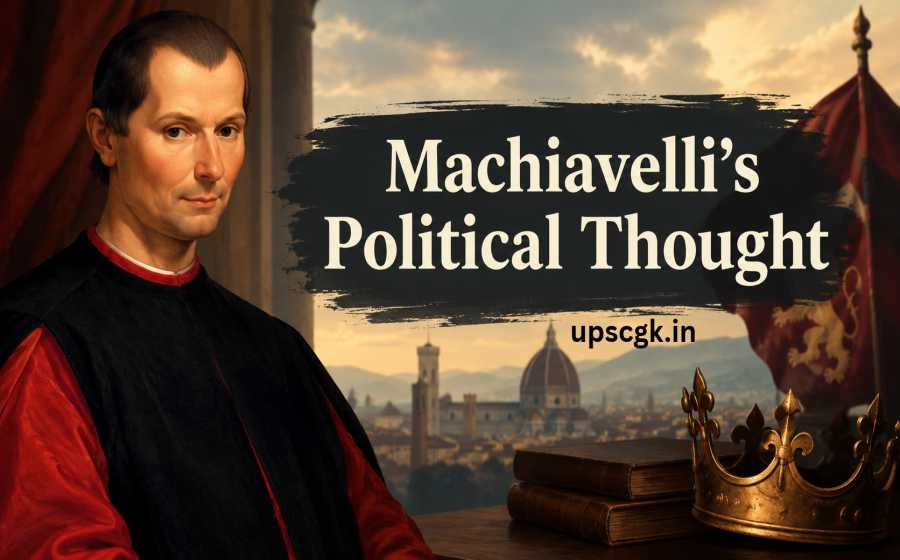
Niccolò Machiavelli (1469-1527) was an influential Italian political thinker whose ideas transformed the study of politics. Often regarded as a founder of modern political thought, Machiavelli examined how rulers acquire power, maintain authority, protect the state, and respond to political challenges. Unlike many earlier thinkers who focused primarily on ideal government and moral principles, he studied politics through practical experience, historical examples, and an assessment of human behaviour.
His most famous work, The Prince, written in 1513 and published posthumously in 1532, explores the methods through which rulers can establish and preserve political power. His other major work, Discourses on Livy, examines republican government, civic participation, political institutions, and the preservation of liberty. Together, these works reveal a thinker concerned not only with strong leadership but also with political stability and republican institutions.
Table of Contents
Historical Background of Machiavelli’s Political Thought
Machiavelli lived during the Italian Renaissance, a period of intellectual development, artistic achievement, and intense political competition. Italy was divided into several independent states, including Florence, Venice, Milan, Naples, and the Papal States. Foreign powers also intervened frequently in Italian affairs, creating instability and military insecurity.
Machiavelli served the Florentine Republic as a diplomat and government official from 1498. His diplomatic missions exposed him to European rulers, military strategies, and the realities of political negotiations. When the Medici family returned to power in Florence in 1512, he lost his official position and was later imprisoned and tortured on suspicion of conspiracy. During his subsequent retirement, he wrote many of his most important political works.
These experiences shaped his practical approach to politics. He believed that understanding political life required examining how governments actually functioned rather than relying exclusively on how they ought to function.
Political Realism: Politics as It Actually Exists
Political realism is one of the central features of Machiavelli’s thought. He argued that political leaders must understand the realities of power, conflict, ambition, and human behaviour.
In The Prince, Machiavelli distinguishes practical political judgement from the pursuit of an idealised image of a perfect ruler. A leader who follows every conventional moral expectation without considering political circumstances may fail to protect the state. Therefore, rulers must evaluate the consequences of their decisions and adapt their actions to changing situations.
This does not mean that Machiavelli simply rejected morality. Rather, he examined the tension between conventional morality and the responsibilities of political leadership. He recognised that actions considered morally questionable in ordinary life might be defended by rulers when necessary to prevent political collapse or protect the community.
His approach helped establish politics as a distinct field of inquiry, encouraging later thinkers to analyse political institutions, authority, and decision-making through practical observation.
Power and the Role of the State
For Machiavelli, maintaining a stable and independent state was a primary political objective. A ruler needed sufficient authority to defend the territory, preserve public order, and prevent internal divisions from destroying the government.
He placed particular importance on political unity and effective institutions. A weak state could become vulnerable to domestic conspiracies, factional conflict, and foreign intervention. Consequently, political leadership required the ability to make difficult decisions and respond decisively to threats.
Machiavelli also understood that power could not depend entirely on personal authority. Military organisation, political institutions, public confidence, and administrative effectiveness were important to the survival of a state.
His emphasis on state security and political stability influenced later discussions of sovereignty, national interest, and the relationship between power and government.
Virtù and Fortuna: The Qualities of Effective Leadership
Two important concepts in Machiavelli’s political thought are virtù and fortuna.
Virtù
Virtù refers to a ruler’s political capability, courage, intelligence, strategic judgement, adaptability, and capacity for decisive action. It does not simply mean moral virtue in the traditional religious sense. A ruler possessing virtù can recognise opportunities, anticipate dangers, and respond effectively to changing circumstances.
For Machiavelli, successful leadership requires practical wisdom rather than rigid adherence to a single method. A leader must know when to negotiate, when to act firmly, and when to change strategy.
Fortuna
Fortuna represents fortune, chance, and circumstances beyond an individual’s control. Political success depends partly on unpredictable events, but Machiavelli argues that capable leaders can prepare for uncertainty and take advantage of favourable opportunities.
The relationship between virtù and fortuna illustrates his understanding of politics: leaders cannot control everything, but preparation, courage, and adaptability can help them influence outcomes.
The Use of Force, Fear and Political Prudence
One of Machiavelli’s most debated arguments concerns whether it is better for a ruler to be loved or feared. In The Prince, he suggests that, if both cannot be achieved, being feared is generally safer than being loved. However, he explicitly warns rulers against becoming hated.
His reasoning is based on political reliability. Affection may weaken when circumstances change, while fear of punishment can provide a more predictable restraint on opposition. Nevertheless, excessive cruelty, confiscation of property, and arbitrary punishment can create resentment and encourage resistance.
Machiavelli also uses the images of the lion and the fox to describe effective leadership. The lion represents strength, while the fox represents cunning and the ability to recognise traps. A successful ruler needs both qualities: force alone cannot solve every political problem, and cleverness alone cannot overcome every threat.
His arguments are often associated with the expression “the ends justify the means.” However, this phrase is not a direct quotation from The Prince. It is a simplified interpretation of his discussion of political necessity, reputation, and the consequences of leadership decisions.
Military Strength and the Importance of Citizen Armies
Machiavelli believed that military organisation was essential to political independence. He criticised rulers who relied excessively on mercenaries because hired soldiers might lack loyalty, discipline, or a lasting commitment to the state.
In The Prince and The Art of War, he emphasised the importance of military preparedness and the relationship between a state’s security and its political institutions. He generally favoured forces drawn from the political community over dependence on unreliable mercenaries.
His argument was that a state unable to defend itself would struggle to preserve its independence. Military strength, in his view, had to be supported by sound leadership, organisation, and civic commitment.
Republicanism and Civic Liberty
Although The Prince is widely associated with princely rule, Machiavelli was also an important republican thinker. His Discourses on Livy examines the institutions and political practices of the Roman Republic.
He believed that republics could achieve strength and durability when citizens participated in public life, laws restrained individual ambition, and political institutions provided ways to manage conflict. Unlike thinkers who regarded political disagreement as necessarily destructive, Machiavelli recognised that competition between social groups could sometimes protect liberty when regulated by effective institutions.
He also emphasised civic virtue, public responsibility, and the willingness of citizens to defend their political community. His republican ideas demonstrate that his political philosophy cannot be reduced to advice for authoritarian rulers alone.
Machiavelli’s Influence and Criticism
Machiavelli influenced modern political thought by encouraging the systematic study of power, leadership, state security, and political institutions. His ideas remain relevant to discussions of diplomacy, political strategy, national interest, and crisis management.
However, critics argue that his emphasis on political necessity can provide a justification for deception, manipulation, and authoritarian conduct. His approach also raises difficult questions about whether political success can justify actions that violate moral principles.
Supporters of his analytical method point out that he exposed the dangers of ignoring political realities. His work invites readers to examine the consequences of leadership decisions rather than accepting political claims at face value.
Modern interpretations therefore distinguish between Machiavelli’s analysis of how rulers behave and the claim that every action taken in pursuit of power is acceptable.
Summary
Machiavelli’s political thought represents a major turning point in the history of political philosophy. Through his analysis of power, political realism, virtù, fortuna, military organisation, and republican government, he explored the challenges of establishing and maintaining an effective state.
His legacy is complex. He is remembered for examining the practical realities of political leadership, but his work also encourages debate about authority, ethics, liberty, and public responsibility. By studying both The Prince and Discourses on Livy, readers can gain a more balanced understanding of Machiavelli as a thinker concerned with political survival, institutional strength, and the conditions necessary for a stable political community.
Also Check: Political Science