Discover Jain Literature and Languages, Agamas, Prakrit, Ardhamagadhi, Sanskrit and regional contributions that shaped India’s literary and cultural heritage.
Jain Literature and Languages
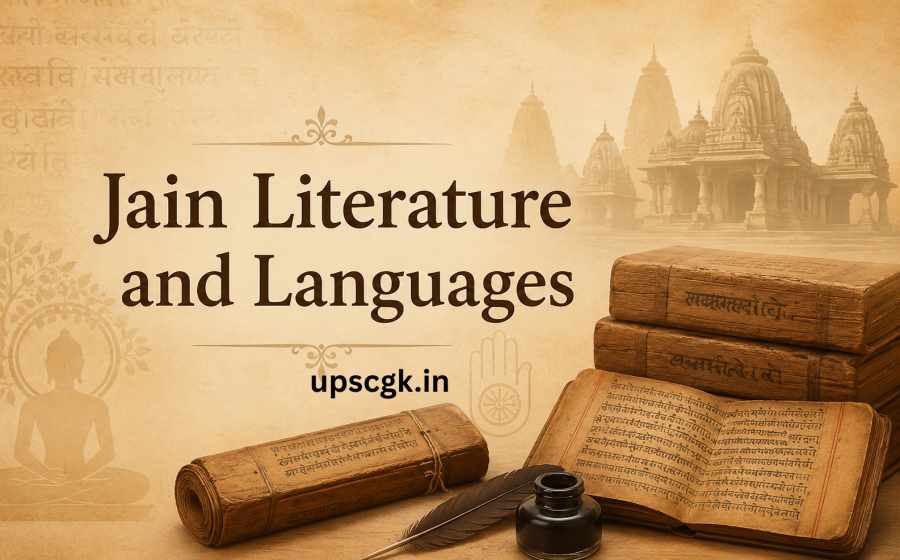
Jainism is one of the oldest religious traditions of India, emphasizing non-violence (Ahimsa), truth (Satya), non-possession (Aparigraha), and self-discipline. Along with its profound spiritual teachings, Jainism has made remarkable contributions to Indian literature, philosophy, linguistics, and cultural development. Jain literature is among the richest literary traditions in India, preserving religious doctrines, ethical teachings, historical accounts, grammar, poetry, and scientific knowledge.
The Jain literary tradition spans over two thousand years and has been composed in several languages, including Prakrit, Ardhamagadhi, Sanskrit, Apabhramsha, Kannada, Tamil, Gujarati, Hindi, and Rajasthani. These texts not only preserve Jain philosophy but also provide valuable insights into the political, social, and cultural history of ancient and medieval India.
Table of Contents
Origin of Jain Literature
Jain literature traces its origin to the teachings of Lord Mahavira, the 24th Tirthankara, who delivered his sermons in Ardhamagadhi Prakrit, the language commonly understood by ordinary people. His disciples, known as Ganadharas, memorized and transmitted these teachings orally for several centuries.
As time passed, Jain monks began compiling these teachings into written scriptures to preserve them accurately. This led to the formation of an extensive body of canonical and non-canonical literature.
The Jain Canon (Agamas)
The primary religious scriptures of Jainism are collectively known as the Agamas. These texts contain the teachings of Mahavira and form the foundation of Jain religious philosophy.
The Agamas mainly discuss:
- Moral and ethical principles
- Rules for monks and nuns
- Spiritual practices
- Karma and rebirth
- Meditation
- Cosmology
- Philosophy of liberation (Moksha)
Division of the Agamas
The Jain Agamas are traditionally classified into several categories:
1. Angas
The Angas are considered the principal scriptures. Traditionally, there were twelve Angas, though the last one, Drishtivada, is believed to have been lost over time.
The remaining Angas discuss subjects such as:
- Conduct of monks
- Religious philosophy
- Narratives of Mahavira
- Cosmology
- Ethics
2. Upangas
These are supplementary scriptures explaining various aspects of Jain doctrine, rituals, astronomy, geography, and cosmology.
3. Chedasutras
These texts prescribe rules regarding monastic discipline, conduct, and penalties for violations.
4. Mulasutras
They serve as introductory scriptures for novice monks and focus on ethical discipline and spiritual practices.
5. Prakirnakas and Chulikasutras
These works deal with diverse religious topics including meditation, devotion, rituals, and moral instructions.
Differences Between Digambara and Svetambara Traditions
The two major sects of Jainism differ regarding the authenticity of the original scriptures.
Svetambara Tradition
The Svetambaras believe that the Agamas have largely been preserved and continue to regard them as authoritative religious texts.
Digambara Tradition
The Digambaras believe that the original Agamas were lost over time. Consequently, they rely on later philosophical works composed by eminent Jain scholars such as Acharya Kundakunda, Acharya Samantabhadra, and Acharya Umasvati. This difference led to the development of two distinct yet closely related literary traditions.
Major Jain Literary Works
Apart from the Agamas, Jain scholars produced a vast collection of philosophical, historical, poetic, and scientific literature.
Some important works include:
Kalpa Sutra
One of the most revered Jain texts, the Kalpa Sutra contains:
- Biography of Mahavira
- Lives of earlier Tirthankaras
- Rules governing monks during the rainy season
It is especially recited during the Jain festival of Paryushana.
Tattvartha Sutra
Composed by Acharya Umasvati, this work is unique because it is accepted by both Digambara and Svetambara sects.
It systematically explains:
- Nature of the soul
- Karma theory
- Right faith
- Right knowledge
- Right conduct
- Liberation
It remains one of the most influential philosophical texts of Jainism.
Samayasara
Written by Acharya Kundakunda, this philosophical masterpiece explores the true nature of the soul and the path to liberation.
Niyamasara
Another important work of Kundakunda, it emphasizes spiritual discipline and ethical conduct.
Pravachanasara
This text elaborates upon Jain philosophy, meditation, and self-realization.
Languages Used in Jain Literature
One of the greatest contributions of Jainism is its promotion of regional and classical languages.
Ardhamagadhi Prakrit
This was the language used by Mahavira in delivering his sermons. Most early Jain scriptures were composed in Ardhamagadhi because it was widely understood by ordinary people.
Prakrit
Prakrit became the principal literary language of early Jainism.
Many canonical texts and religious commentaries were written in various Prakrit dialects.
Jain monks played a major role in preserving and standardizing Prakrit literature.
Sanskrit
From around the early centuries CE onward, Jain scholars increasingly adopted Sanskrit for philosophical and scholarly works.
Important Sanskrit authors include:
- Acharya Umasvati
- Hemachandra
- Haribhadra
- Akalanka
Their writings contributed significantly to Indian philosophy, grammar, logic, and ethics.
Apabhramsha
During the medieval period, Jain scholars extensively used Apabhramsha, which served as a transitional language between Prakrit and modern North Indian languages. Numerous poems, narratives, and devotional works were composed in this language.
Kannada
Jainism flourished in Karnataka under the patronage of various dynasties.
Prominent Kannada Jain writers include:
- Pampa
- Ranna
- Janna
Their literary works are regarded as classics of Kannada literature.
Tamil
Jain scholars significantly influenced early Tamil literature. Several important Tamil epics, including Civaka Cintamani, were composed by Jain authors and enriched the Tamil literary tradition.
Gujarati
Gujarat became a major center of Jain learning.
Acharya Hemachandra made extraordinary contributions to Gujarati grammar, literature, and lexicography.
Hindi and Rajasthani
In medieval North India, Jain scholars composed numerous devotional songs, biographies, and ethical works in Hindi and Rajasthani, making religious teachings accessible to common people.
Contribution to Indian Literature
Jain scholars enriched Indian literature in multiple fields:
- Philosophy
- Ethics
- Grammar
- Mathematics
- Astronomy
- Medicine
- Lexicography
- Poetry
- Biography
- History
Their works often reflected the ideals of non-violence, compassion, truthfulness, and peaceful coexistence. Jain monks also established libraries and manuscript collections, helping preserve countless ancient texts that might otherwise have been lost.
Contribution to Linguistics
Jain scholars played an essential role in the development of Indian linguistics. One of the greatest scholars was Acharya Hemachandra, whose grammar works influenced both Sanskrit and regional languages. His writings helped standardize Gujarati and contributed to the evolution of several Indo-Aryan languages.
Jain authors also produced dictionaries, commentaries, and grammar manuals that became valuable references for later scholars.
Historical Importance of Jain Literature
Jain literary works serve as valuable historical sources because they contain detailed descriptions of:
- Ancient kingdoms
- Trade routes
- Social customs
- Political institutions
- Religious practices
- Economic conditions
- Cultural life
Historians use these texts alongside Buddhist and Brahmanical sources to reconstruct India’s ancient history.
Legacy of Jain Literature
The literary heritage of Jainism continues to influence Indian culture, education, philosophy, and ethics. Jain manuscripts preserved in temples and libraries remain invaluable treasures of India’s intellectual history. Their emphasis on moral living, rational inquiry, and peaceful coexistence continues to inspire scholars and spiritual seekers worldwide.
The multilingual nature of Jain literature also demonstrates India’s rich linguistic diversity and highlights how religious traditions contributed to the development of regional languages and literary cultures.
Summary
Jain literature represents one of the most enduring and influential literary traditions in India. Beginning with the teachings of Lord Mahavira in Ardhamagadhi Prakrit and expanding into Sanskrit, Apabhramsha, Kannada, Tamil, Gujarati, Hindi, and several other languages, Jain scholars created an extraordinary body of religious, philosophical, and literary works. These texts not only preserve the principles of Jainism but also provide invaluable insights into India’s history, language, and culture. Through their dedication to knowledge, non-violence, and intellectual inquiry, Jain authors left a timeless legacy that continues to enrich Indian civilization and world literature.
Also Check: History