Understand equality in political science, its types, dimensions, constitutional basis and role in democracy, justice, liberty and social change.
Equality
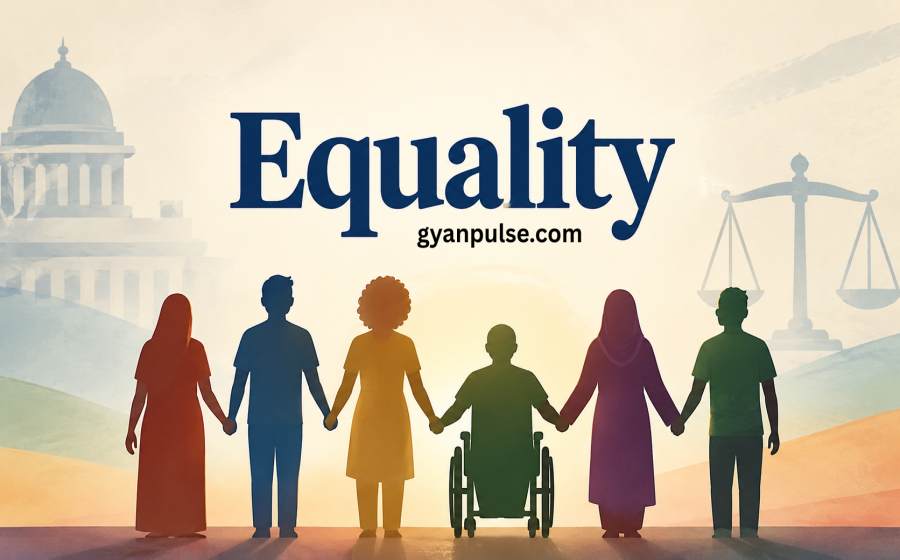
Equality is one of the central ideals of modern political thought and democratic government. It expresses the principle that every human being deserves equal moral worth, respect, rights and consideration. In political science, however, equality does not mean that every individual must be identical or receive exactly the same things. Rather, it concerns the removal of unjust privileges, discrimination and barriers while ensuring fair opportunities for all.
The idea of equality has been closely associated with democracy, liberty, justice and human dignity. Modern political systems seek to establish equality through constitutional rights, democratic participation, social reforms and public policies. At the same time, political thinkers continue to debate whether equality should primarily mean equal treatment, equal opportunity, equal resources or more equal outcomes.
Table of Contents
Meaning of Equality
Equality means the recognition that people should not be treated as inferior or superior merely because of characteristics such as caste, race, religion, gender, social background or place of birth.
Equality should be distinguished from uniformity. Human beings naturally differ in their abilities, interests, circumstances and choices. Therefore, equality does not require everyone to have the same occupation, income, talents or lifestyle.
Instead, political equality seeks to ensure that such differences do not become the basis for unjust discrimination or permanent privilege.
For example, giving every citizen the same legal protection represents formal equality. But if disadvantaged people face serious social or economic barriers, additional measures may be required to provide them with a genuinely fair opportunity. This is the basic distinction between formal and substantive approaches to equality.
Main Features of Equality
The concept of equality has several important features:
1. Absence of Special Privileges
Equality opposes hereditary or arbitrary privileges that allow one group to enjoy advantages simply because of birth or social position.
2. Equality Before Law
All individuals should be subject to the same legal framework, and no person should be above the law.
3. Equal Opportunity
Citizens should have a fair chance to develop their abilities and pursue education, employment and other opportunities.
4. Equal Political Rights
Democracy requires citizens to have equal political status and meaningful opportunities to participate in government.
5. Recognition of Human Dignity
Equality is closely connected with the idea that every individual deserves respect and should not be treated as inherently inferior.
Types and Dimensions of Equality
Equality can be understood through several interconnected dimensions.
1. Legal or Formal Equality
Formal equality means equality before the law and equal protection of the law. It requires laws to avoid arbitrary discrimination and to apply fairly to citizens.
In India, Article 14 of the Constitution guarantees equality before the law and equal protection of the laws. Articles 15 and 16 further address discrimination and equality of opportunity in important areas.
Formal equality is essential for the rule of law, but identical treatment alone may not eliminate inequalities that originate from historical or social disadvantages.
2. Political Equality
Political equality means that citizens possess equal political status and rights.
It includes principles such as:
- Equal citizenship
- Equal voting rights
- Equal political participation
- Equal opportunity to express political opinions
- Equal access to democratic institutions
Universal adult franchise is one of the most important expressions of political equality. Democracy becomes meaningful when citizens participate as political equals rather than as members of legally ranked social groups.
3. Social Equality
Social equality seeks to eliminate discrimination and unequal social status based on caste, religion, gender, race or other inherited characteristics.
A society cannot be considered genuinely equal when some communities are systematically excluded from education, employment, public spaces or social participation.
The Indian Constitution addresses social inequality through provisions including Article 15, which prohibits certain forms of discrimination, and Article 17, which abolishes untouchability.
4. Economic Equality
Economic equality concerns differences in income, wealth, property and access to basic economic resources.
It does not necessarily require every person to possess exactly the same income or property. Instead, it focuses on reducing extreme and unjust inequalities and ensuring access to basic necessities and opportunities.
Education, healthcare, employment opportunities and social security can therefore play an important role in promoting greater economic equality.
5. Equality of Opportunity
Equality of opportunity means that a person’s social background should not unfairly determine their chances of success.
For example, people should have fair access to education and employment regardless of caste, gender, religion or family background.
However, equal rules do not always produce equal opportunities. People who begin from significantly different social and economic positions may require supportive measures to compete fairly. This is why modern discussions of equality often distinguish between formal equality and substantive equality.
6. Substantive Equality
Substantive equality goes beyond simply applying identical rules to everyone. It recognises that historical discrimination, poverty and social exclusion can create unequal starting points.
Consequently, the state may adopt special measures to help disadvantaged groups overcome structural barriers.
In the Indian context, constitutional provisions permitting certain forms of affirmative action reflect the broader objective of achieving meaningful equality rather than merely identical treatment.
Equality and Justice
Equality has a close relationship with justice. A political system that grants extensive privileges to one group while denying basic rights to another is difficult to describe as just.
However, justice does not always require identical treatment. Treating people differently can sometimes promote equality when the differences in treatment are designed to correct genuine disadvantages.
This creates an important principle: equal treatment of equals and appropriate treatment of relevant differences.
The challenge for democratic governments is therefore to determine which differences justify differential treatment and which differences represent unjust discrimination.
Equality and Liberty
Equality and liberty are two fundamental values of political theory. At times, they may appear to conflict.
For example, unrestricted economic freedom can produce substantial differences in wealth. On the other hand, excessive state intervention in the name of economic equality may restrict certain individual choices.
Yet equality can also strengthen liberty. Extreme poverty, social discrimination and lack of educational opportunities can prevent individuals from exercising meaningful freedom.
Thus, modern democratic thought often views equality and liberty not simply as opposites but as values that can support one another when properly balanced.
Political Significance of Equality
Equality has major significance in political life.
Strengthens Democracy
Democracy depends on the political equality of citizens. The principle that every citizen has equal political status provides legitimacy to representative government.
Protects Human Rights
Equality helps ensure that fundamental rights are available without arbitrary discrimination.
Promotes Social Justice
Measures aimed at reducing caste, gender and economic inequalities can contribute to a more inclusive society.
Limits Arbitrary Power
Equality before law supports the rule of law by rejecting the idea that powerful individuals or privileged groups should receive special legal treatment.
Encourages Social Inclusion
Equality enables historically disadvantaged groups to participate more fully in education, employment, politics and public life.
Supports Human Dignity
When citizens are treated as equals, their individual worth and dignity receive recognition in public institutions.
Equality in the Indian Constitutional Framework
The Indian Constitution gives equality a central place in its vision of democracy and social justice.
The Preamble promises equality of status and opportunity. Fundamental Rights reinforce this commitment. Article 14 establishes equality before law and equal protection of laws; Article 15 prohibits specified forms of discrimination; Article 16 provides equality of opportunity in matters of public employment; Article 17 abolishes untouchability; and Article 18 addresses titles.
These provisions demonstrate that constitutional equality is not limited to a simple declaration that everyone is the same. It also involves confronting practices and institutions that produce systematic disadvantage.
Challenges to Achieving Equality
Despite constitutional and legal protections, achieving substantive equality remains difficult.
Economic disparities, social discrimination, unequal access to quality education, gender-based disadvantages and historical inequalities can continue to affect people’s opportunities.
Another challenge is determining the appropriate extent of state intervention. Policies designed to correct historical disadvantages may themselves generate debates about merit, fairness, duration and the allocation of limited resources.
Therefore, equality remains an ongoing political and social objective rather than a condition that can be achieved through one law or policy.
Summary
Equality is a foundational principle of political science and democratic government. It does not demand that every person be identical or receive exactly the same rewards. Instead, it seeks to ensure equal human worth, legal protection, political status and fair opportunities while addressing unjust social and economic barriers. The distinction between formal equality and substantive equality is particularly important. Equal treatment under law provides the foundation, but meaningful equality may require policies that address unequal starting conditions.
In a democracy, equality strengthens justice, liberty, human dignity and political participation. Its continuing importance lies in the effort to create a society in which differences among individuals do not become excuses for discrimination, exclusion or denial of basic rights.
Also Check: Political Science