Discover the Jorwe Culture, a major Chalcolithic tradition of the Deccan Plateau. Learn about its economy, pottery, tools, burial practices and significance.
Jorwe Culture
The Jorwe Culture was one of the most significant Chalcolithic (Copper Age) cultures of the Deccan Plateau in western India. It flourished between approximately 1400 BCE and 700 BCE, marking the final and most advanced phase of the Chalcolithic period in the region. Named after the archaeological site of Jorwe in present-day Ahmednagar district of Maharashtra, this culture represents an important stage in the evolution of settled agricultural communities before the emergence of the Iron Age.
The Jorwe people developed permanent villages, cultivated crops, domesticated animals, crafted distinctive pottery, and used both copper and stone tools. Their settlements reveal organized planning, storage facilities, and evidence of trade with neighboring regions. The culture provides valuable insights into the socio-economic and technological progress of prehistoric communities in peninsular India.
Table of Contents
Discovery and Geographical Distribution
The Jorwe Culture derives its name from the village of Jorwe in Maharashtra, where its characteristic pottery was first identified by archaeologists. Over time, excavations have revealed that this culture spread widely across the Deccan region.
Major Jorwe Culture sites include:
- Jorwe (Maharashtra)
- Inamgaon
- Daimabad
- Nevasa
- Prakash
- Chandoli
- Songaon
- Apegaon
Most settlements were located along river valleys such as the Godavari, Bhima, Pravara, and Tapi, which provided fertile land and a reliable water supply for agriculture.
Chronology
Archaeologists generally divide the Jorwe Culture into two phases:
Early Jorwe Phase (c. 1400–1000 BCE)
- Expansion of settlements
- Growth of agriculture
- Flourishing pottery production
- Stable village life
Late Jorwe Phase (c. 1000–700 BCE)
- Decline in settlement size
- Reduction in agricultural productivity
- Signs of environmental stress
- Eventual disappearance of many villages
The transition from the Early to Late phase reflects changing climatic conditions and economic challenges.
Settlement Pattern
The Jorwe people established permanent villages that were carefully planned.
Important features of their settlements included:
- Rectangular and circular houses
- Walls made of mud mixed with straw
- Floors plastered with clay
- Wooden posts supporting roofs
- Storage pits for grains
- Hearths used for cooking
- Open courtyards for domestic activities
The large settlement at Inamgaon indicates that some villages had administrative or regional importance.
Agriculture and Food Production
Agriculture formed the backbone of the Jorwe economy.
The main crops cultivated were:
- Wheat
- Barley
- Lentils
- Peas
- Horse gram
- Green gram
- Millets
Evidence suggests that farming depended on seasonal rainfall and river water.
The people stored surplus grain in underground pits, reflecting careful planning for periods of scarcity.
Animal Husbandry
Domesticated animals played a significant role in daily life.
Common animals included:
- Cattle
- Buffalo
- Sheep
- Goats
- Dogs
Animal bones recovered from excavation sites also indicate hunting of wild animals such as deer, antelope, and wild boar, supplementing their diet.
Fishing was another important occupation near river settlements.
Distinctive Jorwe Pottery
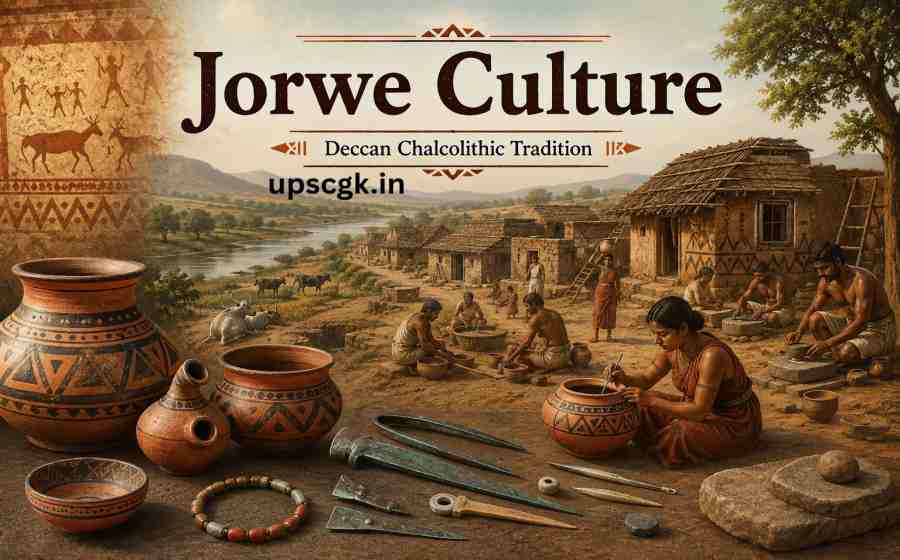
The hallmark of the Jorwe Culture is its beautiful painted pottery.
Its pottery is characterized by:
- Red or orange surface
- Black painted geometric designs
- Bowls with flared rims
- Spouted vessels
- Storage jars
- Decorative motifs of lines, triangles, dots, and zigzag patterns
The pottery reflects both artistic skill and practical utility. It remains the primary feature by which archaeologists identify Jorwe sites.
Tools and Technology
The Jorwe people used both copper and stone tools.
Copper tools included:
- Axes
- Chisels
- Fish hooks
- Needles
- Bangles
Stone tools continued to be widely used because copper remained relatively scarce.
Other tools included:
- Bone points
- Grinding stones
- Querns
- Pestles
This combination of copper and stone technology is a defining feature of the Chalcolithic Age.
Crafts and Trade
Craft production was well developed.
Archaeological findings include:
- Beads of semi-precious stones
- Terracotta figurines
- Shell ornaments
- Bone tools
- Copper ornaments
Trade networks connected Jorwe communities with neighboring regions.
Materials such as:
- Carnelian
- Agate
- Shells
- Copper
were obtained through exchange, indicating long-distance trade contacts.
Burial Practices
The burial customs of the Jorwe people reveal important aspects of their beliefs.
Common practices included:
- Pit burials
- Urn burials for children
- Extended burials
- Grave goods such as pottery and ornaments
Some burials were found within house floors, suggesting that ancestors may have held an important place in family life and rituals.
Religious Beliefs
Although no temples have been discovered, archaeological evidence points toward simple religious practices.
Terracotta figurines, particularly female figurines, suggest the possible worship of fertility or mother goddesses.
Fireplaces and ritual pits found in some settlements may have been used during ceremonial activities.
The people probably worshipped natural forces associated with agriculture, rainfall, and fertility.
Social Organization
The Jorwe society appears to have been organized into settled farming communities.
Evidence indicates:
- Family-based households
- Agricultural cooperation
- Specialized craftsmen
- Community grain storage
Larger settlements such as Inamgaon suggest the presence of village leadership or local administrative structures.
However, there is little evidence of sharp social inequalities compared to later historical societies.
Decline of the Jorwe Culture
The Jorwe Culture gradually declined around 700 BCE.
Several factors may have contributed to its decline:
- Climate change
- Reduced rainfall
- Agricultural failures
- Resource depletion
- Population migration
Many settlements were abandoned, while others became much smaller before disappearing completely.
Eventually, Iron Age cultures replaced the Chalcolithic communities across much of the Deccan Plateau.
Significance of the Jorwe Culture
The Jorwe Culture occupies a crucial place in Indian prehistory because it represents the most advanced Chalcolithic tradition of the Deccan region.
Its importance lies in:
- Development of permanent agricultural villages
- Efficient grain storage systems
- Advanced painted pottery
- Combined use of copper and stone tools
- Organized settlement planning
- Evidence of trade and craft specialization
- Transition toward later Iron Age societies
The discoveries at Inamgaon and other sites have greatly enhanced our understanding of prehistoric life in western India.
Summary
The Jorwe Culture stands as one of the finest examples of Chalcolithic civilization in the Deccan Plateau. Its well-planned villages, distinctive painted pottery, farming economy, copper technology, and organized social life illustrate the remarkable progress achieved by prehistoric communities long before the rise of historical kingdoms. Although environmental challenges eventually led to its decline, the archaeological remains of the Jorwe Culture continue to provide invaluable evidence about the evolution of agriculture, technology, and settled life in ancient India.
Also Check: History