Learn about Ashokas Dhamma, its principles, policies and impact on ancient Indian society, administration, religion and moral governance.
Ashokas Dhamma
Ashoka’s Dhamma was one of the most important moral and administrative policies introduced in ancient India. It was developed by Emperor Ashoka after the destructive Kalinga War during the Mauryan period. Deeply affected by the massive loss of life and human suffering, Ashoka changed his approach to kingship and governance. Instead of focusing only on military conquest, he adopted the path of peace, morality, and welfare for the people.
The term “Dhamma” was derived from the Sanskrit word “Dharma,” meaning righteousness, duty, or moral conduct. However, Ashoka’s Dhamma was not a religious doctrine limited to Buddhism. It was a universal moral code designed to promote harmony, compassion, discipline, and respect among people of all religions and communities.
Ashoka spread his ideas through inscriptions known as Rock Edicts and Pillar Edicts, which were written in simple language so that ordinary people could understand them. These inscriptions provide valuable information about his administration, ideals, and concern for humanity.
Table of Contents
Background of Ashoka’s Dhamma
The turning point in Ashoka’s life was the Kalinga War fought around 261 BCE. Although Ashoka won the war, the destruction caused by the conflict deeply disturbed him. According to his inscriptions, thousands of people were killed, injured, or displaced. This experience transformed Ashoka’s mindset.
After the war, Ashoka embraced Buddhism and decided to rule through moral values rather than violence. He declared that the true conquest was “Dhamma Vijaya” or conquest through righteousness. His goal was to create a peaceful and ethical society where people lived with mutual respect and compassion.
Main Principles of Ashoka’s Dhamma
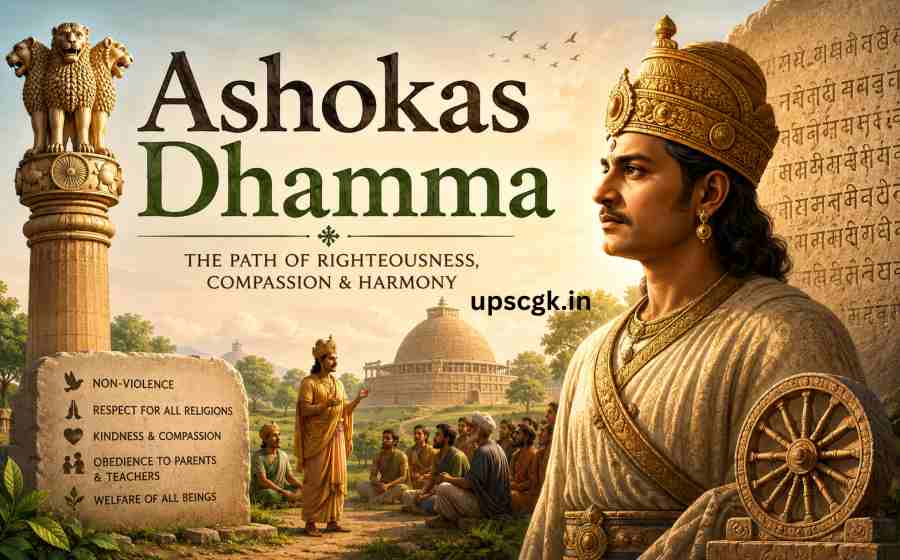
Ashoka’s Dhamma was based on practical moral values rather than rituals or sacrifices. Some of its major principles were:
1. Non-Violence (Ahimsa)
Ashoka strongly opposed unnecessary violence and killing. He discouraged animal sacrifices and reduced hunting activities in the royal court. Though he maintained the army for protection, he promoted peace as the ideal path.
2. Respect for All Religions
One of the most remarkable features of Ashoka’s Dhamma was religious tolerance. Ashoka believed that all religions deserved respect. He encouraged people to avoid criticizing other faiths and instead learn from each other’s good qualities.
This policy helped maintain harmony in a diverse empire with followers of Buddhism, Hinduism, Jainism, and other beliefs.
3. Obedience to Parents and Teachers
Ashoka emphasized the importance of family values and social discipline. He advised people to respect parents, elders, teachers, and religious leaders. According to him, moral behavior started from personal conduct.
4. Kindness and Compassion
Compassion toward humans and animals formed a key part of his policy. Ashoka encouraged charity, kindness, and care for servants, the poor, and the weak sections of society.
5. Truthfulness and Moral Living
Ashoka promoted honesty, purity of thought, and ethical living. He believed that a good citizen should practice self-control, gratitude, and truthfulness in daily life.
6. Welfare of the People
The welfare of subjects became an important responsibility of the state under Ashoka. He considered himself a father-like ruler responsible for the happiness of his people.
Policies Adopted to Spread Dhamma
Ashoka introduced several administrative and social measures to spread his Dhamma throughout the empire.
Rock and Pillar Edicts
Ashoka’s inscriptions were carved on rocks and pillars across different regions of the empire. These edicts informed people about moral values, duties, and the king’s policies. They are considered one of the earliest examples of public communication by a ruler.
Appointment of Dhamma Mahamatras
Ashoka appointed special officers known as “Dhamma Mahamatras.” Their duty was to promote moral values, look after public welfare, and ensure justice for all sections of society.
Public Welfare Activities
Ashoka focused greatly on welfare measures. He ordered the construction of roads, wells, rest houses, and hospitals for both humans and animals. Trees were planted along roads to provide shade for travelers.
Promotion of Buddhism
Although Ashoka respected all religions, he actively supported Buddhism. He sent missionaries to different regions including Sri Lanka, Central Asia, and Southeast Asia to spread Buddhist teachings. His son Mahendra and daughter Sanghamitra are believed to have played an important role in spreading Buddhism in Sri Lanka.
Impact of Ashoka’s Dhamma
Ashoka’s Dhamma had a significant influence on Indian society, politics, and culture.
Political Impact
Ashoka introduced the idea that a ruler should govern through morality and welfare rather than fear and violence. His administration became more humane and people-oriented. This concept of ethical kingship became an important legacy in Indian political thought.
Social Impact
The policy promoted social harmony and reduced religious conflicts. By encouraging respect for all religions and communities, Ashoka created an atmosphere of tolerance and unity within the empire.
Religious Impact
Ashoka played a major role in the spread of Buddhism beyond India. Due to his efforts, Buddhism became an international religion and spread across Asia. His support helped Buddhist art, architecture, and literature flourish.
Cultural Impact
The pillars, stupas, and inscriptions built during Ashoka’s reign became remarkable examples of Mauryan art and architecture. The famous Lion Capital of Sarnath, adopted today as the national emblem of India, reflects the cultural significance of his rule.
Criticism of Ashoka’s Dhamma
Some historians believe that Ashoka’s excessive emphasis on non-violence weakened the military strength of the Mauryan Empire. After his death, the empire gradually declined due to weak successors and administrative difficulties.
However, many scholars argue that the decline of the Mauryan Empire cannot be blamed solely on Ashoka’s peaceful policies. His contributions to governance, ethics, and human values remain highly respected in history.
Summary
Ashoka’s Dhamma was a unique attempt to establish moral governance in ancient India. It focused on peace, tolerance, compassion, and welfare rather than religious domination or military power. Through his policies and inscriptions, Ashoka tried to create a society based on ethical values and mutual respect.
Even today, Ashoka is remembered as one of the greatest rulers in Indian history because of his vision of humanity and peaceful governance. His Dhamma continues to inspire ideas of religious tolerance, social harmony, and responsible leadership across the world.
Also Check: History