Learn about Swami Dayanand Saraswati and Arya Samaj, their principles, social reforms, educational contributions and impact on modern India.
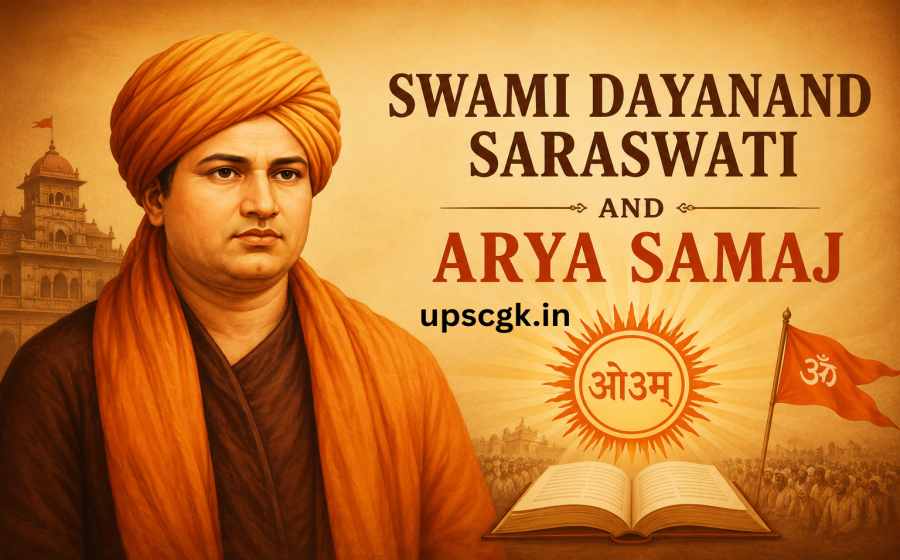
Swami Dayanand Saraswati and Arya Samaj
The nineteenth century witnessed several social and religious reform movements in India that aimed to remove social evils and revive Indian culture. Among these reformers, Swami Dayanand Saraswati emerged as one of the most influential figures. He founded the Arya Samaj in 1875 with the objective of promoting the teachings of the Vedas and reforming Hindu society. His ideas inspired millions of Indians and played a significant role in social, educational, and national awakening.
Table of Contents
Early Life of Swami Dayanand Saraswati
Swami Dayanand Saraswati was born as Mool Shankar Tiwari on 12 February 1824 in Tankara, a town in present-day Gujarat. He was born into a deeply religious Brahmin family. From an early age, he showed a keen interest in spiritual and religious matters.
A turning point in his life came when he questioned the practice of idol worship after observing a mouse climbing on a Shiva idol during a religious ceremony. This incident led him to search for the true meaning of religion. Leaving his home in pursuit of knowledge, he traveled across India and studied various religious philosophies.
Eventually, he became a disciple of Swami Virajananda in Mathura. Under his guidance, Dayanand mastered Sanskrit and Vedic literature. Virajananda inspired him to dedicate his life to spreading the teachings of the Vedas and eliminating ignorance from society.
Foundation of Arya Samaj
Swami Dayanand Saraswati founded the Arya Samaj on 10 April 1875 in Bombay (now Mumbai). The organization aimed to restore the authority of the Vedas and promote rational thinking in religious practices.
The term “Arya” means noble, and Arya Samaj sought to create a society based on truth, morality, and knowledge. The movement rejected superstitions and encouraged people to follow the original teachings of the Vedas.
Its motto was: “Krinvanto Vishwam Aryam” – “Make the whole world noble.”
Main Principles of Arya Samaj
Arya Samaj was based on ten fundamental principles that emphasized moral living, truth, and social welfare. Some of its key beliefs included:
- The Vedas are the supreme source of knowledge.
- God is one, formless, omnipotent, and eternal.
- Idol worship is not supported by the Vedas.
- Truth should always be accepted, and falsehood rejected.
- Education should be promoted for all.
- Society should work for the welfare of humanity.
- Social equality and justice should be encouraged.
- Individuals should develop physically, mentally, and spiritually.
These principles attracted many followers who sought religious reform without abandoning their cultural roots.
Social Reforms Introduced by Swami Dayanand
Swami Dayanand Saraswati strongly opposed several social evils prevalent in Indian society. His reform efforts focused on creating a more just and progressive society.
1. Opposition to Caste Discrimination
He criticized the rigid caste system based on birth. According to him, social status should depend on an individual’s qualities and actions rather than family background.
2. Promotion of Women’s Rights
Dayanand advocated education for women and supported their participation in society. He opposed practices that restricted women’s freedom and opportunities.
3. Support for Widow Remarriage
At a time when widows faced severe social restrictions, Arya Samaj promoted widow remarriage and worked for their upliftment.
4. Opposition to Child Marriage
He strongly condemned child marriage and emphasized that marriage should take place at a mature age.
5. Fight Against Superstitions
Arya Samaj encouraged logical thinking and challenged blind faith, rituals, and superstitious practices that had no basis in the Vedas.
Educational Contributions
One of the most lasting contributions of Arya Samaj was in the field of education. The movement believed that education was the key to social progress.
After Swami Dayanand’s death, his followers established numerous educational institutions across India. The most notable among them was the Dayanand Anglo-Vedic (DAV) movement, which combined modern education with Vedic values.
DAV schools and colleges played an important role in spreading education and producing educated citizens who contributed to India’s development. The movement also established Gurukul institutions, where students received education rooted in Indian traditions and culture.
The Shuddhi Movement
Arya Samaj initiated the Shuddhi Movement, which aimed to bring back individuals who had converted to other religions into the Hindu fold. The movement emphasized cultural identity and sought to strengthen Hindu society.
The Shuddhi campaign became one of the significant activities of Arya Samaj during the late nineteenth and early twentieth centuries.
Literary Contributions
Swami Dayanand Saraswati was a prolific writer. His most famous work was “Satyarth Prakash” (The Light of Truth). In this book, he explained Vedic philosophy and criticized practices that he considered irrational or harmful.
The book became highly influential and remains one of the most important texts associated with Arya Samaj. It inspired social reformers and nationalists across India.
Impact on Indian Nationalism
Although Arya Samaj was primarily a religious and social reform movement, it also contributed to the rise of Indian nationalism. By promoting pride in India’s ancient heritage and encouraging self-confidence, it helped create a spirit of national awakening.
Many prominent freedom fighters and leaders were influenced by Arya Samaj ideals. The movement emphasized self-reliance, education, and social unity, which later became important themes in India’s struggle for independence.
Death and Legacy
Swami Dayanand Saraswati passed away on 30 October 1883 in Ajmer. Despite his relatively short life, his influence continued to grow after his death.
Today, Arya Samaj remains an active organization with branches across India and abroad. Its educational institutions, social reform initiatives, and commitment to Vedic principles continue to shape society.
Swami Dayanand is remembered as one of the greatest reformers of modern India. His efforts to eliminate social evils, promote education, and revive Vedic values left a lasting mark on Indian history.
Summary
Swami Dayanand Saraswati and Arya Samaj played a transformative role in nineteenth-century India. By advocating a return to Vedic teachings, promoting education, supporting women’s rights, and fighting social discrimination, they helped modernize Indian society while preserving its cultural heritage. The movement’s contributions to social reform, education, and national consciousness make it a landmark chapter in Indian history. Even today, the ideals of truth, equality, and knowledge championed by Swami Dayanand continue to inspire generations.
Also Check: History