Learn about Swami Vivekananda and Ramakrishna Mission, their teachings, social service, spiritual vision and lasting impact on modern India.
Swami Vivekananda and Ramakrishna Mission
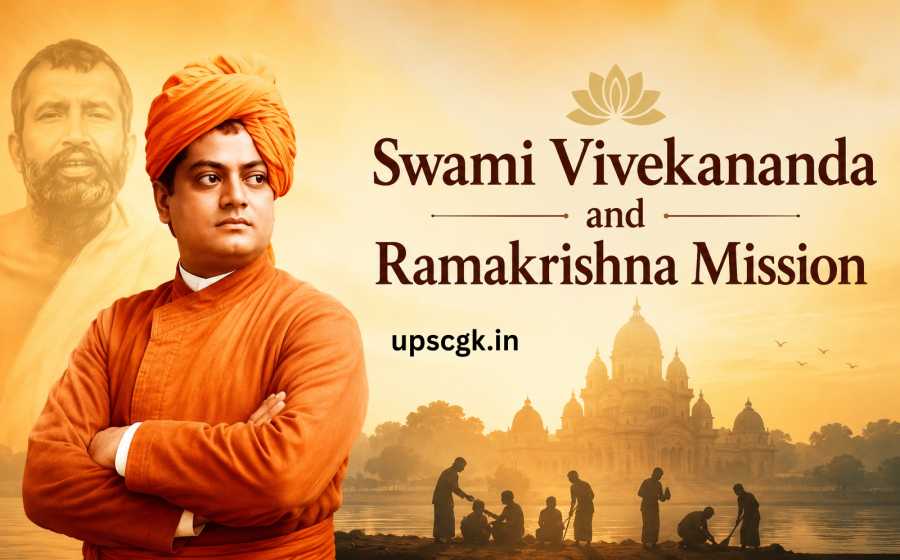
The nineteenth century was a period of social, religious, and cultural transformation in India. During this time, several reformers emerged to address social evils and revive the spiritual strength of the nation. Among them, Swami Vivekananda stands as one of the most influential figures in modern Indian history. Through his teachings and the establishment of the Ramakrishna Mission, he inspired millions of people to combine spirituality with social service. His message of self-confidence, universal brotherhood, and national pride continues to influence people across the world.
Table of Contents
Early Life of Swami Vivekananda
Swami Vivekananda was born as Narendranath Datta on January 12, 1863, in Kolkata. He belonged to a well-educated family and showed exceptional intelligence from a young age. He was deeply interested in philosophy, religion, music, and physical fitness. During his youth, he questioned traditional beliefs and sought answers about the existence of God.
His search for spiritual truth led him to meet Ramakrishna Paramahamsa, a saint of Dakshineswar. Ramakrishna became his spiritual guide and profoundly influenced his life. Under his guidance, Narendranath experienced spiritual realization and eventually became known as Swami Vivekananda.
Influence of Ramakrishna Paramahamsa
Ramakrishna taught that all religions lead to the same ultimate truth. He emphasized devotion, love, and direct experience of God rather than mere rituals. His teachings promoted religious harmony and tolerance.
Swami Vivekananda absorbed these ideas and later presented them to the world in a modern and practical form. After Ramakrishna’s death in 1886, Vivekananda and his fellow disciples dedicated themselves to spreading his teachings and serving humanity.
Chicago Parliament of Religions, 1893
One of the most significant events in Vivekananda’s life was his participation in the World’s Parliament of Religions held in Chicago, USA, in 1893.
On September 11, 1893, he began his speech with the famous words, “Sisters and Brothers of America.” His message of religious tolerance, universal acceptance, and human unity received a standing ovation from the audience.
Through his speeches, Vivekananda introduced the philosophy of Vedanta and the spiritual heritage of India to the Western world. He challenged misconceptions about Indian culture and earned global respect for Indian civilization.
Establishment of Ramakrishna Mission
In 1897, Swami Vivekananda founded the Ramakrishna Mission in Kolkata. The mission was established to spread the teachings of Ramakrishna and to promote social service as a form of worship.
The motto of the mission is: “Atmano Mokshartham Jagat Hitaya Cha”
This means “For one’s own salvation and for the welfare of the world.”
The mission combined spiritual development with practical service, making it unique among religious organizations of its time.
Objectives of Ramakrishna Mission
The main objectives of the Ramakrishna Mission include:
- Promoting spiritual and moral values.
- Providing education to all sections of society.
- Offering medical and healthcare services.
- Conducting relief work during natural disasters.
- Encouraging religious harmony and mutual respect.
- Uplifting the poor and disadvantaged sections of society.
These objectives reflected Vivekananda’s belief that serving humanity is equivalent to serving God.
Teachings of Swami Vivekananda
1. Service to Humanity
Vivekananda believed that God resides in every human being. Therefore, helping the poor, sick, and needy is the highest form of worship.
2. Universal Brotherhood
He emphasized unity among all religions and communities. According to him, different religions are different paths leading to the same destination.
3. Self-Confidence and Strength
One of his most famous messages was that people should have faith in themselves. He encouraged youth to develop physical, mental, and spiritual strength.
4. Importance of Education
Vivekananda viewed education as a tool for character building and personality development. He believed education should empower individuals and help them become self-reliant.
5. Nationalism and Patriotism
He inspired Indians to take pride in their cultural heritage. His ideas contributed significantly to the growth of Indian nationalism during the freedom struggle.
Social and Educational Contributions
The Ramakrishna Mission established schools, colleges, libraries, hospitals, and charitable institutions across India and abroad. These institutions focus on both academic excellence and moral values.
The mission has also played a crucial role in disaster relief operations during floods, earthquakes, cyclones, and other emergencies. Its humanitarian work has earned widespread respect.
In the field of education, the mission has promoted scientific thinking along with spiritual values. It aims to create responsible citizens who contribute positively to society.
Impact on Indian Nationalism
Swami Vivekananda’s ideas deeply influenced many leaders of India’s independence movement. His emphasis on self-respect, courage, and service inspired generations of freedom fighters.
Leaders such as Subhas Chandra Bose, Aurobindo Ghose, and Mahatma Gandhi admired his vision and teachings. His message helped Indians overcome feelings of inferiority under colonial rule and encouraged them to work for national regeneration.
Legacy of Swami Vivekananda
Swami Vivekananda passed away on July 4, 1902, at the age of only 39. Despite his short life, his impact remains immense. His birthday, January 12, is celebrated in India as the National Youth Day to honor his contribution to youth development and nation-building.
Today, the Ramakrishna Mission operates numerous educational, medical, and social service institutions worldwide. Vivekananda’s teachings continue to inspire people to pursue knowledge, strength, compassion, and service.
Summary
Swami Vivekananda was not only a spiritual leader but also a visionary reformer who connected spirituality with practical action. Through the Ramakrishna Mission, he transformed the idea of religion into a force for social welfare and national progress. His message of self-confidence, religious harmony, and service to humanity remains relevant in the modern world. The Ramakrishna Mission continues to carry forward his ideals, making a lasting contribution to society and ensuring that his vision of a strong, compassionate, and enlightened humanity lives on.
Also Check: History