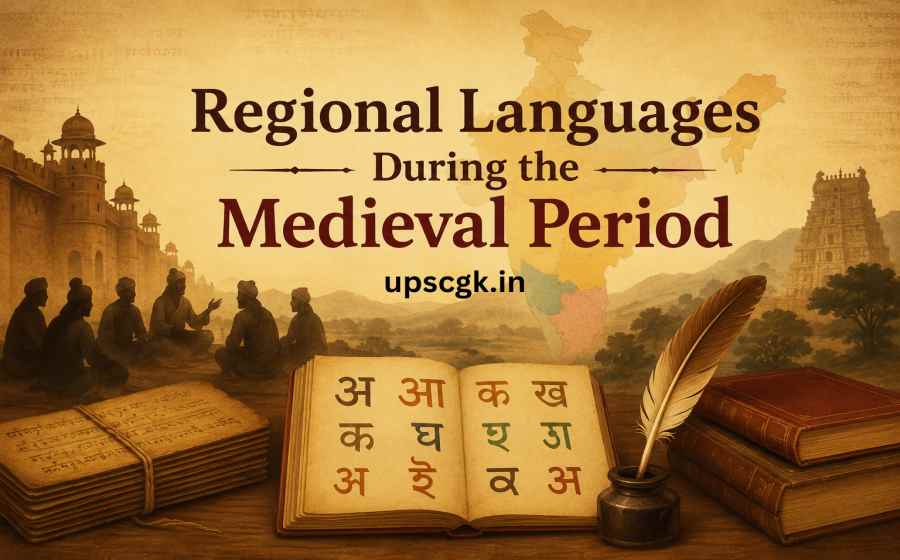
Explore the rise of regional languages during the medieval period in India, their literary development, Bhakti and Sufi influence and cultural significance.
Regional Languages During the Medieval Period
The medieval period in Indian history, spanning roughly from the 8th to the 18th century CE, witnessed remarkable cultural, religious, and linguistic transformations. One of the most significant developments of this era was the emergence and growth of regional languages, often referred to as vernacular languages. While Sanskrit continued to enjoy prestige as the language of religion and scholarship, regional languages gradually became the preferred medium for literature, administration, and communication among ordinary people.
The spread of regional languages was closely associated with the Bhakti Movement, the Sufi tradition, the patronage of regional kingdoms, and the rise of local identities. These languages not only enriched Indian literature but also strengthened cultural unity by making religious teachings and literary works accessible to the masses.
Table of Contents
Background: From Sanskrit to Regional Languages
During ancient India, Sanskrit was the dominant language of religious texts, philosophy, and higher learning. Prakrit and Pali were also widely used, particularly in Buddhist and Jain literature.
However, by the medieval period, social and political changes encouraged the development of local languages. As powerful regional kingdoms emerged across India, rulers promoted the languages spoken by their people. This resulted in the flourishing of languages such as Hindi, Bengali, Marathi, Gujarati, Tamil, Telugu, Kannada, Malayalam, Assamese, Odia, and Punjabi.
These languages gradually developed their own grammar, scripts, and literary traditions, laying the foundation for modern Indian languages.
Factors Responsible for the Growth of Regional Languages
1. Bhakti Movement
The Bhakti saints believed that religious teachings should reach ordinary people rather than remain confined to scholars.
Saints such as Kabir, Tulsidas, Surdas, Mirabai, Namdev, Tukaram, and Chaitanya Mahaprabhu composed devotional songs and poems in regional languages. Their simple style helped millions understand spiritual ideas without the need for Sanskrit.
The Bhakti Movement played a crucial role in popularizing vernacular literature across India.
2. Influence of Sufi Saints
Sufi saints emphasized love, equality, and devotion to God. They often preached in the local languages spoken by common people instead of using only Persian or Arabic.
Their teachings promoted harmony among different communities and enriched regional literary traditions through poetry, songs, and storytelling.
3. Patronage of Regional Kingdoms
Several medieval rulers encouraged literature in local languages by supporting poets and scholars.
For example:
- The Vijayanagara Empire promoted Telugu and Kannada literature.
- The Chola and Pandya rulers supported Tamil literature.
- The Eastern Ganga rulers encouraged Odia literature.
- The Ahom Kingdom contributed to the growth of Assamese literature.
Royal patronage enabled writers to compose epics, dramas, devotional works, and historical accounts in regional languages.
4. Growth of Local Identity
As regional kingdoms expanded, people increasingly identified themselves through their language and culture.
This led to greater demand for literature in local languages, making them symbols of regional pride and cultural heritage.
Major Regional Languages and Their Development
Hindi
Hindi emerged from various Apabhramsha dialects during the medieval period.
Its literary development was greatly influenced by Bhakti poets such as:
- Kabir
- Tulsidas
- Surdas
- Ravidas
Tulsidas’s Ramcharitmanas, written in Awadhi, became one of the most influential devotional works in Indian history.
Bengali
Bengali literature flourished under the influence of the Vaishnava Bhakti Movement.
Chaitanya Mahaprabhu inspired numerous devotional compositions celebrating Lord Krishna. The Mangalkavyas also became an important literary tradition in Bengal.
Marathi
Marathi developed into an important literary language through the works of saints such as:
- Dnyaneshwar
- Namdev
- Eknath
- Tukaram
Dnyaneshwar’s Dnyaneshwari, a commentary on the Bhagavad Gita, made philosophical teachings accessible to ordinary people.
Gujarati
Gujarati literature expanded through the devotional works of saints like Narsinh Mehta.
His poems promoted devotion, compassion, and equality, influencing generations of devotees.
Tamil
Tamil already possessed a rich literary tradition before the medieval period. During medieval times, Shaiva and Vaishnava saints enriched Tamil literature through devotional hymns.
Temple inscriptions and religious literature further strengthened the language.
Telugu
Telugu experienced a golden age under the Vijayanagara rulers.
Great poets such as Srinatha and Allasani Peddana composed celebrated literary works. Telugu came to be known as the “Italian of the East” due to its melodious nature.
Kannada
Kannada literature flourished under the patronage of the Western Chalukyas, Hoysalas, and Vijayanagara rulers.
Jain scholars, Virashaiva saints, and court poets produced numerous literary masterpieces covering religion, philosophy, and history.
Malayalam
Malayalam gradually evolved from Tamil and established itself as an independent language during the medieval period.
Literary works reflected Kerala’s unique culture, temple traditions, and devotional practices.
Odia
Odia literature developed rapidly with works like Sarala Das’s Mahabharata, which brought the epic to common readers in their own language.
Assamese
Assamese literature flourished under the guidance of the saint-scholar Srimanta Sankardeva.
His devotional dramas, songs, and literary works promoted Vaishnavism and cultural unity in Assam.
Punjabi
Guru Nanak and the Sikh Gurus contributed immensely to Punjabi literature.
Their hymns, later compiled in the Guru Granth Sahib, became foundational texts for Sikhism while enriching Punjabi language and literature.
Influence of Persian and Arabic
The establishment of the Delhi Sultanate and the Mughal Empire introduced Persian as the official language of administration. Interaction between Persian-speaking rulers and local populations led to the exchange of vocabulary and literary styles. Over time, this cultural interaction contributed to the development of Urdu, which combined elements of Persian, Arabic, Turkish, and local Indian languages. Urdu poetry, prose, and music later became an important part of India’s cultural heritage.
Impact on Indian Society
The growth of regional languages transformed medieval Indian society in several ways.
- Religious knowledge became accessible to common people.
- Literacy and education expanded beyond elite groups.
- Local cultures and traditions were preserved through literature.
- Regional identities became stronger.
- Poetry, music, drama, and folklore flourished across different regions.
- Social reform messages spread more effectively through vernacular languages.
- Linguistic diversity strengthened India’s composite cultural heritage.
Legacy of Medieval Regional Languages
The literary traditions established during the medieval period continue to influence modern India. Many medieval works remain central to school education, religious practices, performing arts, and cultural celebrations.
Modern Indian languages derive much of their vocabulary, grammar, and literary richness from these medieval developments. The Constitution of India recognizes many of these languages, reflecting their enduring significance.
The medieval period thus laid the foundation for India’s vibrant multilingual identity, where diverse languages coexist while contributing to a shared cultural heritage.
Summary
The rise of regional languages during the medieval period marked a turning point in Indian history. Supported by the Bhakti and Sufi movements, regional rulers, and local communities, these languages became powerful instruments of literature, devotion, education, and cultural expression. They helped bridge the gap between scholars and ordinary people, preserving India’s diverse traditions while fostering unity through accessible communication. Their rich literary legacy continues to shape India’s linguistic and cultural landscape, making the medieval era one of the most influential periods in the evolution of Indian regional languages.
Also Check: History