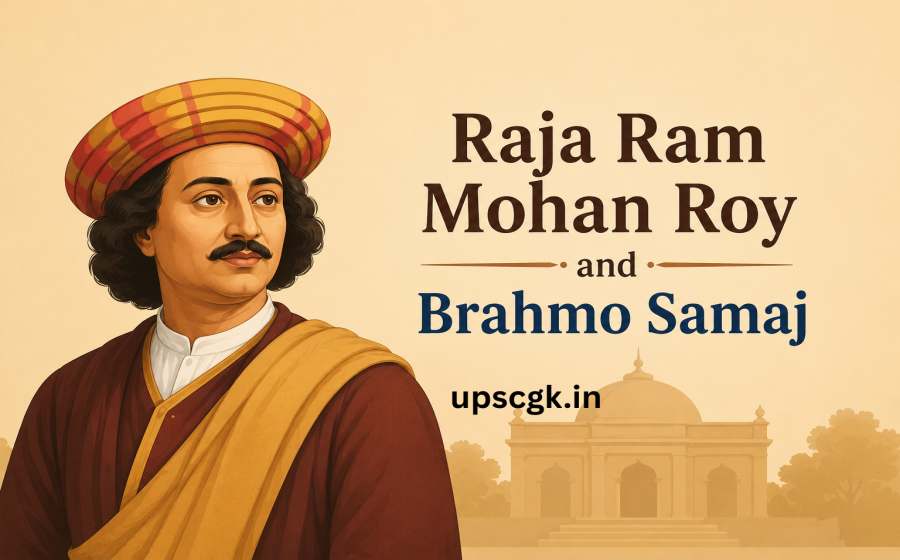
Learn about Raja Ram Mohan Roy and Brahmo Samaj, their role in social and religious reforms, abolition of Sati and contribution to modern India.
Raja Ram Mohan Roy and Brahmo Samaj
Raja Ram Mohan Roy is widely regarded as the “Father of Modern India” because of his remarkable contribution to social, religious, and educational reforms during the early nineteenth century. At a time when Indian society was burdened with social evils, religious superstitions, and rigid customs, he emerged as a powerful voice for change. His efforts laid the foundation for the Indian Renaissance and inspired future reformers across the country.
One of his most significant achievements was the establishment of the Brahmo Samaj, a reform movement that sought to purify Hinduism and promote rational thinking, social equality, and religious tolerance. Through his work, Raja Ram Mohan Roy played a crucial role in shaping modern Indian society.
Table of Contents
Early Life of Raja Ram Mohan Roy
Raja Ram Mohan Roy was born on 22 May 1772 in Radhanagar village of Bengal. He belonged to a respected Brahmin family and received a broad education that included Sanskrit, Persian, Arabic, and later English. His deep knowledge of different religions and philosophies helped him develop a rational outlook toward social and religious practices.
From a young age, he questioned blind faith, idol worship, and various social customs that he believed were harmful to society. His exposure to diverse cultures and ideas encouraged him to advocate for reform and modernization.
Social Conditions in India During His Time
The Indian society of the early nineteenth century faced several challenges. Many social practices had become deeply rooted and were accepted without question. Some of the major problems included:
- Sati system, where widows were forced to burn themselves on their husbands’ funeral pyres.
- Child marriage.
- Polygamy.
- Denial of education to women.
- Caste discrimination.
- Religious superstitions and blind rituals.
Raja Ram Mohan Roy believed that these practices were not essential parts of religion and that society could progress only through reform and education.
Campaign Against the Sati System
One of the most important contributions of Raja Ram Mohan Roy was his fight against the Sati system. He strongly opposed the practice and argued that it had no true basis in Hindu scriptures.
Through writings, public debates, and petitions, he raised awareness about the cruelty of Sati. His persistent efforts influenced the British administration, particularly Governor-General Lord William Bentinck.
As a result, the practice of Sati was officially abolished in 1829 through a legal regulation. This was a landmark achievement in the history of social reform in India and marked a significant step toward women’s rights.
Establishment of Brahmo Samaj
In 1828, Raja Ram Mohan Roy founded the Brahmo Samaj in Calcutta. The organization aimed to reform Hindu society and promote a more rational and ethical approach to religion.
The Brahmo Samaj emphasized the worship of one God and rejected idol worship, meaningless rituals, and priestly domination. It encouraged people to focus on morality, truth, and social responsibility. The movement attracted educated Indians who sought a balance between traditional values and modern ideas.
Principles of Brahmo Samaj
The Brahmo Samaj was based on several important principles:
1. Monotheism
The movement believed in one supreme God and rejected the worship of multiple deities and idols.
2. Opposition to Idol Worship
It encouraged direct worship of God without elaborate rituals or intermediaries.
3. Rational Thinking
The Brahmo Samaj promoted reason and critical thinking in matters of religion and society.
4. Social Equality
It opposed caste discrimination and supported equal treatment of all individuals.
5. Religious Tolerance
The organization respected the teachings of different religions and encouraged harmony among communities.
6. Women’s Rights
It supported female education, widow remarriage, and the improvement of women’s social status.
Educational Reforms
Raja Ram Mohan Roy strongly believed that education was the key to national progress. He supported the introduction of modern scientific and English education in India.
He helped establish educational institutions and advocated the study of subjects such as mathematics, science, philosophy, and literature. He felt that traditional education alone could not prepare Indians for the challenges of the modern world. His educational vision contributed significantly to the development of modern learning in India.
Contribution to Journalism
Raja Ram Mohan Roy was also a pioneer of Indian journalism. He used newspapers and journals as tools to spread awareness and encourage public discussion on important issues.
Some of the publications associated with him included:
- Sambad Kaumudi (Bengali)
- Mirat-ul-Akbar (Persian)
Through these publications, he promoted social reforms, freedom of expression, and political awareness among Indians.
Influence on Indian Renaissance
The ideas of Raja Ram Mohan Roy initiated a broader intellectual and cultural awakening known as the Indian Renaissance. His emphasis on reason, education, social justice, and religious reform inspired many later reformers.
Leaders such as Ishwar Chandra Vidyasagar, Keshab Chandra Sen, and Swami Vivekananda were influenced by the reformist spirit that he helped create. His work encouraged Indians to question outdated customs while preserving the positive aspects of their cultural heritage.
Legacy of Raja Ram Mohan Roy
Raja Ram Mohan Roy passed away in 1833 in Bristol, England. However, his ideas continue to influence Indian society even today.
He is remembered for:
- Abolishing the Sati system.
- Promoting women’s rights.
- Supporting modern education.
- Encouraging religious reform.
- Fighting social inequalities.
- Laying the foundation of the Indian Renaissance.
His vision of a progressive, educated, and inclusive society remains relevant in modern India.
Summary
Raja Ram Mohan Roy was one of the greatest social reformers in Indian history. Through his courageous efforts, he challenged harmful traditions and promoted rational thinking, education, and social justice. The establishment of the Brahmo Samaj marked the beginning of organized social and religious reform movements in India. His contributions not only transformed nineteenth-century Indian society but also paved the way for the modernization and progress of the nation. His legacy continues to inspire generations in the pursuit of equality, knowledge, and human dignity.
Also Check: History