Learn about the Mughal Economy and the Zabt System, Akbar’s land revenue policy that strengthened administration, agriculture and imperial finances.
Mughal Economy
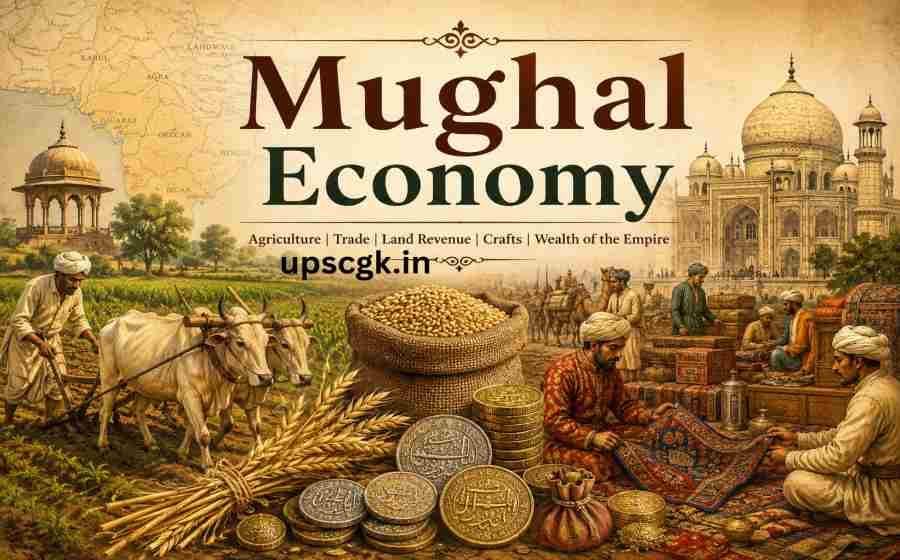
The Mughal Empire developed one of the most organized economic systems in medieval India. Agriculture was the backbone of the Mughal economy because a large section of the population depended on farming for survival. The state collected revenue mainly from agricultural land, making land taxes the most important source of income for the empire. To ensure regular and systematic revenue collection, the Mughal rulers introduced several methods, among which the Zabt System became the most famous and effective.
The Zabt System was introduced and developed during the reign of Akbar under the guidance of his finance minister Raja Todar Mal. It aimed to create a fair and efficient method for assessing and collecting land revenue. The system brought stability to the empire’s economy and became a significant factor in Mughal administrative success.
Table of Contents
Importance of Agriculture in the Mughal Economy
The Mughal economy was primarily agrarian in nature. Agriculture provided employment to most people and supplied raw materials for trade and industries. Crops such as wheat, rice, barley, sugarcane, cotton, and indigo were cultivated in different regions according to climatic conditions.
Since agriculture formed the basis of economic activity, the Mughal government paid close attention to land management and taxation. The state needed sufficient income to maintain the army, administrative machinery, construction activities, and royal expenses. Therefore, an efficient land revenue system became essential.
The prosperity of the empire depended heavily upon agricultural production. When crop yields increased, government revenue also increased, resulting in economic growth.
Introduction of the Zabt System
The System of Zabt was introduced as part of Akbar’s administrative reforms in the late sixteenth century. Earlier revenue collection methods often depended on local officials and varied from region to region, leading to corruption and inconsistency.
To solve these issues, Akbar and Raja Todar Mal designed a more scientific and organized system. The objective was to determine land revenue based on actual agricultural production rather than arbitrary assessments.
Under this system, detailed surveys and measurements of agricultural land were conducted. Officials recorded the area under cultivation and calculated the average productivity of the land.
The system was mainly implemented in regions where agricultural conditions remained relatively stable, especially in northern India.
Main Features of the Zabt System
1. Measurement of Land
One of the most important features of the Zabt System was proper land measurement. Agricultural land was measured using standardized units.
Officials used a measuring device called “Jarib,” which was usually made of bamboo joined with iron rings. Standard measurements reduced confusion and improved accuracy.
Land measurement helped the government estimate the area available for cultivation and determine tax rates more effectively.
2. Classification of Land
Land under cultivation was divided into categories according to fertility and productivity.
The common classifications included:
Polaj: Land cultivated regularly without interruption.
Parauti: Land left uncultivated temporarily to regain fertility.
Chachar: Land left uncultivated for several years.
Banjar: Barren or uncultivated land.
This classification allowed officials to estimate expected production and decide revenue rates more accurately.
3. Calculation of Average Produce
The government calculated average crop production by examining agricultural data over a period of ten years.
Officials determined the average yield and market prices of crops during this period. Revenue demand was then fixed based on these averages.
This process reduced sudden changes in taxation and created stability for both farmers and the administration.
4. Cash Revenue Collection
Instead of collecting taxes in the form of crops, the Mughal administration generally preferred cash payments.
The value of agricultural produce was converted into money according to prevailing market prices.
Cash collection benefited the government because it made administration easier and provided funds directly for state expenditures.
Role of Raja Todar Mal
Raja Todar Mal played a crucial role in designing and implementing the land revenue system. His administrative skills and financial knowledge contributed significantly to Mughal economic development.
He introduced systematic surveys and standardized measurement techniques. His reforms minimized irregularities in tax collection and improved administrative efficiency.
Because of his contributions, Todar Mal is often remembered as one of the greatest finance administrators in Indian history.
Advantages of the Zabt System
The Zabt System offered several benefits to the Mughal administration:
- It created a uniform taxation method.
- It reduced corruption among local officials.
- It provided stable revenue for the empire.
- It increased government control over administration.
- It helped farmers understand tax obligations clearly.
The system also strengthened central authority because the emperor could directly supervise revenue collection.
Limitations of the Zabt System
Despite its advantages, the system had certain limitations.
Revenue demands were sometimes high and difficult for peasants to pay, especially during poor harvests. Farmers often suffered during droughts and natural disasters.
The system also required extensive surveys and record-keeping, making administration expensive and time-consuming.
In regions with changing agricultural patterns, accurate assessment became difficult.
Summary
The Zabt System represented one of the most advanced land revenue systems of medieval India. Introduced under Akbar and organized by Raja Todar Mal, it improved the efficiency of revenue collection and strengthened the Mughal economy. Since agriculture was the foundation of economic life, a systematic land taxation policy became essential for maintaining the empire.
Although certain weaknesses existed, the Zabt System contributed greatly to the financial stability and administrative strength of the Mughal Empire. It remains an important topic in Indian history because it demonstrates how effective governance and economic planning supported one of the largest empires in the Indian subcontinent.
Also Check: History