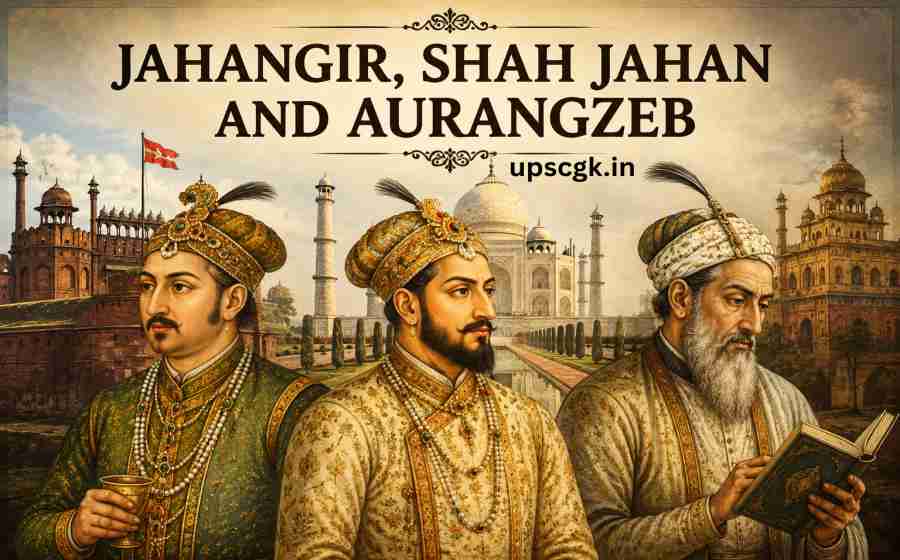
Explore Jahangir, Shah Jahan and Aurangzeb, their rule, policies, administration, religious views and impact on the Mughal Empire in India.
Jahangir, Shah Jahan and Aurangzeb
The Mughal Empire reached its height of political power, administrative strength, and cultural influence under some of its most important rulers. Among them, Jahangir, Shah Jahan, and Aurangzeb played significant roles in shaping medieval Indian history. Each emperor had a different personality, style of governance, and political vision. Their reigns affected administration, religion, economy, culture, and the future of the Mughal Empire.
While Jahangir continued many of Akbar’s policies, Shah Jahan focused on architectural excellence and imperial glory, whereas Aurangzeb introduced stricter religious policies and concentrated heavily on territorial expansion. Their combined rule had a lasting impact on Indian history.
Table of Contents
Jahangir: Rule and Policies (1605–1627)
Jahangir, whose original name was Salim, was the son of Emperor Akbar. He ascended the throne in 1605 after Akbar’s death. Jahangir inherited a strong empire and continued many of the administrative systems created by his father.
Jahangir was known for his interest in justice, art, and nature. He was an educated ruler and maintained detailed records of his reign through his autobiography known as Tuzuk-i-Jahangiri.
Major Policies of Jahangir
1. Policy of Justice
Jahangir became famous for his emphasis on justice. He established a “Chain of Justice” outside his palace. Any citizen who faced injustice could pull the chain to directly seek the emperor’s attention. This system reflected his desire to be seen as a fair ruler.
2. Continuation of Akbar’s Administration
Rather than changing the existing system drastically, Jahangir maintained Akbar’s administrative structure. The Mansabdari system and revenue arrangements remained largely unchanged.
3. Religious Policy
Jahangir followed a relatively tolerant religious approach compared to later rulers. However, he occasionally took actions against certain groups due to political reasons. His relationship with different religious communities remained mostly balanced.
4. Promotion of Arts
The Mughal school of painting reached a new level under Jahangir. He had a deep interest in paintings and encouraged artists to create realistic works involving nature, animals, and human portraits.
5. Foreign Relations
European traders, including the British, increased their influence during Jahangir’s reign. The English East India Company received permission to establish trading centers in India, which later influenced Indian history significantly.
Despite his achievements, Jahangir’s reign was also affected by palace politics and the increasing influence of his wife Nur Jahan in administrative matters.
Shah Jahan: Rule and Policies (1628-1658)
After Jahangir, Shah Jahan became emperor in 1628. He is remembered as one of the greatest Mughal rulers due to the prosperity and architectural achievements of his period. His reign is often considered the golden age of Mughal architecture.
Shah Jahan strengthened central authority and aimed to increase the prestige of the Mughal Empire.
Major Policies of Shah Jahan
1. Strong Central Administration
Shah Jahan followed a highly centralized administrative system. He increased imperial control over provinces and ensured loyalty among nobles and officials.
2. Military Expansion Policy
He expanded Mughal territories through military campaigns. The empire reached considerable strength under his leadership, although some campaigns in Central Asia were unsuccessful.
3. Revenue and Economic Policies
Shah Jahan maintained land revenue systems inherited from previous rulers. Agriculture and trade contributed significantly to economic growth during his reign.
However, expensive wars and large construction projects increased financial pressure on the empire.
4. Architectural Development
Shah Jahan is most famous for constructing magnificent buildings. Mughal architecture reached its highest level during his rule.
Some major structures built during his reign include:
- The Taj Mahal
- Red Fort in Delhi
- Jama Masjid
- Shalimar Gardens
These structures represented artistic excellence and Mughal power.
5. Religious Policy
Although Shah Jahan was less liberal than Akbar, he generally maintained political stability and did not implement extremely harsh religious measures.
His rule brought peace, wealth, and cultural development, but excessive spending on buildings and military campaigns later affected the financial condition of the empire.
Aurangzeb: Rule and Policies (1658–1707)
Aurangzeb became emperor after a fierce war of succession among Shah Jahan’s sons. He ruled for nearly fifty years, making him one of the longest-ruling Mughal emperors.
Aurangzeb was a disciplined ruler with strong religious beliefs. His reign saw the Mughal Empire reach its greatest territorial extent, but many historians also associate his policies with the beginning of Mughal decline.
Major Policies of Aurangzeb
1. Religious Policy
Aurangzeb followed stricter Islamic principles than previous Mughal rulers.
Some of his major actions included:
- Reimposition of the Jizya tax on non-Muslims
- Restrictions on certain religious practices
- Destruction or conversion of some temples during political conflicts
These decisions created tensions in various regions.
2. Expansion Policy
Aurangzeb focused heavily on expanding the empire, especially in southern India. He conducted long military campaigns against regional powers.
The empire reached its largest geographical size during his reign.
3. Administrative Policies
Aurangzeb maintained strict control over administration and attempted to improve discipline among officials.
However, constant military campaigns placed heavy pressure on resources.
4. Legal Reforms
He introduced legal regulations based on Islamic law. The Fatawa-e-Alamgiri, a compilation of Islamic legal principles, was prepared during his reign.
5. Economic Impact
Long wars in the Deccan region required huge financial resources. Military expenses increased significantly, causing economic difficulties.
The burden of continuous warfare weakened the empire’s administration and finances.
Summary
Jahangir, Shah Jahan and Aurangzeb each left a unique mark on the Mughal Empire. Jahangir promoted justice and art, Shah Jahan brought architectural greatness and imperial prestige, while Aurangzeb expanded the empire to its greatest extent but faced growing political and economic challenges.
Their policies shaped medieval Indian society in different ways. While the Mughal Empire achieved its peak under these rulers, certain administrative and economic pressures also laid the foundation for its later decline. Understanding their rule helps explain the evolution of India’s political and cultural history.
Also Check: History