Explore Gandhian political thought, its core principles, Swaraj, non-violence, Satyagraha and relevance to democracy, justice and society.
Gandhian Political Thought
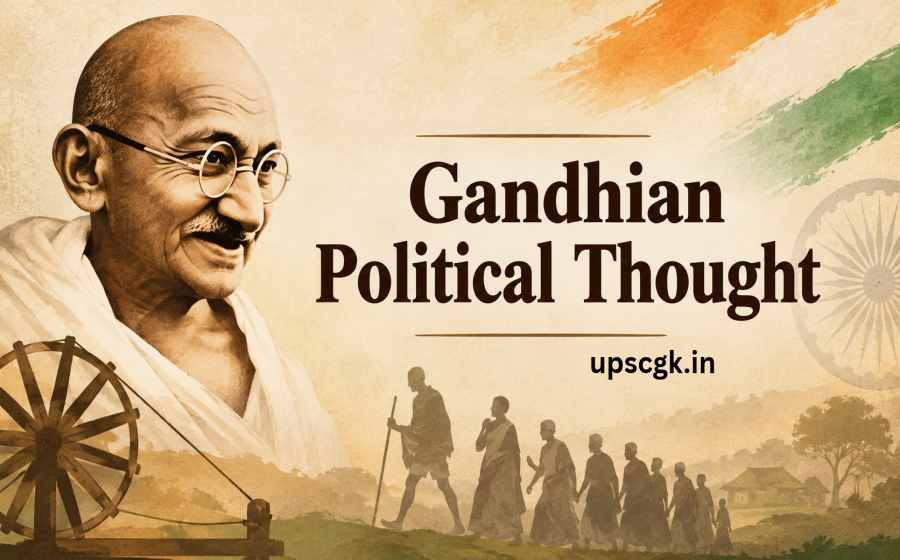
Gandhian political thought is an important school of political philosophy that connects politics with truth, morality, non-violence and social responsibility. Developed through the ideas and experiences of Mahatma Gandhi (1869–1948), it influenced India’s struggle for independence and contributed to wider discussions about peaceful resistance, democracy and social justice.
Unlike political approaches that focus primarily on power, authority or economic interests, Gandhi believed that political action should be guided by ethical principles. He argued that meaningful freedom required more than the removal of foreign rule; it also demanded individual self-discipline, social equality, economic responsibility and respect for human dignity.
The central concepts of Gandhian political thought include Swaraj, Ahimsa, Satyagraha, Sarvodaya, Swadeshi and Trusteeship. Together, these ideas present a vision of a society in which individuals and communities participate in public life while respecting the rights and dignity of others.
Table of Contents
Meaning of Gandhian Political Thought
Gandhian political thought refers to the political, social, economic and ethical ideas associated with Mahatma Gandhi. It developed through his experiences in South Africa, his leadership in the Indian freedom movement and his writings, particularly Hind Swaraj (1909).
Gandhi challenged the belief that political freedom could be achieved through any means necessary. For him, the methods used to achieve a goal were as important as the goal itself. He maintained that injustice should be opposed firmly, but resistance should not depend on hatred, revenge or physical violence.
His political philosophy also emphasised the relationship between personal conduct and public life. According to this approach, a just society cannot be built entirely through laws and institutions if individuals and leaders ignore truth, responsibility and moral discipline.
Gandhi’s ideas were not presented as a single, rigid political system. They evolved through practical experiments, public movements and debates about India’s future. His thought combined ethical principles with methods of political mobilisation and social reform.
Major Principles of Gandhian Political Thought
Truth (Satya)
Truth was one of the foundations of Gandhi’s philosophy. He regarded truth as a guiding principle for personal behaviour, political leadership and social relationships.
In political life, truth requires honesty, transparency and a willingness to examine one’s own actions. Gandhi believed that political objectives should not justify deliberate deception or the exploitation of others.
He also recognised the importance of humility in the search for truth. People may hold different understandings of a situation, so political disagreements should be addressed through dialogue, reason and a willingness to correct mistakes.
Non-Violence (Ahimsa)
Ahimsa means non-violence or the avoidance of harm. In Gandhian thought, it extends beyond refusing to use physical force. It also involves resisting hatred, hostility and the desire for revenge.
Gandhi treated non-violence as an active principle rather than a sign of passivity. It required courage, discipline and a willingness to face suffering without deliberately inflicting it on opponents.
He applied this principle to political movements, including campaigns against colonial rule and discriminatory laws. His approach sought to challenge injustice while preserving the possibility of reconciliation.
Satyagraha
Satyagraha, commonly understood as the force of truth or insistence on truth, was Gandhi’s distinctive method of non-violent resistance. He developed it during his years in South Africa and later used it in India’s freedom struggle.
Satyagraha involved refusing to cooperate with injustice through peaceful and disciplined action. Its methods could include protests, non-cooperation, civil disobedience and accepting the legal consequences of particular acts of resistance.
The purpose was not simply to defeat an opponent. Gandhi hoped that courageous, non-violent resistance could expose injustice, awaken public conscience and encourage a change in attitudes.
Satyagraha differed from passive submission because it required active opposition to wrongdoing. It also differed from violent revolution because it rejected the deliberate use of violence as the principal means of achieving political change.
Simplicity and Self-Discipline
Gandhi believed that political and social transformation required changes in individual conduct. Simplicity, restraint and responsible consumption were important elements of his approach.
He criticised excessive materialism and forms of economic activity that neglected human welfare. His personal practices, including the use of khadi, were intended to express his commitment to self-reliance and social responsibility.
These principles connected personal ethics with broader questions of economic organisation and public policy.
Swaraj: The Idea of Self-Rule
Swaraj is one of the most significant concepts in Gandhian political thought. The term generally means self-rule, but Gandhi gave it a broader meaning that included political independence, personal self-control and the ability of communities to manage their own affairs.
In Hind Swaraj, Gandhi argued that replacing British rulers with Indian rulers would not, by itself, guarantee genuine freedom. A society could become politically independent while continuing to experience exploitation, inequality and a lack of individual responsibility.
Gandhi’s understanding of Swaraj had three important dimensions.
- Political Swaraj: Freedom from colonial domination and the ability of people to determine their political future.
- Individual Swaraj: Self-control, moral discipline and the ability to govern one’s own conduct.
- Community Swaraj: Local participation, decentralised decision-making and greater responsibility for village affairs.
Gandhi supported village self-government and believed that local communities should have meaningful control over their social and economic development. His vision favoured decentralisation rather than excessive concentration of political and economic power.
Swaraj therefore represented more than national independence. It aimed at a society where freedom was accompanied by responsibility, participation and respect for others.
Sarvodaya: Welfare of All
Sarvodaya means the welfare or upliftment of all. It expresses Gandhi’s belief that social progress should benefit every section of society rather than only a privileged minority.
Gandhi’s approach emphasised the dignity of labour, social cooperation and concern for disadvantaged communities. He opposed untouchability and advocated improvements in the conditions of marginalised people. He also supported women’s participation in public life and the promotion of communal harmony.
Sarvodaya was connected with the idea that individual prosperity should not be separated from collective well-being. A society could not be considered truly developed if its progress depended on the suffering or exclusion of others.
This principle encouraged social service, community development and constructive activities such as education, sanitation and the promotion of village industries.
Swadeshi and Economic Self-Reliance
Swadeshi means giving preference to locally produced goods and strengthening domestic economic activity. Gandhi promoted Swadeshi as a way to challenge colonial economic dependence and support Indian producers.
Khadi, or hand-spun and handwoven cloth, became an important symbol of this principle. Gandhi encouraged people to use khadi and support village industries, connecting everyday economic choices with the wider freedom movement.
His economic thinking emphasised:
- Local production and self-reliance.
- The dignity of manual labour.
- Reduced dependence on exploitative economic relationships.
- Greater attention to the needs of rural communities.
- Responsible consumption and a more equitable distribution of resources.
Gandhi was critical of industrial development when it concentrated wealth, displaced workers or treated human beings merely as instruments of production. His emphasis on village-based economic activity continues to inform debates about sustainable development, local enterprise and inclusive growth.
However, his preference for decentralised production and his criticism of large-scale industrialisation remain subjects of debate, particularly in societies that require modern infrastructure, advanced technology and large-scale employment.
Trusteeship: Ethical Use of Wealth
Trusteeship was Gandhi’s proposed approach to addressing economic inequality without relying on violent class conflict. According to this idea, people who possess substantial wealth should regard themselves as responsible custodians of resources and use them in ways that benefit society.
Rather than treating wealth as an unrestricted means of personal enrichment, trusteeship placed emphasis on social responsibility and the welfare of workers and communities.
Gandhi hoped that ethical persuasion and changes in social attitudes could encourage wealthy individuals to contribute more fairly to society. His approach sought to reduce the conflict between capital and labour through cooperation and moral responsibility.
Nevertheless, critics question whether voluntary trusteeship can adequately address deep structural inequalities without enforceable laws, taxation and effective public institutions. This debate illustrates the difference between Gandhi’s ethical ideal and the practical requirements of modern economic governance.
Gandhi’s Vision of Democracy and Decentralisation
Gandhi supported self-government and active participation by ordinary people. His preference for decentralised political authority reflected his belief that citizens should have a meaningful role in decisions affecting their daily lives.
He placed considerable importance on village communities, local responsibility and cooperation. In his vision, democracy was not limited to elections or the formation of governments; it also involved the everyday practice of equality, service and respect.
Gandhi’s ideas are relevant to discussions about Panchayati Raj institutions and grassroots participation in India. However, modern constitutional democracy includes representative institutions, fundamental rights, judicial review and other arrangements that cannot be reduced entirely to Gandhi’s village-centred model.
His political thought is therefore best understood as an influential perspective on democratic participation and decentralisation, rather than a complete description of India’s present constitutional system.
Role of Gandhian Thought in India’s Freedom Movement
Gandhi translated his political principles into mass movements that challenged British colonial rule. His leadership helped bring diverse groups of Indians into organised political action.
Important examples include:
- Champaran Satyagraha (1917): Gandhi supported indigo cultivators in Bihar who faced oppressive plantation arrangements.
- Kheda Satyagraha (1918): He supported peasants in Gujarat who sought relief from land revenue demands during a period of hardship.
- Non-Cooperation Movement (1920–1922): The movement encouraged Indians to withdraw cooperation from British institutions.
- Salt March (1930): Gandhi led a march to Dandi to challenge British restrictions and taxation on salt, helping launch a wider civil disobedience campaign.
- Quit India Movement (1942): Gandhi and the Indian National Congress called for an end to British rule, leading to widespread protests and severe colonial repression.
These movements demonstrated how non-cooperation and civil disobedience could become instruments of mass political mobilisation. Their outcomes varied, and the independence struggle also involved many other leaders, organisations and revolutionary traditions. Nevertheless, Gandhian methods became an important part of India’s anti-colonial political history.
Relevance of Gandhian Political Thought Today
Gandhian political thought continues to inform discussions about several contemporary issues.
Peaceful protest: Satyagraha offers a framework for opposing injustice through disciplined, non-violent action.
Democratic accountability: Truthfulness, public responsibility and peaceful dissent remain relevant to the relationship between citizens and governments.
Social equality: Sarvodaya encourages attention to disadvantaged communities and the unequal distribution of opportunities.
Sustainable development: Swadeshi, simplicity and responsible consumption raise questions about environmental sustainability and excessive resource use.
Community participation: Swaraj highlights the importance of local decision-making and citizen involvement in public affairs.
Conflict resolution: Non-violence and dialogue provide alternatives to retaliation and encourage efforts to resolve disagreements without escalating hostility.
These ideas are not a substitute for effective laws, institutions or public policies. Their application requires consideration of political circumstances, power inequalities and the rights of all affected communities.
Criticism and Limitations of Gandhian Political Thought
Although Gandhi’s philosophy has influenced political movements worldwide, it has also attracted criticism.
First, critics question whether non-violent resistance is equally effective against every type of oppressive regime, especially when authorities respond with extreme violence.
Second, Gandhi’s preference for village-centred economic organisation has been criticised for offering insufficient answers to the demands of modern industrial economies, technological development and large populations.
Third, trusteeship relies heavily on moral responsibility and voluntary cooperation, raising questions about how wealth and power should be redistributed when voluntary efforts fail.
Finally, some critics argue that appeals to moral transformation alone cannot remove entrenched inequalities without structural reforms, legal safeguards and political accountability.
These criticisms do not eliminate the significance of Gandhian thought. Instead, they encourage a critical examination of its principles, achievements and practical limitations.
Summary
Gandhian political thought combines political freedom with moral responsibility, social equality and peaceful resistance. Its major concepts—Swaraj, Ahimsa, Satyagraha, Sarvodaya, Swadeshi and Trusteeship—offer a distinctive perspective on the relationship between individuals, society and political power.
Gandhi’s contribution extended beyond India’s struggle for independence. His methods of non-violent resistance and his emphasis on ethical political action continue to influence debates about democracy, justice, peace and social change.
At the same time, his ideas must be examined critically in light of modern economic conditions, constitutional institutions and persistent inequalities. The enduring significance of Gandhian political thought lies in its challenge to consider not only what political movements seek to achieve, but also the methods they use and the kind of society they aim to create.
Also Check: Political Science