Learn about the Home Rule Movement, led by Annie Besant and Bal Gangadhar Tilak, its objectives, key events and significance in India’s freedom struggle.
Home Rule Movement
The Home Rule Movement was one of the most important political movements in India’s struggle for independence. Launched during the First World War, it aimed to secure self-government for India within the British Empire. Inspired by the Irish Home Rule Movement, it marked a new phase in the Indian freedom struggle by bringing political awareness to the masses and reviving nationalist activities after a period of political inactivity.
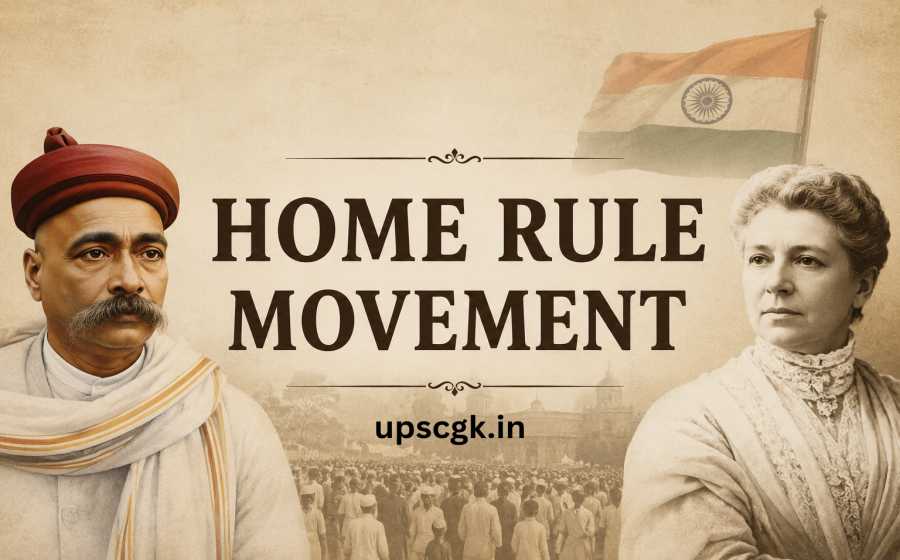
The movement was primarily led by two prominent leaders: Annie Besant and Bal Gangadhar Tilak. Their efforts played a crucial role in strengthening the demand for self-rule and preparing the ground for later mass movements led by Mahatma Gandhi.
Table of Contents
Background of the Home Rule Movement
The early twentieth century witnessed growing dissatisfaction among Indians regarding British rule. The partition of Bengal in 1905 had sparked nationalist sentiments, but the movement lost momentum after the Surat Split of 1907 between the Moderates and Extremists in the Indian National Congress.
Additionally, the outbreak of the First World War in 1914 created a new political situation. India provided extensive support to Britain in terms of soldiers, resources, and finances. Many Indian leaders believed that Britain would reward India’s loyalty by granting greater political rights. However, there were no clear signs of constitutional reforms.
In this atmosphere, nationalist leaders felt the need for a new movement that could unite Indians and demand self-government. This led to the emergence of the Home Rule Movement.
Objectives of the Home Rule Movement
The main objectives of the movement were:
- To achieve self-government or Home Rule for India within the British Empire.
- To create political awareness among the Indian masses.
- To unite different sections of Indian society in the struggle for political rights.
- To revive nationalist activities after years of decline.
- To increase pressure on the British government for constitutional reforms.
The movement did not initially demand complete independence but sought autonomy similar to that enjoyed by colonies such as Canada and Australia.
Role of Bal Gangadhar Tilak
Tilak was among the earliest leaders to advocate self-rule. After his release from imprisonment in Mandalay in 1914, he returned to active politics and sought to reunite nationalist forces.
In April 1916, Tilak established the Home Rule League in Poona (now Pune). His league operated mainly in Maharashtra, Karnataka, the Central Provinces, and Berar.
Tilak adopted an energetic campaign to spread the message of self-government. He organized public meetings, delivered speeches, and encouraged people to participate in political activities. His famous slogan, “Swaraj is my birthright, and I shall have it,” became a powerful symbol of Indian nationalism.
Tilak’s leadership attracted students, professionals, and middle-class Indians, making the movement highly influential in western India.
Role of Annie Besant
Annie Besant was an Irish-born social reformer, educationist, and nationalist who became one of the strongest supporters of Indian self-government.
In September 1916, she founded the All India Home Rule League. Unlike Tilak’s league, her organization had a wider geographical reach, covering most parts of India.
Besant used newspapers such as New India and Commonweal to spread nationalist ideas. She traveled extensively across the country, addressing public meetings and encouraging people to demand greater political rights.
Her dynamic leadership attracted many young Indians and educated citizens to the nationalist movement. She successfully transformed the demand for Home Rule into a nationwide political issue.
Working of the Home Rule Leagues
The Home Rule Leagues functioned through a network of local branches. Their activities included:
- Organizing public meetings and lectures.
- Publishing newspapers, pamphlets, and political literature.
- Enrolling members from different regions.
- Educating people about self-government and constitutional rights.
- Building public opinion against colonial rule.
The leagues used peaceful and constitutional methods to achieve their goals. They emphasized political education and mass participation rather than violent resistance.
Government Reaction
The growing popularity of the Home Rule Movement alarmed the British authorities. The government attempted to suppress the movement through censorship, restrictions on meetings, and arrests of activists.
In 1917, Annie Besant was arrested and placed under internment. Instead of weakening the movement, her arrest triggered widespread protests across India. Public demonstrations demanded her immediate release.
Several prominent leaders joined the campaign, and pressure on the government increased significantly. Eventually, Besant was released due to growing public opposition.
Achievements of the Home Rule Movement
The Home Rule Movement achieved several important successes:
1. Revival of Nationalism
The movement revived political activity after a period of stagnation and renewed public interest in the freedom struggle.
2. Popularization of Self-Government
The concept of self-rule became widely accepted among educated Indians and the middle class.
3. Political Education
Thousands of Indians became politically aware through meetings, speeches, and publications.
4. Unity Among Leaders
The movement helped bring Moderates and Extremists closer together, strengthening the nationalist cause.
5. Influence on British Policy
The growing pressure contributed to the announcement of the Montagu Declaration in 1917, which promised the gradual development of self-governing institutions in India.
Limitations of the Movement
Despite its achievements, the Home Rule Movement had certain limitations:
- Its influence remained largely confined to educated and urban sections of society.
- It did not achieve immediate self-government.
- The movement lost momentum after 1917.
- The rise of Mahatma Gandhi and mass-based movements shifted the focus of Indian nationalism.
Nevertheless, its contribution to India’s political awakening remained significant.
Significance in India’s Freedom Struggle
The Home Rule Movement occupies a special place in Indian history. It bridged the gap between early constitutional politics and the later mass movements of the freedom struggle. It demonstrated the power of organized political action and prepared the Indian people for larger national campaigns.
The movement also highlighted the importance of leadership, public participation, and political awareness. By demanding self-government as a legitimate right, Annie Besant and Bal Gangadhar Tilak laid a strong foundation for future struggles against British rule.
Summary
The Home Rule Movement was a landmark event in India’s journey toward independence. Led by Annie Besant and Bal Gangadhar Tilak, it revived nationalism, spread political consciousness, and strengthened the demand for self-government. Although it did not achieve immediate autonomy, it played a crucial role in shaping the future direction of the Indian freedom movement. Its legacy continues to be remembered as a significant step toward India’s eventual independence in 1947.
Also Check: History