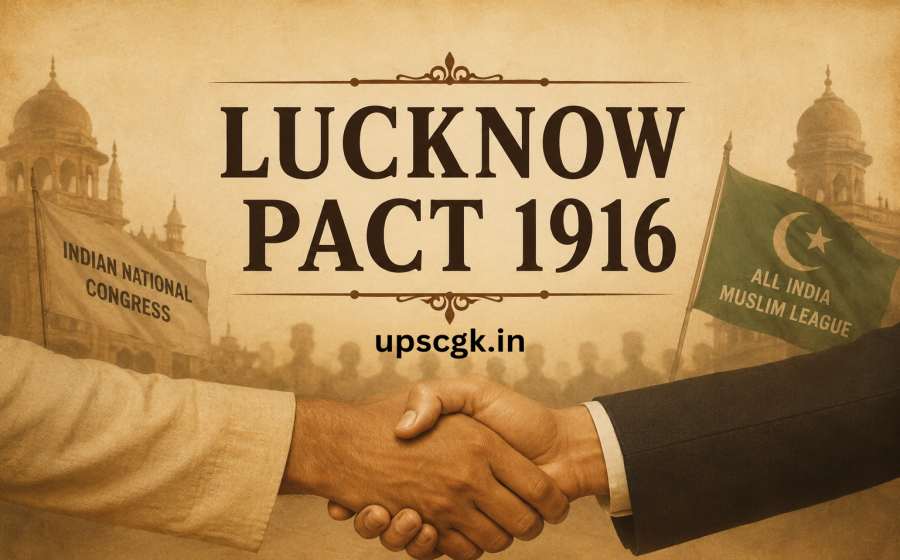
Lucknow Pact 1916 was a historic agreement between Congress and the Muslim League that promoted Hindu Muslim unity and strengthened India’s freedom movement.
Lucknow Pact 1916
The Lucknow Pact of 1916 was one of the most significant political developments in the history of India’s freedom struggle. It marked a rare moment of cooperation between the Indian National Congress and the All-India Muslim League. The pact was signed during the sessions of both organizations held in Lucknow in December 1916. It symbolized Hindu-Muslim unity and represented a united demand for greater self-government from British rule.
The agreement is considered a milestone because it brought together two major political organizations that had often differed in their approaches and objectives. The Lucknow Pact demonstrated that Indians, regardless of religious background, could work together for common political goals. It also increased pressure on the British government to introduce constitutional reforms in India.
Table of Contents
Background of the Lucknow Pact
The early twentieth century witnessed growing nationalist sentiments in India. The British government’s policies, including the Partition of Bengal in 1905, had generated widespread opposition. At the same time, political awareness among Indians was increasing rapidly.
The Indian National Congress was seeking greater participation of Indians in governance, while the Muslim League, established in 1906, aimed to safeguard the interests of Muslims. Initially, the League was relatively loyal to the British government, but changing political circumstances encouraged cooperation with Congress.
Several factors contributed to the emergence of the Lucknow Pact:
1. Annulment of Bengal Partition
The British government reversed the Partition of Bengal in 1911. Many Muslim leaders felt disappointed because they had supported the partition. This dissatisfaction reduced Muslim confidence in British promises.
2. Impact of World War I
The First World War (1914–1918) created expectations that Britain would reward India’s support with political reforms. Indian leaders wanted to present a united front to demand self-government.
3. Rise of Nationalist Leaders
Leaders such as Bal Gangadhar Tilak played a major role in promoting unity among different political groups. Tilak had rejoined Congress after years of differences between moderates and extremists, strengthening the national movement.
4. Desire for Political Cooperation
Both Congress and the Muslim League realized that cooperation would increase their bargaining power against British rule. This mutual understanding laid the foundation for the pact.
Main Features of the Lucknow Pact
The Lucknow Pact contained several important provisions regarding constitutional reforms and political representation.
Separate Electorates
Congress accepted the Muslim League’s demand for separate electorates for Muslims. Under this system, Muslim voters would elect Muslim representatives.
Representation for Muslims
The pact provided fixed proportions of seats for Muslims in provincial legislatures, even in provinces where their population was lower than the proposed representation.
Expansion of Legislative Councils
Both organizations demanded larger legislative councils with a majority of elected members rather than nominated officials.
Greater Indian Participation
The pact sought increased Indian participation in administration and governance at both provincial and central levels.
Self Government
Congress and the Muslim League jointly demanded self-government for India within the British Empire.
Limitation on Executive Power
The pact proposed reducing the powers of the executive and increasing the authority of elected representatives.
Leaders Associated with the Lucknow Pact
Several prominent leaders contributed to the success of the agreement:
- Bal Gangadhar Tilak
- Annie Besant
- Muhammad Ali Jinnah
- Ambika Charan Mazumdar
Among them, Muhammad Ali Jinnah received special recognition for facilitating cooperation between Congress and the Muslim League. At that time, he was often referred to as the “Ambassador of Hindu-Muslim Unity.”
Significance of the Lucknow Pact
Strengthened National Unity
The pact demonstrated that Hindus and Muslims could unite for common political objectives. This unity gave new momentum to the national movement.
Congress-League Cooperation
For the first time, Congress and the Muslim League jointly presented constitutional demands to the British government.
Increased Pressure on Britain
The united stance of Indian political organizations made it difficult for the British government to ignore demands for reform.
Encouraged Political Reforms
The pact influenced later constitutional developments, including the reforms announced by the British government after World War I.
Revival of Congress
The agreement helped reunite moderate and extremist factions within Congress, strengthening the organization.
Criticism of the Lucknow Pact
Despite its importance, the pact also faced criticism.
Acceptance of Separate Electorates
Many historians argue that Congress’s acceptance of separate electorates encouraged communal politics and deepened religious divisions in the long run.
Overrepresentation of Muslims
Some critics believed that the representation granted to Muslims in certain provinces exceeded their population share.
Temporary Unity
The spirit of cooperation created by the pact did not last long. Political differences between Congress and the Muslim League reappeared in later years.
Impact on the Freedom Movement
The Lucknow Pact created a sense of optimism in Indian politics. It showed that cooperation among different communities was possible and strengthened the demand for self-government. The agreement also helped build a broader nationalist movement capable of challenging British authority.
Although the unity achieved at Lucknow proved temporary, the pact remains a landmark event in modern Indian history. It reflected the aspirations of Indian leaders to present a united national front and played an important role in shaping the future course of the freedom struggle.
Summary
The Lucknow Pact of 1916 was a historic agreement between the Indian National Congress and the All-India Muslim League. It represented a rare period of Hindu-Muslim cooperation and strengthened the demand for self-government in India. While its acceptance of separate electorates later became controversial, the pact remains an important chapter in India’s nationalist movement. It demonstrated the power of political unity and significantly influenced the evolution of constitutional reforms and the struggle for independence.
Also Check: History