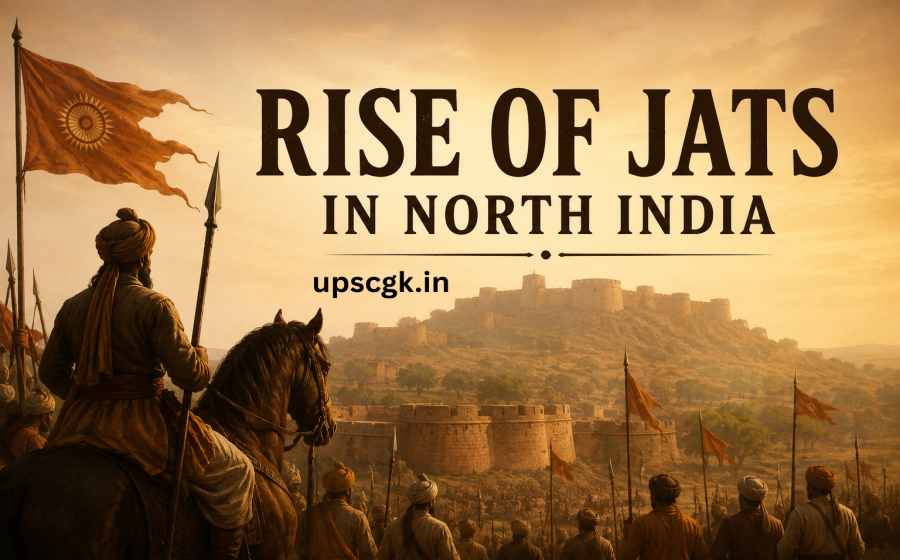
Learn about the Rise of Jats in North India, their revolt against Mughal rule, prominent leaders and the establishment of the powerful Bharatpur Kingdom.
Rise of Jats in North India
The Rise of the Jats in North India was one of the most significant political developments during the decline of the Mughal Empire in the late seventeenth and early eighteenth centuries. Originally an agricultural and pastoral community spread across present-day Western Uttar Pradesh, Haryana, Delhi, and Rajasthan, the Jats gradually transformed into a powerful military and political force. Their resistance against Mughal authority was fueled by excessive taxation, religious discrimination, administrative oppression, and the weakening of central imperial control.
By the eighteenth century, the Jats had established an independent kingdom centered at Bharatpur, which became one of the strongest successor states of the Mughal Empire. Their rise demonstrated how regional powers filled the political vacuum left by the declining Mughal administration.
Table of Contents
Background of the Jats
The Jats were primarily cultivators and cattle breeders who lived in the fertile plains along the Yamuna and Chambal rivers. They were known for their independent spirit, strong community organization, and military capabilities.
Although they had occasionally challenged imperial authority even during the reign of Emperor Akbar, the Mughal administration generally maintained control over the region. However, conditions changed significantly during the reign of Aurangzeb (1658–1707), when economic hardships and religious policies created widespread dissatisfaction. The fertile regions of Mathura, Agra, Bharatpur, and surrounding areas became the center of repeated Jat uprisings.
Causes Behind the Rise of the Jats
Several factors contributed to the emergence of the Jats as a political force.
1. Heavy Taxation
The Mughal administration imposed high land revenue demands on peasants. Local officials often collected taxes harshly, leaving cultivators with little surplus. The Jats, being predominantly agriculturists, were severely affected by these policies.
2. Religious Policies of Aurangzeb
Aurangzeb’s religious measures, including the re-imposition of the Jizya tax, destruction of several temples, and restrictions on non-Muslim religious practices, created resentment among many Hindu communities. The region around Mathura, a major Hindu pilgrimage center, witnessed growing opposition.
3. Weakening Mughal Authority
As Mughal control weakened during the later years of Aurangzeb and after his death, provincial governors became less effective. This provided local communities like the Jats an opportunity to assert independence.
4. Administrative Corruption
Corrupt revenue officials, oppressive local governors, and inefficient administration increased public dissatisfaction. The inability of the Mughal government to address local grievances encouraged rebellion.
5. Strong Community Organization
The Jats possessed a well-organized village system based on clan solidarity. Their unity enabled them to mobilize large numbers of fighters quickly whenever conflict arose.
Early Jat Revolts
The first major Jat uprising occurred during Aurangzeb’s reign under the leadership of Gokula.
Revolt of Gokula (1669)
Gokula, a wealthy zamindar from the Mathura region, led a revolt against Mughal officials in 1669. The immediate cause was the oppressive behavior of the Mughal faujdar and excessive taxation.
The rebels attacked Mughal outposts and challenged imperial authority. Although the Mughal army eventually defeated the rebellion and Gokula was executed, his movement inspired future Jat resistance.
Leadership of Raja Ram
Following Gokula’s death, the movement was revived under Raja Ram.
Raja Ram strengthened the military organization of the Jats and launched several attacks on Mughal territories. His forces used guerrilla warfare effectively against larger Mughal armies.
One of the notable achievements during his leadership was the raid on the region around Agra, which exposed the declining strength of the Mughal administration. Although Raja Ram was eventually killed in battle, his leadership kept the spirit of resistance alive.
Churaman and the Consolidation of Jat Power
The next important leader was Churaman, who transformed scattered rebellions into an organized political movement. Churaman established fortified centers and expanded Jat influence across western Uttar Pradesh and eastern Rajasthan. He skillfully took advantage of the succession struggles that followed Aurangzeb’s death in 1707.
The Mughal Empire, weakened by internal conflicts, was unable to suppress the growing Jat power. By this time, the Jats had emerged as an independent regional force.
Maharaja Suraj Mal: The Greatest Jat Ruler
The greatest ruler of the Jats was Maharaja Suraj Mal (1707–1763), often regarded as the founder of a strong and stable Jat kingdom.
Under his leadership, Bharatpur became one of the most prosperous states in northern India.
Achievements of Suraj Mal
- Expanded the Bharatpur Kingdom through successful military campaigns.
- Captured strategic territories including Agra.
- Built the famous Lohagarh Fort, considered one of the strongest forts in India.
- Improved revenue administration and agricultural development.
- Encouraged trade and maintained political stability.
- Followed a policy of religious tolerance and administrative efficiency.
Suraj Mal was respected not only by the Jats but also by neighboring powers due to his diplomatic skills and military strength.
Establishment of the Bharatpur Kingdom
The rise of the Jats ultimately resulted in the formation of the Bharatpur Kingdom, one of the most important successor states of the Mughal Empire.
Bharatpur became a center of military strength, trade, and regional administration. The kingdom successfully resisted several attacks by stronger powers because of its excellent fortifications and capable leadership.
The Lohagarh Fort earned a reputation for being nearly impregnable and symbolized the growing strength of the Jat rulers.
Relations with Other Regional Powers
During the eighteenth century, the Jats interacted with several regional powers.
The Mughals
Initially hostile, relations between the Jats and the Mughal Empire fluctuated between warfare and temporary alliances depending on political circumstances.
The Marathas
The Jats maintained both cooperation and rivalry with the Marathas. Suraj Mal occasionally assisted the Marathas but also pursued an independent foreign policy that prioritized Bharatpur’s interests.
The Rajputs
Relations with the Rajput states varied over time. Some alliances were formed through diplomacy, while territorial disputes occasionally led to conflict.
Importance of the Rise of the Jats
The emergence of the Jats had significant political and historical consequences.
- It accelerated the fragmentation of the Mughal Empire.
- Demonstrated the growing power of peasant communities in Indian politics.
- Led to the establishment of a stable regional kingdom at Bharatpur.
- Encouraged the rise of other regional powers across India.
- Weakened Mughal authority in the Gangetic plains.
- Contributed to the transition from centralized imperial rule to regional states during the eighteenth century.
Decline of Jat Power
After the death of Suraj Mal in 1763, the kingdom gradually lost its earlier strength due to succession disputes and increasing pressure from neighboring powers.
The rise of the British East India Company in northern India further reduced the political influence of the Bharatpur rulers. Although Bharatpur remained important for several decades, it could not regain the prominence achieved under Suraj Mal.
Summary
The Rise of the Jats in North India was a defining chapter in the political transformation of eighteenth-century India. Beginning as a series of peasant uprisings against oppressive Mughal rule, the movement evolved into a powerful regional kingdom under visionary leaders such as Gokula, Raja Ram, Churaman, and Maharaja Suraj Mal. Their success reflected the decline of Mughal authority and the emergence of regional states that reshaped India’s political landscape.
The establishment of the Bharatpur Kingdom showcased the administrative ability, military strength, and determination of the Jats. Their contribution remains an important part of Indian history, illustrating how local communities could rise to challenge one of the world’s greatest empires and establish an enduring legacy.
Also Check: History