
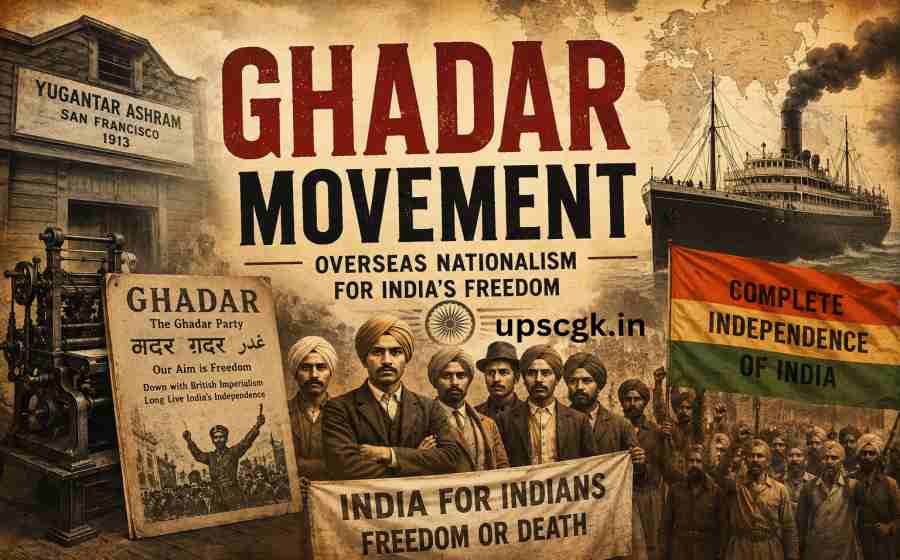
Learn about the Ghadar Movement, a revolutionary overseas nationalist movement launched by Indian immigrants to overthrow British rule in India.
Ghadar Movement
The Ghadar Movement was one of the most remarkable revolutionary movements in India’s struggle for independence. Unlike many nationalist movements that originated within India, the Ghadar Movement was born abroad among Indian immigrants who were determined to free their homeland from British colonial rule. It represented the spirit of overseas nationalism, where Indians living in foreign countries united to fight for India’s freedom.
The movement emerged during the early twentieth century when thousands of Indians, particularly Punjabis, migrated to countries such as the United States and Canada in search of employment and better opportunities. While living abroad, these immigrants faced racial discrimination and social exclusion. Their experiences strengthened their nationalist feelings and inspired them to challenge British rule in India. The Ghadar Movement became a symbol of revolutionary patriotism and international resistance against colonialism.
Table of Contents
Background of the Ghadar Movement
During the late nineteenth and early twentieth centuries, many Indians migrated to North America, especially to the western regions of Canada and the United States. Most of these migrants were farmers, laborers, and ex-soldiers from Punjab. Despite their hard work, they often faced discriminatory immigration laws and racial prejudice.
Indian immigrants gradually realized that their poor treatment abroad was linked to India’s status as a British colony. They believed that Indians would gain respect and equality only when India became an independent nation. This realization led to the growth of nationalist ideas among overseas Indians.
The political atmosphere of the time also played an important role. Revolutionary movements were emerging across the world, and anti-colonial sentiments were spreading rapidly. Influenced by these developments, Indian immigrants began organizing themselves to fight against British imperialism.
Formation of the Ghadar Party
The Ghadar Movement formally began in 1913 with the establishment of the Ghadar Party in San Francisco, California, United States. The word “Ghadar” means “revolt” or “rebellion.” The party aimed to overthrow British rule in India through armed revolution.
The headquarters of the movement was established at Yugantar Ashram in San Francisco. The movement attracted Indians from various regions, religions, and backgrounds, creating a strong sense of national unity.
The Ghadar Party believed that peaceful petitions and constitutional methods would not bring freedom to India. Therefore, it advocated revolutionary action and encouraged Indians to rise against British authority.
Major Leaders of the Ghadar Movement
Several dedicated revolutionaries contributed to the success and growth of the movement.
Lala Har Dayal
Lala Har Dayal was the chief ideologue and one of the founding leaders of the Ghadar Movement. A brilliant scholar and nationalist, he inspired Indian immigrants to join the struggle against British rule.
Sohan Singh Bhakna
Sohan Singh Bhakna served as the first president of the Ghadar Party. He played a crucial role in organizing Indian workers and promoting nationalist activities among overseas Indians.
Kartar Singh Sarabha
Kartar Singh Sarabha became one of the most celebrated revolutionaries of the movement. Despite being very young, he worked tirelessly to spread revolutionary ideas and inspire Indians to fight for independence.
Rash Behari Bose
Although primarily active in India, Rash Behari Bose cooperated with Ghadar revolutionaries and helped coordinate plans for armed rebellion against British rule.
The Ghadar Newspaper
One of the most powerful tools of the movement was the publication of the newspaper Ghadar. It was printed in multiple languages, including Punjabi, Urdu, Hindi, and English.
The newspaper carried articles, poems, and revolutionary messages encouraging Indians to unite against British rule. Copies were distributed across several countries, including India, Canada, Singapore, Hong Kong, and other regions with Indian communities.
The publication became extremely popular because it openly criticized British policies and inspired patriotic feelings among readers. Through this newspaper, the movement spread its revolutionary message worldwide.
Role During the First World War
The outbreak of the First World War in 1914 provided a significant opportunity for the Ghadar revolutionaries. They believed that Britain would be vulnerable because it was heavily engaged in the war.
Thousands of Ghadar activists returned to India with the objective of organizing a nationwide armed uprising. Their plan was to encourage Indian soldiers serving in the British Indian Army to revolt against their colonial rulers.
However, British intelligence agencies managed to infiltrate the movement. Many plans were exposed before they could be executed. Several leaders were arrested, while others were forced into hiding. The proposed rebellion of 1915 ultimately failed due to lack of coordination and extensive British surveillance.
British Response
The British government reacted harshly to the activities of the Ghadar Movement. Numerous revolutionaries were arrested and tried in what became known as the Lahore Conspiracy Cases.
Many activists received long prison sentences, transportation for life, or death penalties. Kartar Singh Sarabha was executed at a young age, becoming a martyr for India’s freedom struggle.
The British authorities also tightened security measures and increased surveillance on revolutionary organizations both inside and outside India.
Significance of the Ghadar Movement
The Ghadar Movement occupies a special place in Indian history for several reasons. First, it demonstrated that the Indian freedom struggle was not limited to the Indian subcontinent. Indians living abroad actively participated in the fight against colonial rule.
Second, the movement promoted national unity by bringing together people from different religions, regions, and social backgrounds under a common cause.
Third, it inspired future generations of revolutionaries. Many freedom fighters admired the courage and sacrifice of Ghadar activists. Their spirit of resistance influenced later revolutionary organizations in India.
Fourth, the movement highlighted the global dimension of India’s independence struggle. It established international networks and spread awareness about British colonial exploitation worldwide.
Summary
The Ghadar Movement was a pioneering example of overseas nationalism in India’s freedom struggle. Founded by Indian immigrants in North America, it sought to liberate India through revolutionary action and armed resistance. Although its immediate objectives were not achieved, the movement left a lasting impact on the national movement. The sacrifices of leaders such as Lala Har Dayal, Sohan Singh Bhakna, and Kartar Singh Sarabha inspired countless Indians to continue the fight for independence. Today, the Ghadar Movement is remembered as a powerful symbol of patriotism, courage, and the global nature of India’s quest for freedom.
Also Check: History