Explore the Economy and Trade in Gupta Period, including agriculture, industries, taxation, internal and foreign trade and economic prosperity of ancient India.
Economy and Trade in Gupta Period
The Gupta Period, which lasted from the 4th century CE to the 6th century CE, is often called the “Golden Age of Ancient India.” Under rulers like Chandragupta I, Samudragupta, and Chandragupta II, India witnessed remarkable growth in political stability, culture, education, science, and economic prosperity. The economy of the Gupta Empire was strong and well-organized, supported by agriculture, flourishing trade, skilled craftsmanship, and efficient administration. Trade expanded both within India and with foreign countries, making the Gupta Empire one of the wealthiest civilizations of its time.
Table of Contents
Agricultural Economy in Gupta Period
Agriculture formed the backbone of the Gupta economy. Most people in the empire depended on farming for their livelihood. Fertile river valleys, especially around the Ganga plains, helped in producing abundant crops. Farmers cultivated rice, wheat, barley, pulses, sugarcane, cotton, sesame, and spices.
The Gupta rulers paid great attention to irrigation and land management. Wells, canals, tanks, and reservoirs were built to support agriculture. Land revenue was the primary source of income for the state. Farmers generally paid taxes in the form of crops or money. The tax system was moderate, which allowed peasants to maintain economic stability.
Land grants became common during this period. Kings donated villages and agricultural lands to Brahmins, temples, and educational institutions. These grants often came with administrative rights and tax exemptions. This practice increased the influence of religious institutions in economic life.
Industries and Crafts
The Gupta Period saw major growth in industries and handicrafts. Skilled artisans produced high-quality goods that were admired both in India and abroad. Textile production was especially important. Cotton and silk fabrics from cities like Pataliputra, Varanasi, Mathura, and Ujjain were famous for their fine quality.
Metalwork also reached a high level of excellence. The famous Iron Pillar of Delhi, which has resisted rust for centuries, reflects the advanced metallurgical knowledge of the Gupta age. Goldsmiths, blacksmiths, ivory workers, potters, and jewelers contributed significantly to the economy.
Guilds, known as “Shrenis,” played an important role in industrial development. These guilds were associations of merchants and craftsmen that regulated production, maintained quality, fixed prices, and protected the interests of workers. Guilds also functioned as financial institutions by lending money and supporting trade activities.
Trade and Commerce
Trade flourished greatly during the Gupta Period due to political peace and improved transportation. Both internal and external trade contributed to the empire’s prosperity.
Internal Trade
Internal trade connected villages, towns, and cities across the empire. Roads and river routes facilitated the movement of goods. Major trade centers included Pataliputra, Ujjain, Prayag, Mathura, Tamralipti, and Vaishali.
Merchants transported agricultural products, textiles, spices, metals, ornaments, and handicrafts from one region to another. Markets were active and well-regulated. The use of coins made commercial transactions easier and more efficient.
The Gupta rulers maintained roads and ensured safety for traders. This encouraged merchants to travel long distances and conduct business freely.
Foreign Trade
Foreign trade during the Gupta Period was highly developed. India maintained trade relations with countries in Southeast Asia, Central Asia, China, and the Roman Empire. Indian merchants exported silk, cotton textiles, spices, precious stones, ivory products, perfumes, and medicinal herbs.
Imports included horses from Central Asia, gold from foreign lands, and luxury goods from Western countries. Indian ports on the eastern and western coasts became important centers of maritime trade.
Tamralipti in Bengal was a famous port for trade with Southeast Asia and China. Trade routes through the Arabian Sea connected India with the Middle East and Mediterranean regions. The Gupta Empire benefited greatly from these commercial exchanges.
Chinese traveler Faxian visited India during the reign of Chandragupta II and described the prosperity, peaceful society, and flourishing economy of the Gupta Empire in his travel accounts.
Currency System
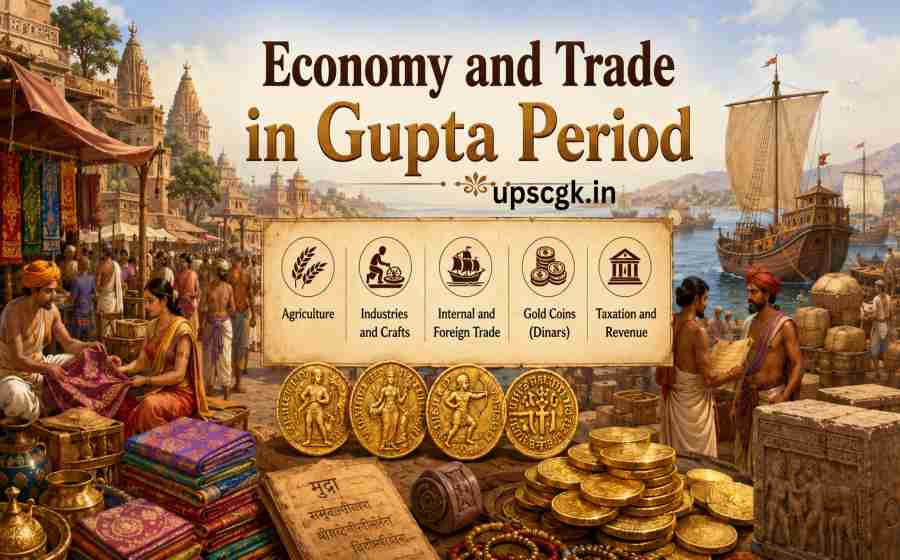
The Gupta rulers issued a large number of gold coins, known as “Dinars,” which indicate the economic prosperity of the empire. These coins were beautifully designed and carried images of kings, deities, and symbols of power.
Gold coins were mainly used in large trade transactions, while silver and copper coins were used for daily exchanges. The availability of a stable currency system promoted trade and strengthened the economy.
The artistic quality of Gupta coins also reflects the cultural and economic achievements of the period. Numismatic evidence provides historians with valuable information about Gupta trade, administration, and society.
Taxation and Revenue
The Gupta administration maintained an organized taxation system. Land tax was the most important source of revenue. Other taxes included trade tax, customs duties, and taxes on professions and industries.
Taxes were generally collected fairly, and the burden on people was not extremely heavy. This helped maintain social harmony and economic growth. Revenue collected by the state was used for administration, defense, irrigation projects, roads, temples, and educational institutions.
Local officials played a role in revenue collection and management. Village communities also had some autonomy in handling local economic matters.
Urbanization and Economic Prosperity
The Gupta Period experienced urban growth due to flourishing trade and industrial activities. Cities became centers of administration, culture, education, and commerce. Urban markets attracted traders from different regions.
Economic prosperity improved the standard of living for many people. Wealthy merchants and landowners contributed to religious and cultural activities by donating to temples, monasteries, and universities such as Nalanda University.
The prosperity of the Gupta Empire also supported advancements in science, mathematics, literature, and art. Scholars like Aryabhata and Kalidasa flourished during this economically stable era.
Decline of Gupta Economy
Toward the later phase of the Gupta Empire, economic decline began due to political instability, invasions by the Hunas, and weakening central authority. Foreign trade with the Roman Empire also reduced. Land grants increased feudal tendencies, reducing direct revenue for the state.
As local powers became stronger, economic unity weakened. Despite this decline, the Gupta Period remains one of the most prosperous and culturally rich phases in Indian history.
Summary
The economy and trade in the Gupta Period played a major role in making it the Golden Age of Ancient India. Agriculture, industries, guilds, internal trade and foreign commerce together created immense prosperity. Efficient administration, stable currency, and peaceful conditions encouraged economic growth across the empire.
The Gupta economic system not only strengthened the empire politically but also supported remarkable achievements in education, science, literature and art. Even today, historians consider the Gupta economy a symbol of ancient India’s prosperity, organization, and commercial excellence.
Also Check: History