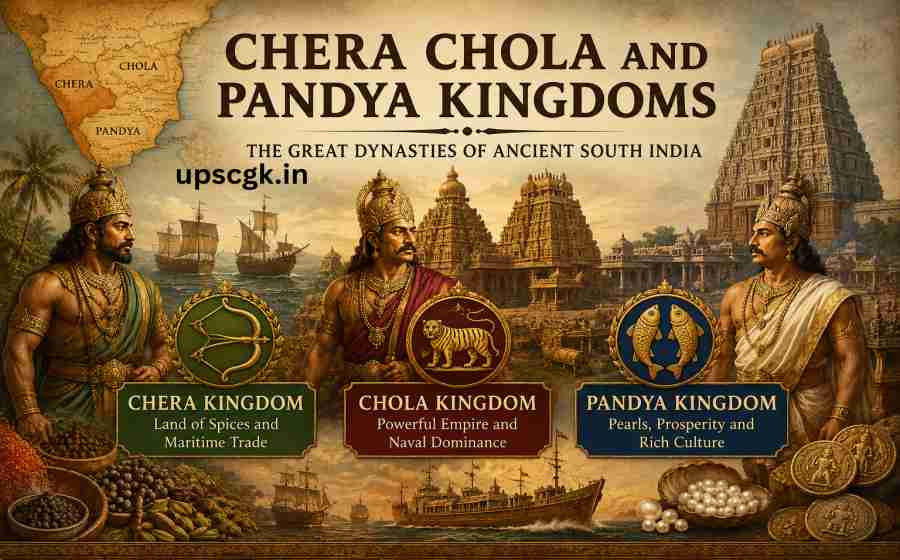
Discover the political, cultural, and economic history of the Chera Chola and Pandya Kingdoms, the great dynasties of ancient South India.
Chera Chola and Pandya Kingdoms
The Chera, Chola, and Pandya kingdoms were among the most powerful and influential dynasties of ancient South India. These kingdoms played a major role in shaping the political, cultural, economic, and religious history of the Indian subcontinent. They are often referred to as the “Three Crowned Kings” of Tamilakam because they ruled different parts of South India for several centuries.
These kingdoms flourished mainly in present-day Tamil Nadu, Kerala, and parts of Karnataka and Andhra Pradesh. Their contributions in administration, maritime trade, temple architecture, literature, and art made South India one of the most advanced regions of the ancient world.
Table of Contents
Origin of the Three Kingdoms
The history of the Chera, Chola, and Pandya kingdoms is closely connected with the Sangam Age, which lasted roughly from 300 BCE to 300 CE. Sangam literature provides valuable information about the political systems, social life, economy, and culture of these kingdoms.
- The Cheras ruled mainly over present-day Kerala and western Tamil Nadu.
- The Cholas controlled the fertile Kaveri delta region.
- The Pandyas ruled the southern part of Tamil Nadu around Madurai.
These kingdoms frequently fought among themselves for power and territory, but they also contributed greatly to the development of Tamil culture and civilization.
Chera Kingdom
Political History of the Cheras
The Chera kingdom was located on the western coast of South India. It was famous for its spice trade and maritime connections with foreign countries such as Rome, Egypt, and Arabia.
The capital of the Cheras was believed to be Vanchi. One of the most famous rulers of the Chera dynasty was Senguttuvan Chera, who is remembered for his military strength and patronage of Tamil literature.
The Cheras maintained strong naval and trade relations with foreign merchants. Their ports became important centers of international trade. Black pepper, cardamom, ivory, pearls, and sandalwood were exported in large quantities.
Cultural Contributions of the Cheras
The Chera rulers supported Tamil literature and poets during the Sangam Age. Temples, music, dance, and local traditions flourished under their rule.
The kingdom also became an important center for the spread of Jainism and Buddhism. Later, Hinduism became dominant in the region with the construction of temples dedicated to Shiva and Vishnu.
The Cheras are also remembered for promoting overseas trade, which brought wealth and cultural exchange to South India.
Chola Kingdom
Political History of the Cholas
The Chola dynasty became one of the greatest empires in Indian history. Their rule reached its peak during the medieval period between the 9th and 13th centuries CE.
The early Cholas were mentioned in Sangam literature, but the imperial Cholas rose to power under Vijayalaya Chola. The most famous Chola rulers included Rajaraja Chola I and Rajendra Chola I.
Rajaraja Chola expanded the empire by conquering parts of Sri Lanka and neighboring territories. His son Rajendra Chola further extended the empire to Southeast Asia through successful naval expeditions.
The Cholas had a highly organized administrative system. The empire was divided into provinces, districts, and villages. Local self-government played a significant role, especially in village administration.
Military and Naval Power
The Cholas possessed one of the strongest naval forces in Indian history. Their navy controlled important sea routes in the Indian Ocean and helped them establish dominance over maritime trade.
Their military strength enabled them to maintain a vast empire and influence regions beyond India, including parts of modern Indonesia, Malaysia, and Thailand.
Cultural Achievements of the Cholas
The Chola period is considered a golden age of South Indian art and architecture. Magnificent temples were built during their rule, especially the Brihadeeswara Temple at Thanjavur, constructed by Rajaraja Chola.
Chola temples were not only places of worship but also centers of education, art, music, and economic activities.
Bronze sculptures reached exceptional artistic standards during this period. The famous Nataraja statue of Lord Shiva is one of the finest examples of Chola art.
Tamil literature also flourished under Chola patronage. Religious movements such as Shaivism and Vaishnavism gained popularity.
Pandya Kingdom
Political History of the Pandyas
The Pandya kingdom was centered around Madurai, one of the oldest continuously inhabited cities in India. The Pandyas were known for their military strength, trade relations, and patronage of Tamil culture.
The kingdom gained prosperity through pearl fishing and maritime trade. Madurai became an important cultural and commercial center.
Several Pandya rulers expanded their territories and fought wars against the Cholas and Cheras. During the medieval period, the Pandyas once again emerged as a strong power after the decline of the Cholas.
Cultural and Economic Contributions
The Pandyas were major patrons of Sangam literature. Many Tamil poets and scholars received support from the Pandya court.
Madurai became famous as a center of learning and Tamil literary activities. The famous Meenakshi Temple reflects the architectural excellence associated with the Pandya period.
Trade with foreign countries brought economic prosperity. Roman coins discovered in South India prove the existence of active commercial relations with the Roman Empire.
Religion also flourished under the Pandyas. Hinduism remained dominant, but Jainism and Buddhism also had a presence in the region.
Administration and Society
The administration of these kingdoms was well organized. Kings were assisted by ministers, military commanders, and local officials.
Agriculture formed the backbone of the economy. Irrigation tanks, canals, and river-based farming increased agricultural production. Trade and commerce also played an important role in economic development.
Society during this period was divided into different social groups and occupations. Artisans, traders, farmers, and poets contributed significantly to the prosperity of the kingdoms.
Women enjoyed a respectable position in society, and references in Sangam literature indicate their participation in social and cultural life.
Importance of the Chera Chola and Pandya Kingdoms
The Chera, Chola, and Pandya kingdoms left a lasting impact on Indian history. Their contributions can still be seen in South Indian culture, language, temple architecture, and traditions.
Key achievements include:
- Development of Tamil literature and Sangam poetry
- Expansion of maritime trade and naval power
- Construction of magnificent temples
- Promotion of art, music, and dance
- Establishment of efficient administration systems
- Cultural influence on Southeast Asia
These kingdoms transformed South India into a center of economic prosperity and cultural brilliance.
Summary
The Chera, Chola and Pandya kingdoms were pillars of South Indian civilization. Their political achievements, cultural advancements, maritime trade, and architectural wonders made them among the greatest dynasties in Indian history.
Their legacy continues to inspire historians, scholars, and lovers of Indian culture. The temples, literature, and traditions created during their rule remain valuable treasures of India’s glorious past.
Also Check: History