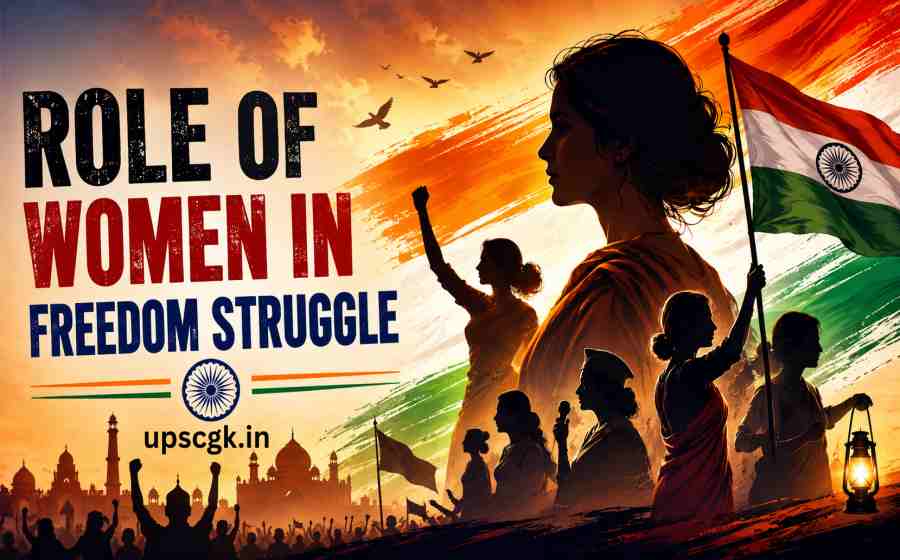
Explore the Role of Women in Freedom Struggle and learn how women contributed to India’s fight for independence through leadership, sacrifice and activism.
Role of Women in Freedom Struggle
The Indian freedom struggle was one of the greatest movements in world history, fought through decades of sacrifice, courage, and determination. While leaders like Mahatma Gandhi, Jawaharlal Nehru, and Subhas Chandra Bose played crucial roles, the contribution of women was equally significant. Women from different regions, religions, and social backgrounds stepped forward to challenge British rule and participate actively in the struggle for independence. Their involvement transformed not only the national movement but also the status of women in Indian society.
Table of Contents
Early Contributions of Women in the Freedom Struggle
The participation of women in India’s freedom movement can be traced back to the Revolt of 1857. Rani Lakshmibai of Jhansi emerged as one of the earliest symbols of resistance against British rule. Refusing to surrender her kingdom, she fought courageously against British forces and became a legendary figure in Indian history. Her bravery inspired future generations of women to join the fight for freedom and demonstrated that women could lead from the front during times of national crisis.
Women and the Rise of Nationalism
As nationalist sentiments spread across India during the late nineteenth and early twentieth centuries, women began taking part in public and political activities. Movements such as the Swadeshi Movement, Non-Cooperation Movement, and Civil Disobedience Movement encouraged women to leave the confines of their homes and participate in protests, rallies, and campaigns. They promoted the use of indigenous goods, boycotted foreign products, and helped spread awareness about the freedom struggle among the masses.
Sarojini Naidu and Women’s Leadership
Among the most influential women leaders of the freedom movement was Sarojini Naidu, popularly known as the “Nightingale of India.” She was a powerful orator, poet, and political leader who inspired thousands through her speeches and activism. She actively participated in the Salt Satyagraha and became the first Indian woman to preside over the Indian National Congress. Her leadership encouraged many women to take part in national politics and contribute to the independence movement.
Annie Besant and the Home Rule Movement
Annie Besant played a significant role in strengthening the demand for self-government in India. Through the Home Rule Movement, she promoted political awareness and encouraged Indians to seek greater autonomy from British rule. Although she was born in Ireland, her dedication to India’s cause earned her widespread respect among Indian nationalists. Her efforts laid an important foundation for future mass movements against colonial rule.
Revolutionary Women Freedom Fighters
Not all women participated through peaceful protests. Many joined revolutionary organizations and took part in armed resistance against British authorities. Pritilata Waddedar and Kalpana Datta were among the courageous women who actively participated in revolutionary activities. They challenged colonial rule through direct action and demonstrated exceptional bravery in the face of danger. Their sacrifices highlighted the determination of women to secure India’s freedom at any cost.
Women’s Role in the Quit India Movement
The Quit India Movement of 1942 marked one of the most important phases of India’s freedom struggle, and women played a crucial role in its success. Aruna Asaf Ali emerged as a leading figure when she hoisted the Indian national flag during the movement despite severe British repression. Her actions became a symbol of resistance and inspired people across the country to continue fighting for independence even after many senior leaders had been imprisoned.
Kasturba Gandhi and Grassroots Participation
Kasturba Gandhi made valuable contributions to the freedom movement through her involvement in various campaigns led by Mahatma Gandhi. She participated in protests, promoted social reforms, and encouraged women to join the national movement. Her willingness to endure imprisonment for the cause of freedom demonstrated her unwavering commitment to India’s independence and inspired countless women across the nation.
Usha Mehta and the Secret Congress Radio
One of the most remarkable contributions during the Quit India Movement came from Usha Mehta. She established a secret radio station known as Congress Radio, which broadcast messages supporting the freedom movement. At a time when the British government attempted to suppress information, this underground radio network helped maintain communication among freedom fighters and kept the spirit of resistance alive throughout the country.
Captain Lakshmi Sahgal and the Indian National Army
Captain Lakshmi Sahgal played a significant role in the Indian National Army (INA) led by Subhas Chandra Bose. She commanded the Rani of Jhansi Regiment, an all-women military unit formed to fight against British rule. Her leadership challenged traditional gender roles and proved that women could serve effectively in military and leadership positions while contributing directly to the struggle for independence.
Contributions of Ordinary Women
Apart from famous leaders, thousands of ordinary women contributed to the freedom movement. Rural women, students, teachers, workers, and homemakers participated in marches, protests, and boycotts. Many faced imprisonment, violence, and economic hardships for supporting the nationalist cause. Although their names may not appear in history books, their collective efforts played a vital role in making the freedom movement a mass movement.
Impact of Women’s Participation
The active participation of women in the freedom struggle had a lasting impact on Indian society. It challenged traditional social barriers and opened new opportunities for women in politics, education, and public life. Their involvement demonstrated that nation-building requires equal participation from both men and women. The freedom movement became an important milestone in the advancement of women’s rights and empowerment in India.
Summary
The role of women in India’s freedom struggle was extraordinary and indispensable. From Rani Lakshmibai’s battlefield heroism to Sarojini Naidu’s political leadership, from Aruna Asaf Ali’s defiance to Usha Mehta’s secret broadcasts, women contributed in countless ways to the cause of independence. Alongside these renowned figures, thousands of ordinary women made sacrifices that helped shape the destiny of the nation. Their courage, resilience, and patriotism remain a source of inspiration and remind us that India’s freedom was achieved through the collective efforts of both men and women.
Also Check: History