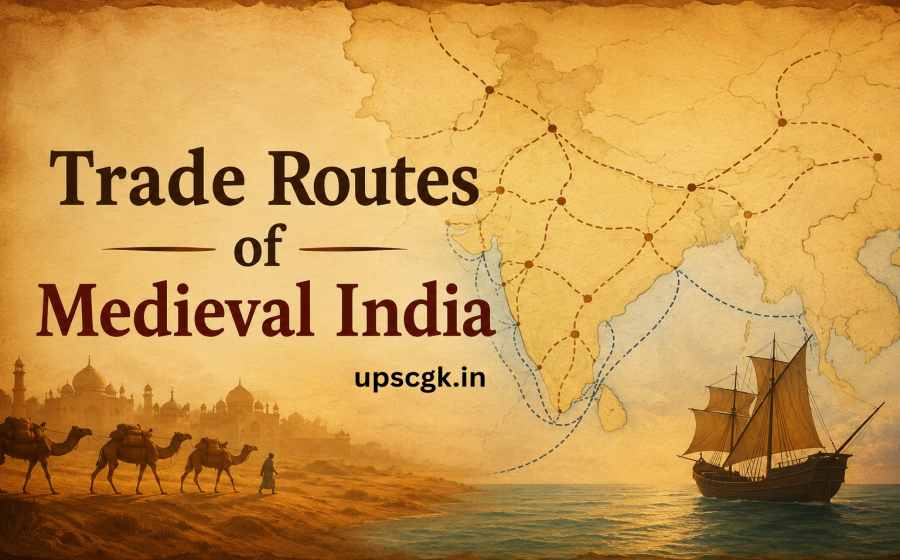
Discover the trade routes of Medieval India, importance, major land and sea routes, key trading centers and their impact on India’s economy and global commerce.
Trade Routes of Medieval India
Trade played a crucial role in shaping the political, economic, and cultural landscape of Medieval India. Between the 8th and the 18th centuries, India emerged as one of the world’s leading centers of commerce, connecting Asia, Africa, Europe, and the Middle East through an extensive network of land and maritime trade routes. These routes facilitated not only the exchange of goods but also ideas, technologies, religions, and cultures.
Indian merchants traded valuable commodities such as spices, textiles, precious stones, ivory, perfumes, indigo, sugar, and metal goods with distant kingdoms. In return, India imported horses, silk, luxury goods, gold, silver, and various other products. The flourishing trade contributed significantly to the prosperity of powerful kingdoms like the Delhi Sultanate, Vijayanagara Empire, Bahmani Sultanate, and the Mughal Empire.
Table of Contents
Importance of Trade in Medieval India
Trade was one of the primary sources of wealth for medieval Indian kingdoms. Kings encouraged merchants by constructing roads, maintaining ports, ensuring security, and collecting customs duties. The prosperity generated through commerce strengthened state finances and promoted urbanization.
Trade also encouraged the growth of markets, banking systems, merchant guilds, and international diplomatic relations. Religious ideas such as Islam and Buddhism spread along these commercial routes, while artistic styles and scientific knowledge moved freely between civilizations.
Major Land Trade Routes
1. The Grand Northern Route
One of the oldest trade routes connected northern India with Central Asia. This route passed through:
- Delhi
- Lahore
- Multan
- Kabul
- Samarkand
- Bukhara
Merchants carried cotton textiles, spices, indigo, and precious stones from India, while horses, dry fruits, carpets, and luxury goods arrived from Central Asia.
The Delhi Sultanate relied heavily on this route for importing high-quality war horses, which were essential for maintaining a strong cavalry.
2. The Silk Route Connection
Although the main Silk Route passed through Central Asia, several branches connected India with this famous trading network.
Indian merchants exchanged:
- Cotton cloth
- Spices
- Ivory
- Precious gems
In return, they received:
- Chinese silk
- Porcelain
- Paper
- Tea
This connection strengthened economic ties between India, China, Persia, and the Mediterranean world.
3. Deccan Trade Routes
The Deccan plateau linked northern and southern India through an extensive network of roads.
Major trading centers included:
- Daulatabad
- Gulbarga
- Bidar
- Vijayanagara
These routes transported cotton, rice, iron, diamonds, horses, and handicrafts across the subcontinent.
Maritime Trade Routes
India’s long coastline made maritime trade even more significant than overland commerce.
Arabian Sea Route
The western coast of India maintained strong commercial relations with:
- Arabia
- Persia
- East Africa
- Egypt
Important ports included:
- Cambay (Khambhat)
- Surat
- Calicut (Kozhikode)
- Bharuch
Indian merchants exported:
- Black pepper
- Cardamom
- Cotton textiles
- Indigo
- Sugar
- Rice
Imports included:
- Arabian horses
- Dates
- Pearls
- Gold
- Silver
Arab merchants dominated much of this trade before the arrival of the Portuguese.
Bay of Bengal Route
The eastern coast connected India with:
- Sri Lanka
- Myanmar
- Thailand
- Malaysia
- Indonesia
- China
Major ports included:
- Nagapattinam
- Masulipatnam
- Tamralipti
- Pulicat
Ships carried textiles, spices, rice, sandalwood, and precious stones while importing silk, ceramics, aromatic woods, and luxury goods.
These routes played a major role in spreading Indian culture throughout Southeast Asia.
Major Trading Centers
Several cities became prosperous commercial hubs due to their strategic location.
Delhi
As the capital of the Delhi Sultanate and later the Mughal Empire, Delhi attracted merchants from Persia, Central Asia, and the Middle East.
Surat
Surat became India’s most important port during the Mughal period. European companies, including the Portuguese, Dutch, English, and French, established trading centers here.
Calicut
Located on the Malabar Coast, Calicut was famous for its spice trade. Pepper from this region was highly valued across Europe and the Middle East.
Cambay (Khambhat)
Cambay was renowned for exporting cotton textiles, beads, and handicrafts to foreign markets.
Vijayanagara
The capital of the Vijayanagara Empire became a flourishing commercial city where merchants from Persia, Arabia, Portugal, and Southeast Asia conducted business.
Commodities Traded
Medieval India’s trade involved a remarkable variety of goods.
Major Exports
- Black pepper
- Cardamom
- Cinnamon
- Cotton textiles
- Silk fabrics
- Indigo
- Sugar
- Rice
- Diamonds
- Pearls
- Ivory products
- Sandalwood
- Steel weapons
Major Imports
- Arabian horses
- Silk
- Gold
- Silver
- Copper
- Luxury ceramics
- Glassware
- Dates
- Dry fruits
- Perfumes
Indian textiles and spices were especially sought after in Europe and West Asia, making them among the most profitable exports.
Merchant Communities
Several merchant groups played an important role in medieval trade.
Some prominent merchant communities included:
- Gujarati merchants
- Chettiars of South India
- Marwari traders
- Multani merchants
- Arab traders
- Persian merchants
These merchants often formed guilds that regulated trade, settled disputes, financed voyages, and maintained commercial networks across regions.
Role of Foreign Traders
Foreign merchants significantly expanded India’s international trade.
Arab traders had dominated Indian Ocean commerce for centuries before the arrival of Europeans.
From the late 15th century onward:
- Portuguese established trading posts.
- Dutch expanded spice commerce.
- English East India Company increased textile exports.
- French also participated in coastal trade.
Competition among these European powers gradually transformed India’s trading system and eventually paved the way for colonial influence.
Economic and Cultural Impact
The flourishing trade routes brought immense prosperity to medieval India. Commercial taxes generated substantial revenue for rulers, enabling them to build forts, roads, irrigation systems, mosques, temples, and magnificent monuments.
Trade also encouraged the growth of towns, ports, markets, and artisan communities. Cultural interactions introduced new architectural styles, languages, cuisines, and artistic traditions. Religious ideas, including Islam, spread peacefully through merchant networks, particularly along India’s western coast.
Indian mathematical knowledge, medicine, textiles, and craftsmanship also gained international recognition through these commercial exchanges.
Decline of Traditional Trade Routes
Several factors contributed to the decline of medieval trade routes:
- Political instability after the decline of major empires
- Frequent invasions
- Rise of European naval dominance
- Portuguese control over sea trade
- Shift of global trade toward Atlantic routes
- Colonial monopolies established by European companies
Despite these changes, many medieval ports continued to function and later became important centers during British rule.
Summary
The trade routes of Medieval India connected the country to major regions across Asia, Africa, and Europe through extensive land and sea networks. These routes supported the exchange of spices, textiles, precious stones, horses, and luxury goods while promoting economic growth, urbanization, and cultural interaction. Flourishing ports such as Surat, Calicut, and Cambay, along with inland trade centers like Delhi and Vijayanagara, made India a global commercial hub. Although political changes and European colonial expansion eventually altered these networks, the trade routes of Medieval India left a lasting impact on the country’s economy, society, and historical development.
Also Check: History