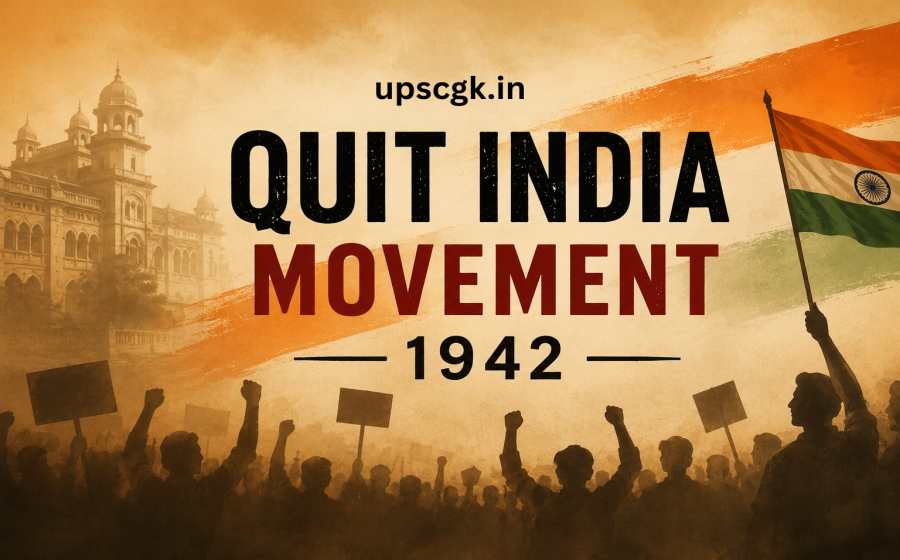
Quit India Movement 1942 was a landmark freedom struggle led by Mahatma Gandhi that united Indians against British rule and accelerated independence.
Quit India Movement 1942
The Quit India Movement of 1942 was one of the most significant milestones in India’s struggle for independence. Launched by the Indian National Congress under the leadership of Mahatma Gandhi, the movement aimed to end British rule in India immediately. It inspired millions of Indians to participate in a nationwide protest against colonial rule and became a turning point in the freedom struggle.
The movement is also known as the August Movement because it was launched in August 1942. Gandhi’s powerful slogan, “Do or Die,” motivated people across the country to fight for freedom with determination and courage.
Table of Contents
Background of the Quit India Movement
The political situation in India during the early 1940s was highly tense. The British government had involved India in World War II without consulting Indian leaders. This decision created widespread resentment among Indians.
In 1942, the British government sent the Cripps Mission to India to secure Indian cooperation during the war. The mission offered limited constitutional reforms but did not promise complete independence. Indian leaders rejected the proposals because they failed to meet the aspirations of the Indian people.
The failure of the Cripps Mission convinced many nationalists that Britain had no intention of granting genuine freedom to India. As a result, the demand for complete independence became stronger than ever.
Launch of the Movement
The Quit India Movement was officially launched on 8 August 1942 during the Bombay session of the Indian National Congress at Gowalia Tank Maidan, now known as August Kranti Maidan.
During the session, Mahatma Gandhi delivered his famous speech and urged Indians to follow the principle of “Do or Die.” He called upon the people to continue the struggle until India achieved complete independence. The Congress passed the Quit India Resolution, demanding the immediate withdrawal of British rule from India.
Major Leaders of the Movement
Several prominent leaders supported and guided the movement, including:
- Mahatma Gandhi
- Jawaharlal Nehru
- Sardar Vallabhbhai Patel
- Maulana Abul Kalam Azad
- Rajendra Prasad
- Aruna Asaf Ali
- Jayaprakash Narayan
These leaders played important roles in mobilizing the masses and spreading the message of independence throughout the country.
British Response
The British government reacted swiftly and harshly. Within hours of the movement’s launch, Gandhi and most senior Congress leaders were arrested.
The government imposed strict censorship, banned public meetings, and used police and military forces to suppress protests. Thousands of freedom fighters were jailed, and many demonstrations were dispersed through force.
However, the arrests could not stop the movement. In many regions, ordinary citizens took leadership roles and continued protests independently.
Popular Participation
One of the most remarkable features of the Quit India Movement was the participation of people from all sections of society.
Students
Students left schools and colleges to join demonstrations, distribute pamphlets, and spread nationalist ideas.
Workers
Industrial workers organized strikes and disrupted government operations.
Farmers
Many farmers refused to cooperate with British authorities and participated in protests.
Women
Women played a crucial role by organizing meetings, carrying messages, and supporting underground activities. Aruna Asaf Ali emerged as one of the most influential figures during this period.
Youth and Underground Activists
Several young revolutionaries operated underground networks, publishing secret newspapers and coordinating resistance activities after top leaders had been arrested.
Major Events During the Movement
The movement witnessed widespread protests throughout India.
- Demonstrations were held in major cities and rural areas.
- Railway tracks and communication lines were disrupted.
- Government offices became targets of public anger.
- Underground radio stations spread nationalist messages.
- Parallel governments were established in some regions.
Notable examples of parallel governments emerged in places such as:
- Ballia
- Satara
- Tamluk
These local administrations symbolized resistance against British authority and demonstrated the growing desire for self-rule.
Significance of the Quit India Movement
The Quit India Movement holds immense importance in Indian history for several reasons:
1. Mass National Movement
It became one of the largest nationwide movements against British rule and involved millions of Indians.
2. Demonstrated National Unity
People from different regions, religions, and social backgrounds participated in the struggle for freedom.
3. Challenged British Authority
The movement made it increasingly difficult for the British government to maintain control over India.
4. Inspired Future Freedom Efforts
The determination shown by Indians during the movement strengthened the momentum of the independence struggle.
5. Prepared the Ground for Independence
Although the movement was suppressed, it convinced British policymakers that governing India against the wishes of its people was becoming impossible.
Limitations of the Movement
Despite its significance, the movement faced certain challenges:
- Most top leaders were arrested at the beginning.
- Lack of centralized leadership affected coordination.
- The British government used severe repression.
- The movement did not achieve immediate independence.
Nevertheless, its impact on public opinion and British policy was profound.
Impact on India’s Independence
The Quit India Movement marked the final phase of India’s mass struggle against British rule. While it did not force an immediate British withdrawal, it weakened the legitimacy of colonial governance.
After the end of World War II, Britain faced economic difficulties and increasing pressure to transfer power. The determination displayed during the Quit India Movement played a major role in shaping the events that eventually led to India’s independence on 15 August 1947.
Summary
The Quit India Movement of 1942 was a defining chapter in India’s freedom struggle. Led by Mahatma Gandhi and supported by millions of Indians, it reflected the nation’s unwavering desire for independence. The slogan “Do or Die” became a symbol of courage and sacrifice. Although the movement faced severe repression, it accelerated the decline of British rule and brought India closer to freedom. Its legacy continues to inspire generations and remains a powerful reminder of the strength of collective action in the pursuit of liberty.
Also Check: History