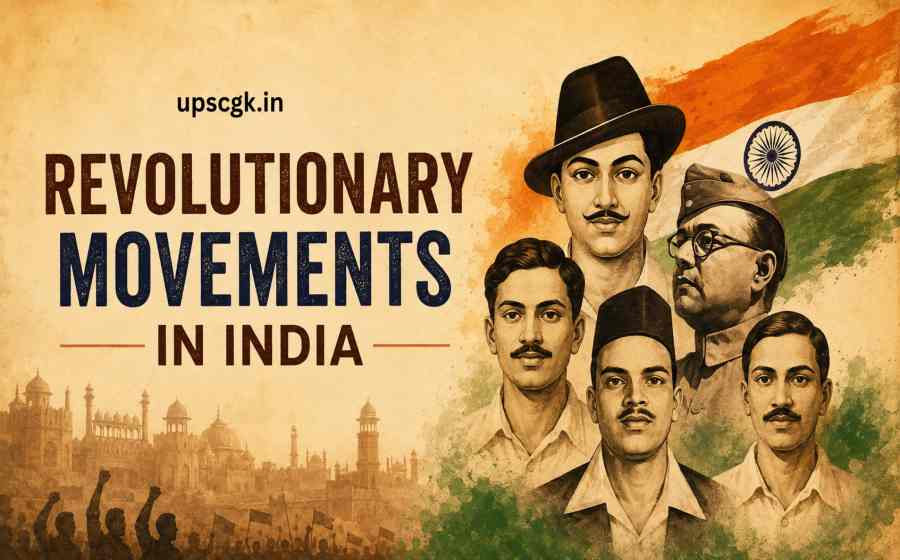
Explore the revolutionary movements in India, key leaders, major events and their role in the Indian freedom struggle against British rule.
Revolutionary Movements in India
The Indian freedom struggle was not limited to petitions, protests, and non-violent movements. Alongside constitutional and peaceful methods, a powerful revolutionary movement emerged that aimed to challenge British rule through direct action and armed resistance. Revolutionary organizations and brave young patriots played a significant role in inspiring nationalism and awakening the spirit of sacrifice among Indians.
The revolutionary movement became particularly influential during the early twentieth century when many young Indians lost faith in the moderate methods of political reform. Inspired by the ideals of liberty, nationalism, and self-sacrifice, revolutionaries sought to overthrow British rule and establish an independent India.
Table of Contents
Background of Revolutionary Movements
The growth of revolutionary activities was influenced by several factors:
- Dissatisfaction with British policies and repression.
- Failure of moderate political methods to achieve substantial reforms.
- Partition of Bengal in 1905 and the resulting nationalist sentiment.
- Influence of international revolutionary movements in Ireland, Russia, and Italy.
- Growing political consciousness among educated Indian youth.
As British authorities imposed stricter laws and suppressed political dissent, many young nationalists believed that armed struggle was necessary to achieve freedom.
Early Revolutionary Activities
The revolutionary movement first gained momentum in Bengal and Maharashtra. Secret societies were formed to train young people and organize resistance against British officials.
Anushilan Samiti
The Anushilan Samiti was one of the earliest revolutionary organizations in Bengal. It promoted physical training, nationalist education, and revolutionary activities. Members secretly prepared for armed resistance against British rule.
Jugantar Group
The Jugantar Group emerged as another important revolutionary organization. It was associated with nationalist leaders and young revolutionaries who advocated direct action against colonial authorities.
Key Revolutionary Leaders
Aurobindo Ghosh
Aurobindo Ghosh was among the early supporters of revolutionary nationalism. He inspired young Indians through his writings and political activities. Although he later turned towards spirituality, his early contribution greatly influenced revolutionary thought.
Bal Gangadhar Tilak
Bal Gangadhar Tilak was not a revolutionary in the armed sense, but his assertive nationalism inspired many young patriots. His slogan, “Swaraj is my birthright, and I shall have it,” became a source of motivation for revolutionaries.
Khudiram Bose
Khudiram Bose became one of the youngest martyrs of India’s freedom struggle. In 1908, he participated in an attempt to target a British judge. Though the mission failed, his courage and sacrifice made him a national hero.
Rash Behari Bose
Rash Behari Bose played a crucial role in organizing revolutionary networks across India. He later moved abroad and continued efforts to secure India’s independence through international support.
Bhagat Singh
Bhagat Singh remains one of the most celebrated revolutionaries in Indian history. He believed that revolutionary action could awaken the masses and challenge colonial oppression. His courage, intellect, and sacrifice inspired generations of Indians.
Chandrashekhar Azad
Chandrashekhar Azad was a prominent leader of revolutionary organizations in northern India. He dedicated his life to the freedom struggle and vowed never to be captured alive by British authorities.
Ram Prasad Bismil
Ram Prasad Bismil was a key figure in the revolutionary movement and one of the leaders involved in the famous Kakori Conspiracy. His patriotic writings and bravery inspired many young Indians.
Subhas Chandra Bose
Subhas Chandra Bose represented a militant approach to achieving independence. Through the Indian National Army, he sought to liberate India with armed support during the Second World War.
Major Revolutionary Events
Partition of Bengal and Rise of Militancy (1905)
The partition of Bengal by British authorities generated widespread resentment. Many young nationalists viewed it as an attempt to divide Indians and weaken nationalism. This event became a turning point in the growth of revolutionary activities.
Alipore Bomb Case (1908)
The Alipore Bomb Case became one of the earliest major revolutionary trials in India. It exposed the existence of secret revolutionary organizations and brought national attention to the revolutionary movement.
Delhi Conspiracy Case (1912)
A bomb was thrown at the Viceroy during a ceremonial procession in Delhi. Although the Viceroy survived, the incident demonstrated the increasing strength of revolutionary networks.
Ghadar Movement (1913)
The Ghadar Party was founded by Indians living abroad, particularly in North America. The movement aimed to organize an armed uprising against British rule and encouraged Indians worldwide to support independence.
Kakori Conspiracy (1925)
The Kakori Conspiracy involved revolutionaries who seized government funds from a train to finance their activities. The event highlighted the determination and organizational abilities of Indian revolutionaries.
Assembly Bomb Incident (1929)
Bhagat Singh and his associates threw non-lethal bombs in the Central Legislative Assembly to protest repressive laws. Their objective was to make their political message heard rather than cause casualties.
Chittagong Armoury Raid (1930)
Led by Surya Sen, revolutionaries attacked British armouries in Chittagong. The raid demonstrated extraordinary courage and became a landmark event in the revolutionary movement.
Formation of the Indian National Army
During the Second World War, the Indian National Army intensified the struggle against British rule. Its campaigns strengthened nationalist sentiment and influenced the final phase of the independence movement.
Contributions of Revolutionary Movements
The revolutionary movement made several important contributions:
- Inspired patriotism and national pride.
- Demonstrated the willingness of Indians to sacrifice for freedom.
- Challenged British authority and exposed colonial vulnerabilities.
- Motivated young people to participate in the freedom struggle.
- Complemented other nationalist movements by keeping the spirit of resistance alive.
Although revolutionaries could not achieve independence solely through armed struggle, their actions significantly strengthened the broader freedom movement.
Limitations of Revolutionary Activities
Despite their courage, revolutionary groups faced several challenges:
- Lack of widespread public support in the early years.
- Limited financial and military resources.
- Strong surveillance by British intelligence agencies.
- Internal organizational difficulties.
- Severe repression through arrests and executions.
These factors prevented revolutionary movements from developing into a nationwide armed uprising.
Summary
The revolutionary movements in India occupy a proud place in the history of the freedom struggle. Leaders such as Bhagat Singh, Chandrashekhar Azad, Khudiram Bose, Ram Prasad Bismil, Rash Behari Bose, and Subhas Chandra Bose demonstrated unmatched courage and patriotism. Their sacrifices inspired millions and strengthened the determination of Indians to achieve independence. While India’s freedom ultimately resulted from a combination of political, social, and revolutionary efforts, the contribution of these brave revolutionaries remains an enduring symbol of nationalism, sacrifice, and love for the nation.
Also Check: History