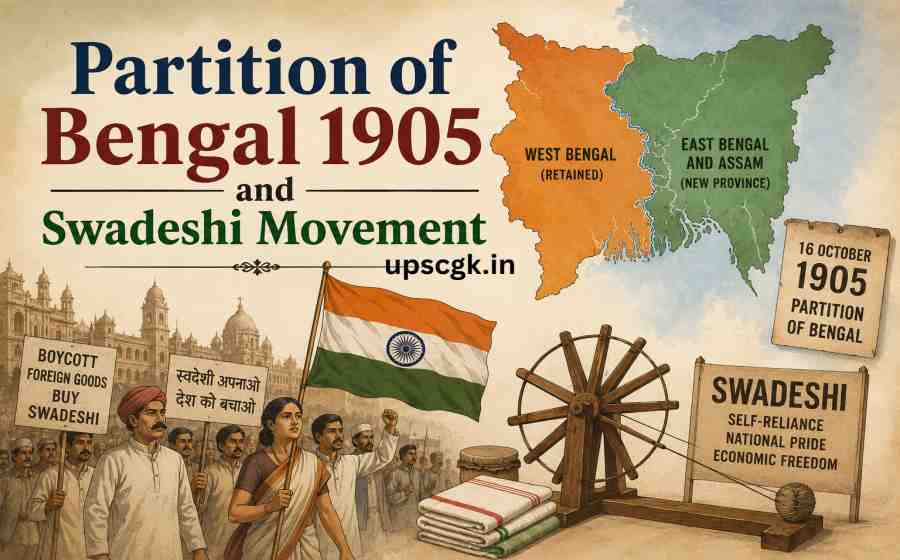
Partition of Bengal 1905 and Swadeshi Movement marked a turning point in India’s freedom struggle, promoting nationalism, boycott and self-reliance.
Partition of Bengal 1905 and Swadeshi Movement
The Partition of Bengal in 1905 was one of the most significant events in the history of India’s freedom struggle. Announced by the British government under Lord Curzon, the partition aimed to divide the vast Bengal Presidency into two separate provinces. While the British claimed that the division was done for administrative convenience, Indians viewed it as a deliberate attempt to weaken the growing nationalist movement by creating divisions among communities.
The opposition to the partition led to the birth of the Swadeshi Movement, a powerful mass movement that encouraged the use of Indian-made goods and the boycott of foreign products. The movement marked a new phase in India’s struggle for independence and awakened political consciousness across the country.
Table of Contents
Background of the Partition of Bengal
At the beginning of the 20th century, Bengal was the largest province in British India. It included present-day West Bengal, Bangladesh, Bihar, Odisha, and parts of Assam. With a population of nearly 80 million people, the British argued that governing such a large province was difficult.
Lord Curzon, the Viceroy of India from 1899 to 1905, proposed the partition of Bengal. On 19 July 1905, the British government officially announced the plan, and it came into effect on 16 October 1905.
Under the partition:
- Western Bengal, including Bihar and Odisha, remained under one administration.
- Eastern Bengal and Assam were combined into a new province with Dacca (Dhaka) as its capital.
The British government justified the decision as an administrative reform. However, Indian nationalists believed that the real objective was to divide Hindus and Muslims and weaken the growing unity among Indians.
Reasons Behind the Partition
Several factors contributed to the British decision:
1. Administrative Justification
The British claimed that Bengal’s large size made governance inefficient. Dividing the province, according to them, would improve administration and public services.
2. Divide and Rule Policy
Many Indian leaders believed that the partition was a political strategy. Bengal had become the center of nationalist activities, and the British wanted to reduce its influence by dividing the population along religious lines.
3. Weakening Nationalism
The British were concerned about the rise of educated Indians and the growing demand for political rights. The partition was intended to break the unity of the nationalist movement.
Public Reaction to the Partition
The announcement generated widespread anger and resentment. Indians from different regions and social backgrounds opposed the decision.
Prominent leaders such as Surendranath Banerjee, Bipin Chandra Pal, and Aurobindo Ghosh played a leading role in organizing protests.
On 16 October 1905, the day the partition came into effect, people observed a day of mourning. Thousands took part in processions, prayers, and demonstrations. Hindus and Muslims tied rakhi threads to symbolize unity and brotherhood.
Birth of the Swadeshi Movement
The anti-partition agitation soon evolved into the Swadeshi Movement. The term “Swadeshi” means “of one’s own country.”
The movement encouraged Indians to:
- Boycott foreign goods.
- Use products made in India.
- Promote indigenous industries.
- Support national education.
- Develop self-reliance and economic independence.
The movement became one of the first mass-based political movements in modern Indian history.
Major Features of the Swadeshi Movement
Boycott of Foreign Goods
People refused to buy British textiles, sugar, salt, and other imported products. Foreign goods were publicly burned as a symbol of protest.
Promotion of Indigenous Industries
Indian entrepreneurs established textile mills, soap factories, banks, insurance companies, and other businesses. The movement provided a boost to local industries and encouraged economic nationalism.
National Education
Many students left government institutions and joined national schools and colleges established by Indian leaders. Educational institutions focused on patriotism and self-respect.
Public Meetings and Processions
Large gatherings, speeches, and demonstrations spread awareness among the masses. Political participation expanded beyond the educated elite.
Cultural Nationalism
Patriotic songs, literature, and art became important tools for mobilizing public support. The song Vande Mataram, written by Bankim Chandra Chattopadhyay, became the symbol of the movement.
Role of Leaders
Several leaders made significant contributions to the movement.
Bal Gangadhar Tilak
Tilak supported the Swadeshi Movement and encouraged people to participate actively in the struggle against British rule.
Bipin Chandra Pal
Pal was one of the strongest advocates of boycott and Swadeshi policies. His speeches inspired thousands across Bengal and other regions.
Aurobindo Ghosh
Aurobindo emphasized complete independence and encouraged national awakening through political action and education.
Rabindranath Tagore
Tagore promoted unity among communities and participated in anti-partition campaigns through songs, literature, and public events.
Impact of the Swadeshi Movement
The movement had far-reaching consequences.
Political Impact
It transformed the Indian freedom struggle from a limited political movement into a mass movement involving students, workers, women, and businessmen.
Economic Impact
The promotion of indigenous industries encouraged economic self-reliance and reduced dependence on imported goods.
Social Impact
National consciousness spread among different sections of society. People began to identify themselves as part of a larger Indian nation.
Rise of Assertive Nationalism
The movement strengthened the influence of assertive nationalist leaders who advocated stronger methods of resistance against British rule.
Annulment of the Partition
Continuous protests and public opposition forced the British government to reconsider its decision. In 1911, the partition was officially annulled.
The British reunited Bengal and simultaneously shifted the capital of British India from Calcutta to Delhi. Although the partition was reversed, the Swadeshi Movement had already left a lasting impact on Indian politics and society.
Summary
The Partition of Bengal in 1905 was a turning point in India’s freedom struggle. What began as a British administrative measure was widely perceived as an attempt to divide Indians and weaken nationalism. The strong public response led to the Swadeshi Movement, which promoted self-reliance, national unity, and economic independence. The movement awakened millions of Indians and laid the foundation for future mass movements against British rule. Its legacy remains an important chapter in the history of Indian nationalism and the struggle for independence.
Also Check: History