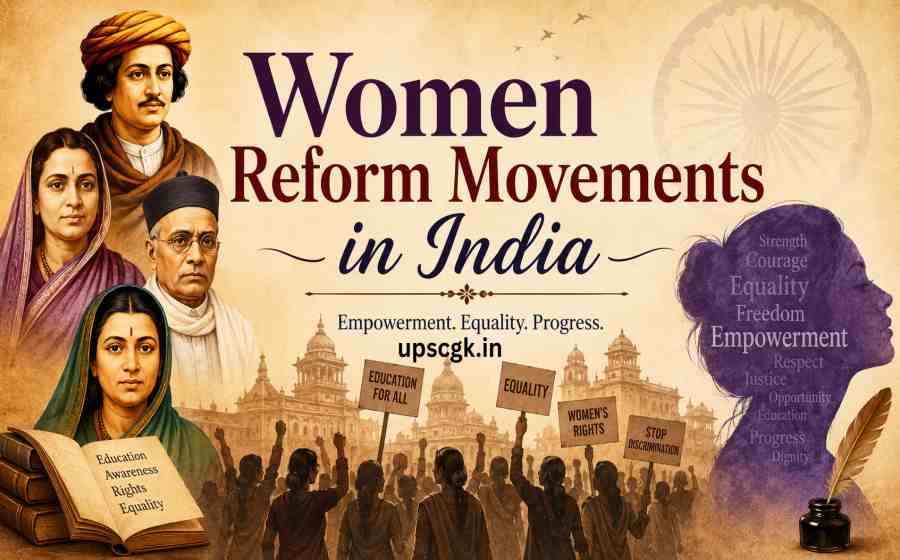
Explore Women Reform Movements in India, their history, key leaders, major achievements and impact on women’s rights, education and social equality.
Women Reform Movements in India
The history of India is not only a story of kings, kingdoms, and freedom struggles but also a remarkable journey of social reforms. Among the most significant developments in Indian society were the women reform movements that aimed to improve the status of women and eliminate social evils that restricted their rights and opportunities. These movements played a crucial role in shaping modern India and promoting gender equality.
For centuries, women in India faced various social challenges such as child marriage, sati, purdah, lack of education, denial of property rights, and discrimination in public life. Reformers, social activists, and women leaders worked tirelessly to challenge these practices and create a more equitable society. Their efforts laid the foundation for women’s empowerment and inspired future generations.
Table of Contents
Status of Women Before Social Reforms
During the medieval and early colonial periods, the condition of women in many parts of India was difficult. Several social customs limited their freedom and opportunities. Women often had little access to education, were married at a young age, and had limited participation in social and political affairs.
Some of the major problems faced by women included:
- Child marriage
- Sati system
- Widow oppression
- Female illiteracy
- Purdah system
- Lack of property rights
- Social and economic dependence
These issues highlighted the urgent need for reform and social change.
Early Women Reform Movements
The nineteenth century marked the beginning of organized efforts to improve women’s status in India. Social reformers recognized that national progress was impossible without the upliftment of women.
Raja Ram Mohan Roy and the Abolition of Sati
One of the earliest champions of women’s rights was Raja Ram Mohan Roy. He strongly opposed the sati system, a practice in which widows were forced to sacrifice themselves on their husband’s funeral pyre.
Through continuous campaigns and public awareness efforts, he influenced the British government to abolish sati in 1829. His work marked a significant milestone in women’s reform movements.
Ishwar Chandra Vidyasagar and Widow Remarriage
Another prominent reformer, Ishwar Chandra Vidyasagar, advocated widow remarriage and women’s education. His efforts led to the enactment of the Widow Remarriage Act of 1856.
Vidyasagar believed that education was the key to empowering women and worked extensively to establish schools for girls.
Women’s Education Movement
Education became one of the most important tools for women’s empowerment.
Savitribai Phule’s Contribution
Savitribai Phule is widely regarded as India’s first female teacher. Along with her husband, Jyotirao Phule, she established schools for girls and fought against caste and gender discrimination.
Despite facing social opposition and harassment, Savitribai continued her mission to provide education to women and marginalized communities.
Expansion of Girls’ Education
The late nineteenth and early twentieth centuries witnessed the growth of schools, colleges, and educational institutions for women. Educated women gradually began participating in public life, literature, journalism, and social activism.
Women’s Participation in the Freedom Movement
The Indian freedom struggle provided women with an opportunity to actively participate in national affairs. Many women leaders emerged during this period and inspired social change.
Role of Mahatma Gandhi
Mahatma Gandhi encouraged women to join mass movements such as the Non-Cooperation Movement, Civil Disobedience Movement, and Quit India Movement.
Gandhi believed that women possessed qualities such as courage, patience, and determination that were essential for the nation’s struggle for independence.
Prominent Women Leaders
Several women made significant contributions during the freedom movement:
- Sarojini Naidu
- Annie Besant
- Aruna Asaf Ali
- Kasturba Gandhi
- Vijaya Lakshmi Pandit
Their active participation challenged traditional gender roles and inspired millions of women across the country.
Women’s Reform Movements After Independence
After India gained independence in 1947, the Constitution guaranteed equality and fundamental rights to all citizens regardless of gender.
Several reforms were introduced to improve women’s status:
- Equal voting rights
- Equal opportunity in public employment
- Legal protection against discrimination
- Improved access to education
- Property and inheritance rights
- Protection against exploitation
Government policies and social organizations worked together to promote women’s welfare and development.
Modern Women’s Movements
The decades following independence saw the rise of new women’s movements focusing on social justice, equality, and empowerment.
Campaigns Against Dowry
The dowry system became a major concern in modern India. Women’s organizations launched campaigns demanding stricter laws and social awareness against dowry-related violence.
Fight Against Gender Discrimination
Various groups worked to ensure equal opportunities in education, employment, healthcare, and political participation. Awareness campaigns encouraged society to challenge stereotypes and support women’s rights.
Political Representation
Efforts were also made to increase women’s participation in governance and decision-making. Reservation policies in local government institutions enabled millions of women to enter public life and leadership positions.
Impact of Women Reform Movements
Women reform movements have transformed Indian society in numerous ways:
- Increased female literacy rates
- Greater participation in politics and governance
- Improved legal rights
- Higher employment opportunities
- Enhanced social awareness about gender equality
- Better access to education and healthcare
Today, Indian women contribute significantly to science, technology, business, sports, education, defense, and public administration.
Challenges That Still Remain
Despite remarkable progress, some challenges continue to exist:
- Gender-based violence
- Unequal wages
- Limited representation in some sectors
- Social stereotypes
- Educational disparities in certain regions
Addressing these issues requires continued efforts from governments, institutions, and society as a whole.
Summary
Women reform movements in India have been instrumental in creating a more just and inclusive society. From the abolition of sati and promotion of widow remarriage to modern campaigns for equality and empowerment, these movements have transformed the lives of millions of women. The contributions of reformers, educators, freedom fighters, and activists continue to inspire India’s journey toward gender justice and social progress. As the nation advances, the principles of equality, dignity, and opportunity for all women remain essential for building a stronger and more prosperous India.
Also Check: History