
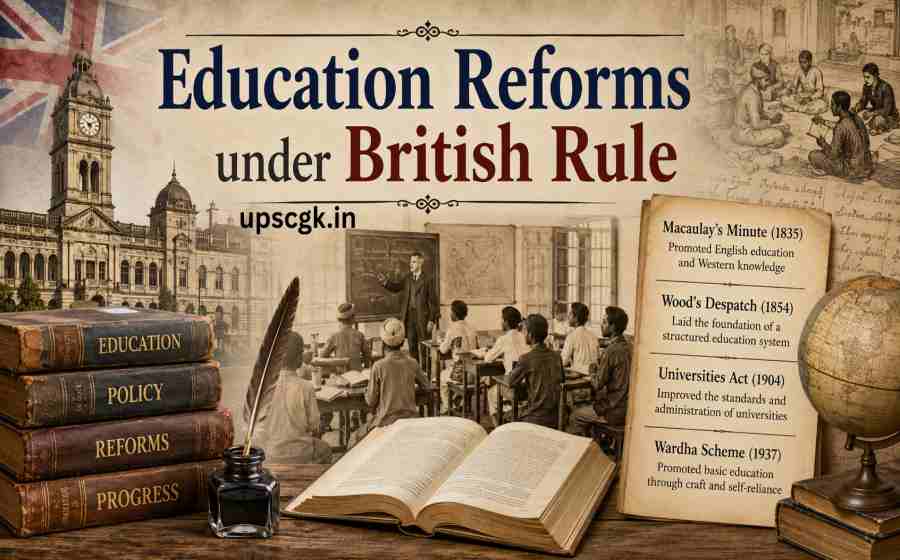
Explore the major education reforms under British rule in India, including Macaulay’s Minute, Wood’s Despatch and the growth of modern schools and universities.
Education Reforms under British Rule
The British period marked a significant transformation in the Indian education system. Before British intervention, education in India was mainly imparted through traditional institutions such as Gurukuls, Pathshalas, Madrasas, and Maktabs. The arrival of the British introduced Western ideas, modern subjects, and new methods of teaching. While the primary objective of British educational policies was often administrative convenience, these reforms had a lasting impact on Indian society and laid the foundation for the modern education system in India.
Table of Contents
Traditional Education Before British Rule
Prior to British rule, education in India was largely based on religious and cultural traditions. Hindu institutions focused on subjects like Sanskrit, philosophy, mathematics, and literature, while Muslim institutions emphasized Persian, Arabic, theology, and law. Education was generally limited to certain sections of society, and access varied across regions.
When the British East India Company expanded its control over India, it initially showed little interest in educational development. However, by the early nineteenth century, education became an important area of policy discussion.
Charter Act of 1813
The Charter Act of 1813 was the first major step taken by the British government toward education in India. The Act allocated one lakh rupees annually for the promotion of education and the revival of literature.
This measure initiated a debate between two groups:
- Orientalists, who supported education in traditional Indian languages and subjects.
- Anglicists, who favored English-language education and Western knowledge.
The debate continued for several years and influenced future educational reforms.
Macaulay’s Minute (1835)
One of the most influential events in the history of Indian education was Thomas Babington Macaulay’s Minute on Education in 1835.
Macaulay strongly advocated the promotion of English education. He argued that Western literature, science, and philosophy were superior to traditional Indian learning. Based on his recommendations, Governor-General Lord William Bentinck introduced English as the medium of instruction for higher education.
The main objectives of Macaulay’s policy were:
- To spread Western knowledge in India.
- To create a class of educated Indians who could assist in British administration.
- To promote English language and culture.
Although criticized for undermining indigenous education, Macaulay’s policy played a major role in the spread of English education in India.
Wood’s Despatch (1854)
Wood’s Despatch of 1854 is often called the “Magna Carta of English Education in India.” It provided a comprehensive framework for educational development.
Key recommendations included:
- Establishment of a Department of Public Instruction in each province.
- Promotion of primary, secondary, and higher education.
- Use of vernacular languages at the primary level.
- Expansion of teacher training institutions.
- Encouragement of private educational institutions through grants-in-aid.
- Establishment of universities in major cities.
Wood’s Despatch laid the foundation for a structured educational system in India and significantly expanded access to learning.
Establishment of Universities (1857)
Following the recommendations of Wood’s Despatch, universities were established in:
- Calcutta
- Bombay
- Madras
These universities were modeled on the University of London and primarily functioned as examining bodies. They encouraged higher education and produced a growing class of educated Indians.
Over time, universities became important centers for intellectual development and nationalist thought.
Hunter Commission (1882)
The Hunter Commission was appointed to review the progress of education in India.
Its major recommendations were:
- Greater emphasis on primary education.
- Transfer of responsibility for primary education to local authorities.
- Improvement in teacher training.
- Expansion of vocational and practical education.
The Commission highlighted the importance of educating the masses rather than focusing only on higher education.
Indian Universities Act (1904)
The British government introduced the Indian Universities Act in 1904 to improve the quality and administration of universities.
Key features included:
- Increased government control over universities.
- Better standards of teaching and research.
- Improvement in university administration.
- Expansion of academic facilities.
While the Act enhanced educational standards, many Indian leaders criticized it for increasing colonial interference in academic institutions.
Sadler Commission (1917–1919)
The Sadler Commission examined the problems of higher education, particularly at Calcutta University.
Important recommendations included:
- Twelve years of schooling before university admission.
- Establishment of intermediate colleges.
- Improvement in teacher education.
- Greater focus on university teaching rather than merely conducting examinations.
Many of its recommendations influenced future educational reforms in India.
Hartog Committee (1929)
The Hartog Committee focused on improving educational quality rather than merely increasing enrollment.
Its recommendations included:
- Reduction of student dropout rates.
- Improvement in primary education standards.
- Better teacher training.
- Greater emphasis on vocational education.
The Committee recognized that educational expansion without quality improvement would not be effective.
Wardha Scheme of Basic Education (1937)
Proposed under the leadership of Mahatma Gandhi, the Wardha Scheme aimed to provide education through productive work and handicrafts.
Key principles were:
- Free and compulsory education for children.
- Learning through craft-based activities.
- Promotion of self-reliance.
- Use of the mother tongue as the medium of instruction.
Although not fully implemented, the scheme influenced educational thinking in independent India.
Impact of British Education Reforms
British educational reforms had both positive and negative consequences.
Positive Impacts
- Introduction of modern scientific and technical knowledge.
- Development of a network of schools, colleges, and universities.
- Growth of English as a link language.
- Emergence of an educated middle class.
- Spread of political awareness and nationalism.
- Promotion of social reform movements.
Negative Impacts
- Neglect of traditional Indian educational institutions.
- Limited access to education for rural and poorer sections.
- Excessive focus on clerical and administrative training.
- Creation of educational inequalities.
- Decline of indigenous languages in higher education.
Summary
Education reforms under British rule fundamentally transformed India’s educational landscape. Beginning with the Charter Act of 1813 and continuing through Macaulay’s Minute, Wood’s Despatch, the Hunter Commission, and other reforms, the British introduced a modern educational framework that continues to influence India today. While colonial policies often served administrative and political interests, they also contributed to the spread of modern education, scientific thinking, and nationalist consciousness. The legacy of these reforms remains visible in India’s schools, colleges, universities, and administrative systems, making them an important chapter in Indian history.
Also Check: History