Formation of Khalsa and its military and religious significance explained here, including Guru Gobind Singh’s vision, principles and impact on Sikh history.
Formation of Khalsa
The formation of the Khalsa stands as one of the most important events in Indian and Sikh history. It transformed the Sikh community into a disciplined, fearless, and spiritually committed brotherhood dedicated to justice, equality, and protection of humanity. Established by Guru Gobind Singh in 1699, the Khalsa became both a religious order and a military force that reshaped the destiny of the Sikhs and influenced Indian history deeply.
The word “Khalsa” means “pure” or “belonging directly to God.” Through the creation of the Khalsa, Guru Gobind Singh aimed to remove fear, social discrimination, caste divisions, and injustice from society. The movement united people from different backgrounds and gave them a common identity based on courage, faith, and equality.
Table of Contents
Historical Background
Before the formation of the Khalsa, the Sikh community had already gone through major struggles. The earlier Sikh Gurus had spread the message of devotion to one God, honesty, equality, and service to humanity. However, during the rule of the Mughal Empire, especially under Emperor Aurangzeb, religious intolerance and persecution increased.
The execution of Guru Tegh Bahadur in 1675 became a turning point. Guru Tegh Bahadur sacrificed his life to protect the religious freedom of Kashmiri Pandits who were facing forced conversions. His martyrdom deeply affected young Guru Gobind Singh and convinced him that spirituality alone was not enough; people also needed the strength to defend righteousness and justice. As a result, Guru Gobind Singh decided to create a community of saint-soldiers who would combine spiritual devotion with military courage.
Establishment of the Khalsa
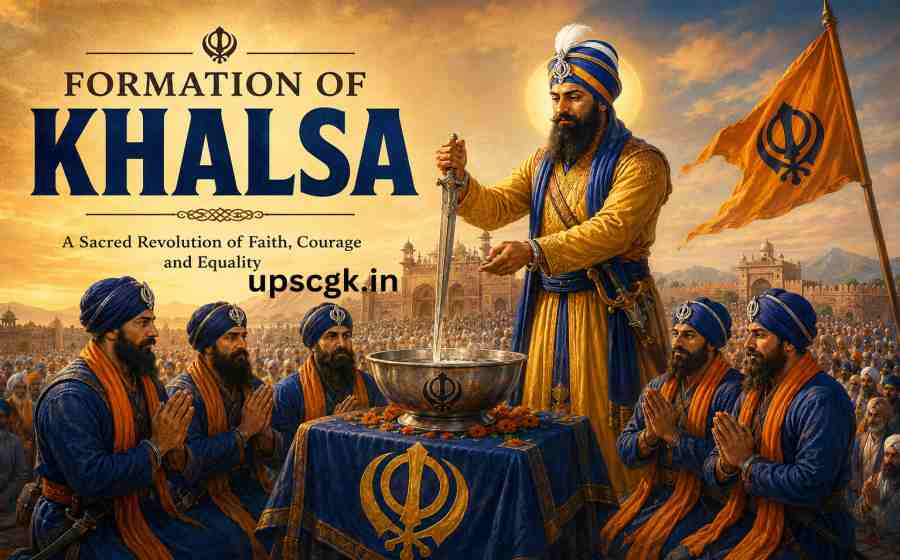
The Khalsa was officially formed on the day of Baisakhi on 13 April 1699 at Anandpur Sahib in present-day Punjab. Thousands of Sikhs gathered there to celebrate the festival. During the gathering, Guru Gobind Singh appeared before the crowd with a sword and demanded a volunteer willing to sacrifice his life for faith.
After a moment of silence, one man stepped forward. Guru Gobind Singh took him into a tent and later returned with his sword stained in blood. He repeated the demand four more times, and four additional men volunteered. These five men became famous as the “Panj Pyare” or the “Five Beloved Ones.”
The Panj Pyare were:
- Bhai Daya Singh
- Bhai Dharam Singh
- Bhai Himmat Singh
- Bhai Mohkam Singh
- Bhai Sahib Singh
They came from different castes and regions, symbolizing equality and unity.
Guru Gobind Singh then prepared “Amrit” (holy nectar) by mixing water and sugar crystals in an iron bowl while reciting sacred hymns. The Panj Pyare were initiated into the Khalsa through this ceremony, known as the Amrit Sanchar. Later, Guru Gobind Singh himself received initiation from the Panj Pyare, showing that all members of the Khalsa were equal.
Men were given the surname “Singh” meaning lion, while women received the surname “Kaur” meaning princess. This eliminated caste identities and promoted social equality.
Religious Significance of the Khalsa
The formation of the Khalsa had immense religious importance for Sikhism.
1. Creation of a Distinct Sikh Identity
The Khalsa gave Sikhs a clear and united identity. Members were instructed to follow the Five Ks:
- Kesh (uncut hair)
- Kangha (wooden comb)
- Kara (iron bracelet)
- Kirpan (sword)
- Kachera (special shorts)
These symbols represented discipline, spirituality, courage, cleanliness, and readiness to protect the weak.
2. Equality and Brotherhood
One of the biggest religious contributions of the Khalsa was the rejection of caste discrimination. People from all social backgrounds became equal members of the Sikh community. This was revolutionary in a society deeply divided by caste hierarchy.
3. Spiritual Discipline
The Khalsa emphasized devotion to God, truthful living, service to humanity, and moral conduct. Sikhs were expected to avoid addiction, dishonesty, and immoral behavior. The Khalsa combined spiritual purity with practical action.
4. Defense of Religious Freedom
The Khalsa was not formed to attack others but to protect justice and religious liberty. Guru Gobind Singh taught that the sword should only be used against oppression and tyranny.
Military Significance of the Khalsa
The Khalsa also played a major military role in Indian history.
1. Transformation into a Warrior Community
Before the Khalsa, Sikhs were mainly a peaceful spiritual community. After 1699, they became organized warriors capable of resisting oppression. Guru Gobind Singh trained Sikhs in horse riding, weapon use, and battlefield tactics.
2. Resistance Against Mughal Oppression
The Khalsa became a strong force against Mughal persecution. Sikh warriors fought bravely in several battles against Mughal armies and hill chiefs. Their courage inspired people across northern India.
3. Foundation of Sikh Military Power
The Khalsa later laid the foundation for Sikh political and military power in Punjab. In the eighteenth century, Sikh misls emerged as military groups, eventually leading to the rise of the Sikh Empire under Maharaja Ranjit Singh.
4. Protection of the Common People
The Khalsa fought not only for Sikhs but also for the rights of ordinary people suffering under injustice. They became defenders of the weak and symbols of resistance against tyranny.
Long-Term Impact of the Khalsa
The formation of the Khalsa permanently transformed Sikh society and Indian history. It strengthened unity among Sikhs and gave them the confidence to preserve their faith despite severe hardships. The Khalsa tradition continues today and remains central to Sikh identity across the world.
The ideals of courage, equality, sacrifice, and service introduced by Guru Gobind Singh still inspire millions. Sikh soldiers and communities worldwide continue to uphold these principles through humanitarian work, social service, and dedication to justice.
Summary
The formation of the Khalsa in 1699 was far more than a religious event; it was a social, spiritual, and military revolution. Guru Gobind Singh created a fearless community devoted to God, equality, and protection of humanity. The Khalsa gave Sikhs a unique identity and transformed them into defenders of justice and freedom.
Its military strength helped resist oppression, while its spiritual teachings promoted morality and brotherhood. Even today, the Khalsa remains a shining symbol of courage, discipline, and selfless service in world history.
Also Check: History