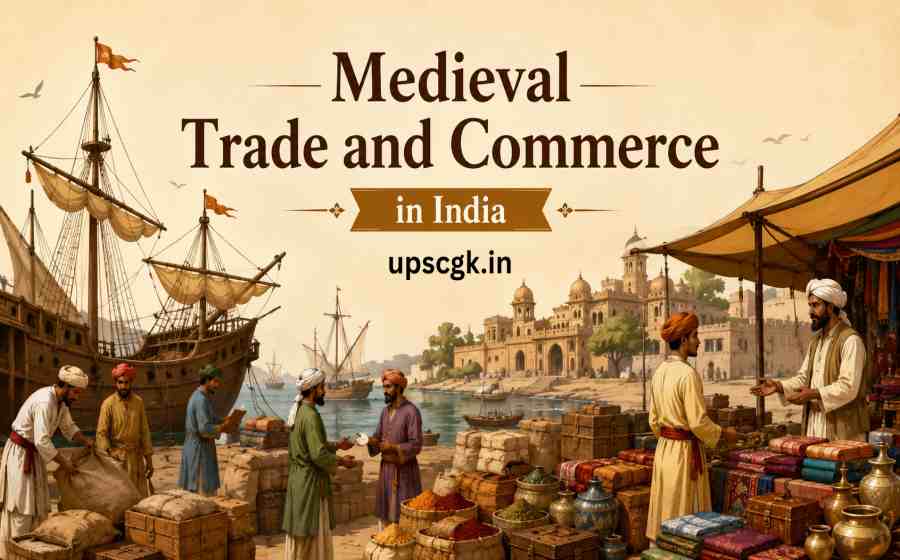
Medieval Trade and Commerce in India flourished through internal markets and foreign trade, boosting economic growth, urbanization and cultural exchange.
Medieval Trade and Commerce in India
Trade and commerce played a vital role in shaping the economic, social, and cultural life of medieval India. The medieval period, stretching roughly from the 8th century to the 18th century, witnessed significant growth in both internal and foreign trade. The expansion of trade networks connected villages, towns, and cities within India while also linking the subcontinent with regions such as Central Asia, the Middle East, Africa, Southeast Asia, and Europe.
The prosperity of many medieval kingdoms depended heavily on trade revenues. Merchants, artisans, and traders contributed significantly to economic development, while ports and market centers became hubs of commercial activity. The flourishing trade system also facilitated cultural exchange, technological diffusion, and the spread of ideas across different regions.
Table of Contents
Internal Trade in Medieval India
Internal trade refers to the exchange of goods within the country. During the medieval period, India possessed a well-developed network of roads, rivers, and market towns that supported domestic commerce.
Market Centers and Trade Routes
Numerous towns emerged as important commercial centers due to their strategic location. Major cities such as Delhi, Agra, Lahore, Ahmedabad, Multan, Kannauj, and Vijayanagara became thriving marketplaces. Trade routes connected these urban centers with rural areas, enabling the movement of agricultural products, handicrafts, and manufactured goods.
The famous Grand Trunk Road, developed and improved by rulers such as Sher Shah Suri, facilitated trade between northern and eastern India. River routes along the Ganga, Yamuna, Godavari, Krishna, and Narmada rivers also served as important transportation channels.
Goods Traded Internally
A wide variety of goods were exchanged through internal trade, including:
- Food grains such as rice and wheat
- Sugar and jaggery
- Cotton and silk textiles
- Salt and spices
- Metal products
- Horses and cattle
- Precious stones and jewelry
- Handicrafts and pottery
Different regions specialized in producing particular commodities. Bengal was famous for fine textiles, Gujarat for cotton fabrics, Kashmir for shawls, and South India for spices.
Role of Merchants
Merchants formed the backbone of medieval commerce. Wealthy merchant communities organized trade activities and maintained commercial networks across regions. Merchant guilds played an important role in regulating trade, ensuring fair practices, and protecting the interests of traders.
Some merchants accumulated immense wealth and often provided financial assistance to rulers. Their influence extended beyond economic activities, as they also funded temples, educational institutions, and charitable works.
Currency and Banking
The growth of trade encouraged the use of coins and financial instruments. Gold, silver, and copper coins circulated widely during different medieval dynasties. The introduction of standardized coinage under various rulers enhanced commercial transactions.
Bankers and moneylenders facilitated trade by providing credit and loans. The use of “hundis” (credit notes) allowed merchants to transfer money safely across long distances without carrying large amounts of cash.
Foreign Trade in Medieval India
Foreign trade was a major source of wealth and prosperity for medieval India. The country’s strategic location along important maritime and land routes enabled extensive trade with foreign regions.
Trade with Central Asia and the Middle East
India maintained strong commercial relations with Central Asia, Persia, and the Arab world. Overland routes connected northern India with Afghanistan and beyond. Traders transported valuable commodities such as textiles, spices, indigo, and precious stones.
Arab merchants played a crucial role in promoting trade between India and the Islamic world. They established commercial settlements along India’s western coast and helped integrate Indian markets with international trade networks.
Maritime Trade
Sea trade flourished through ports located along the eastern and western coasts of India. Important ports included:
- Surat
- Cambay (Khambhat)
- Calicut (Kozhikode)
- Cochin
- Masulipatnam
- Nagapattinam
Indian merchants and foreign traders used the Arabian Sea and the Bay of Bengal to conduct business with distant regions. Monsoon winds greatly aided maritime navigation and commerce.
Trade with Southeast Asia
India maintained vibrant trade relations with Southeast Asian kingdoms. Indian merchants exported textiles, spices, ivory, and precious stones to regions such as present-day Indonesia, Malaysia, Thailand, and Cambodia.
These commercial contacts also contributed to the spread of Indian culture, religion, art, and architecture across Southeast Asia.
Trade with Europe
The arrival of European trading powers marked a new phase in medieval commerce. The Portuguese reached India in 1498 through the voyage of Vasco da Gama. They were followed by the Dutch, English, and French.
European traders sought valuable Indian goods, particularly spices, cotton textiles, silk, indigo, and precious stones. The establishment of trading factories and ports strengthened India’s role in global commerce.
Major Exports and Imports
Exports
India exported numerous high-quality products, including:
- Cotton textiles
- Silk fabrics
- Spices
- Indigo
- Sugar
- Rice
- Precious stones
- Ivory products
- Handicrafts
Indian textiles, especially muslin and calico, enjoyed immense demand in international markets.
Imports
India imported:
- Horses from Central Asia and Arabia
- Gold and silver
- Luxury goods
- Silk from China
- Glassware
- Metals
- Certain manufactured products
The import of high-quality horses was particularly important for medieval armies.
Impact of Trade and Commerce
The expansion of trade had far-reaching effects on medieval Indian society:
Economic Growth
Trade generated substantial wealth for kingdoms and merchants. Tax revenues from commercial activities strengthened state finances and supported administrative systems.
Urbanization
The growth of commerce led to the development of towns and cities. Commercial centers attracted artisans, traders, and laborers, contributing to urban expansion.
Cultural Exchange
Trade facilitated the exchange of ideas, technologies, languages, and artistic traditions between India and foreign civilizations.
Development of Industries
The demand for trade goods encouraged the growth of textile production, shipbuilding, metalworking, and other industries.
Summary
Medieval India’s trade and commerce system was one of the most vibrant in the world. A strong internal trade network connected different regions of the country, while extensive foreign trade linked India with Asia, Africa, and Europe. Merchants, ports, market centers, and trade routes played a crucial role in sustaining economic prosperity. The flourishing commercial activities not only generated wealth but also promoted urbanization, cultural interaction, and industrial development. The legacy of medieval trade continues to highlight India’s historical importance as a major center of global commerce.
Also Check: History