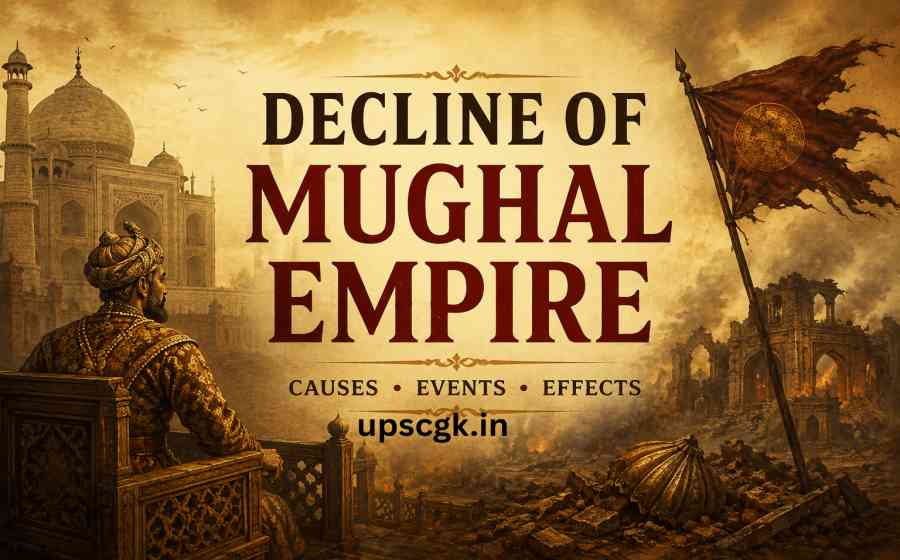
Learn about the Decline of Mughal Empire, its major causes, key events and lasting effects that changed the political history of India.
Decline of Mughal Empire
The Mughal Empire was one of the greatest empires in Indian history. Founded by Babur in 1526 after the First Battle of Panipat, it ruled a large part of the Indian subcontinent for nearly three centuries. The Mughal Empire reached its peak during the reign of emperors like Akbar, Jahangir, and Shah Jahan. The empire became famous for strong administration, economic prosperity, cultural development, and architectural wonders.
However, after the rule of Aurangzeb, the empire started weakening. During the eighteenth century, it gradually lost control over its territories and eventually collapsed. The decline of the Mughal Empire was not caused by a single event but by several political, military, economic, and social factors working together.
Table of Contents
Major Causes of the Decline of Mughal Empire
1. Weak Successors After Aurangzeb
One of the biggest reasons behind the decline was the rise of weak rulers after Aurangzeb’s death in 1707. Aurangzeb was the last powerful Mughal emperor. After him, many emperors lacked leadership skills and administrative abilities.
The later rulers were more interested in luxury and palace life rather than governing the empire effectively. Frequent conflicts for the throne also created instability. Since there was no clear rule of succession, princes fought against each other to gain power. These succession wars weakened the central authority and damaged the administration.
2. Large Size of the Empire
The Mughal Empire had expanded over a vast area. Managing such a large territory became difficult. Communication and transportation systems during that period were slow.
Aurangzeb’s long military campaigns in southern India exhausted the empire’s resources. Controlling distant regions became increasingly difficult, and many local rulers started acting independently.
3. Religious Policies of Aurangzeb
Aurangzeb’s religious policies also played a role in weakening the empire. Earlier emperors, especially Akbar, followed a policy of religious tolerance and maintained good relations with different communities.
Aurangzeb reintroduced the Jizya tax and adopted stricter religious policies. This created dissatisfaction among several groups, including Rajputs, Sikhs, and Marathas. As a result, many communities that had once supported Mughal rule began opposing it.
4. Rise of Regional Powers
As Mughal authority weakened, several regional powers emerged and challenged the empire.
The rise of the Maratha Empire became a major challenge. The Marathas expanded rapidly and reduced Mughal influence in many regions.
Other regional powers also gained strength, including:
- Sikh Confederacy
- Kingdom of Mysore
- Nizam of Hyderabad
- Nawab of Bengal
These regional powers gradually reduced the authority of the Mughal rulers.
5. Economic Problems
Economic weakness also contributed significantly to the empire’s decline. Continuous wars and military campaigns required huge amounts of money.
Heavy spending on wars, administration, and royal lifestyles put pressure on the treasury. Corruption increased among officials, and tax collection became inefficient.
Farmers suffered because of high taxes, resulting in reduced agricultural productivity. Economic difficulties created dissatisfaction among the population and weakened the state’s foundation.
6. Foreign Invasions
Foreign invasions severely damaged the Mughal Empire.
In 1739, Nader Shah invaded India and attacked Delhi. He looted enormous wealth, including the famous Peacock Throne and valuable treasures. This invasion exposed the weakness of the Mughal military system.
Later, Ahmad Shah Durrani launched repeated invasions, causing further destruction and instability.
7. Arrival of European Powers
European trading companies gradually increased their influence in India.
The British East India Company initially came for trade but slowly began interfering in Indian politics. As the Mughal Empire weakened, European powers used political divisions for their benefit.
Over time, the British became stronger and established control over large parts of India.
Effects of the Decline of Mughal Empire
Political Instability
The decline of Mughal power created political instability throughout India. Many small kingdoms emerged and frequently fought against each other for control and territory.
Rise of Regional States
With the weakening of Mughal authority, several regional powers gained independence and expanded their territories.
Economic Decline
Trade and agriculture suffered because of wars and political disturbances. Many regions experienced economic hardships.
Foreign Domination
One of the most important consequences was the rise of British influence in India. The political vacuum created by Mughal decline provided an opportunity for the British East India Company to expand its control.
End of Mughal Rule
The final blow came during the Indian Rebellion of 1857. After the revolt, the British officially ended Mughal rule and exiled Bahadur Shah II, the last Mughal emperor.
Summary
The decline of the Mughal Empire was a gradual process influenced by weak rulers, administrative failures, economic difficulties, religious conflicts, regional uprisings, and foreign invasions. Although the empire eventually collapsed, its impact on Indian history remained significant. Mughal contributions to architecture, administration, art, and culture still continue to influence modern India. Understanding the decline of the Mughal Empire helps us understand how political weakness and internal divisions can change the course of history.
Also Check: History