
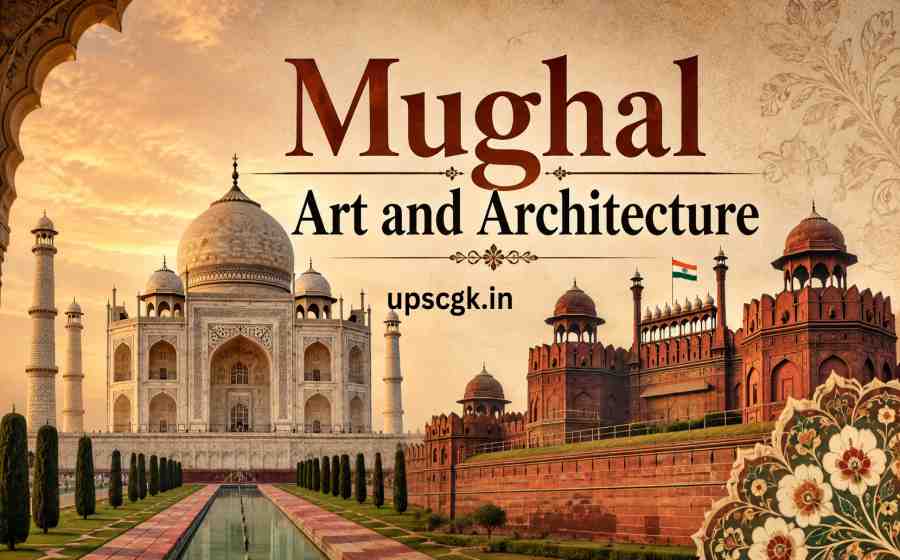
Explore Mughal Art and Architecture in detail, including the Taj Mahal, Red Fort, forts, gardens, paintings and architectural achievements of the Mughal Empire.
Mughal Art and Architecture
The Mughal Empire was not only known for its political power and administrative systems but also for its remarkable contributions to art and architecture. Mughal rulers transformed the cultural and artistic landscape of India by blending Indian, Persian, Central Asian, and Islamic traditions. Their monuments, paintings, gardens, and decorative styles became symbols of creativity and elegance. Even today, many Mughal structures stand as masterpieces of world architecture and attract millions of visitors from around the globe.
Mughal architecture developed gradually under different rulers. Each emperor introduced his own ideas and styles, resulting in a rich and diverse architectural tradition. The buildings constructed during this period reflected not only beauty but also power, wealth, and religious influence.
Table of Contents
Beginning of Mughal Architecture
The foundations of Mughal architecture were laid by Babur, the founder of the Mughal Empire. Babur admired Persian gardens and introduced the concept of carefully planned gardens in India. However, his reign was short, and he could not undertake many large construction projects.
Humayun’s reign also witnessed limited architectural development due to political instability. Yet, after his death, the construction of his tomb marked an important turning point. Humayun’s Tomb in Delhi is considered one of the earliest examples of mature Mughal architecture. It introduced many features that later became common in Mughal buildings, such as grand domes, symmetrical structures, and large gardens.
Akbar and Architectural Expansion
The reign of Akbar marked a major stage in the development of Mughal architecture. Akbar encouraged the combination of Persian and Indian styles. His buildings displayed strength, creativity, and cultural integration.
One of Akbar’s greatest architectural achievements was Fatehpur Sikri, which became his capital for some time. It was constructed using red sandstone and contained palaces, mosques, administrative buildings, and residential complexes. Important structures within Fatehpur Sikri include Buland Darwaza, Panch Mahal, and Diwan-i-Khas.
Akbar’s architectural style showed a mixture of Hindu and Islamic elements. Features such as pillars, balconies, decorative brackets, and carved motifs reflected this fusion.
Jahangir and Artistic Development
Jahangir was more interested in painting and artistic refinement than in massive construction projects. During his reign, Mughal painting reached new heights. Artists created detailed portraits, natural scenes, and depictions of animals and birds.
Architecture during Jahangir’s period became more delicate and decorative. Marble began replacing red sandstone in many structures. Decorative floral designs and intricate patterns gained popularity.
The tomb of Itimad-ud-Daulah, often called the “Baby Taj,” is an important monument from this period. It introduced the extensive use of white marble and decorative stone inlay work that later influenced the Taj Mahal.
Shah Jahan and the Golden Age of Mughal Architecture
The reign of Shah Jahan is often called the golden age of Mughal architecture. Under his rule, architecture achieved extraordinary levels of beauty and perfection.
Taj Mahal
The Taj Mahal is considered the finest example of Mughal architecture and one of the most famous monuments in the world. Shah Jahan built it in memory of his wife Mumtaz Mahal.
The monument is constructed mainly of white marble and displays perfect symmetry. The beautiful dome, four surrounding minarets, decorative carvings, and precious stone inlay work make it a masterpiece. Floral designs and verses from the Quran further enhance its beauty.
The Taj Mahal combines artistic excellence with emotional significance. It represents love, elegance, and architectural perfection.
Red Fort
Another major contribution of Shah Jahan was the Red Fort in Delhi. Constructed using red sandstone, the fort served as the main residence of Mughal emperors.
The Red Fort contains several remarkable structures, including:
- Diwan-i-Aam (Hall of Public Audience)
- Diwan-i-Khas (Hall of Private Audience)
- Rang Mahal
- Moti Masjid
The fort reflected the political authority and luxurious lifestyle of the Mughal rulers.
Jama Masjid
Shah Jahan also constructed the Jama Masjid in Delhi, one of the largest mosques in India. Its large courtyard, tall minarets, and impressive domes demonstrate the grandeur of Mughal architecture.
Characteristics of Mughal Architecture
Mughal architecture possessed several unique features:
1. Use of Domes
Large and elegant domes became a defining characteristic of Mughal buildings.
2. Symmetry
Most structures followed balanced and symmetrical designs.
3. Gardens
Mughal rulers developed beautiful gardens using the Persian Charbagh concept, dividing gardens into four sections.
4. Decorative Designs
Walls and surfaces were decorated with floral patterns, carvings, geometric designs, and calligraphy.
5. Use of Marble and Red Sandstone
Red sandstone dominated earlier constructions, while white marble became popular during later periods.
6. Minarets and Arches
Large gateways, arches, and minarets added elegance and grandeur.
Mughal Paintings and Fine Arts
Mughal rulers also encouraged painting and other forms of art. Mughal miniature paintings became famous for their detail and realism. Artists illustrated court scenes, battles, hunting scenes, and portraits of emperors.
Persian artistic traditions blended with Indian styles to create a unique school of painting. Jahangir particularly encouraged naturalistic paintings and portraits.
Calligraphy and decorative arts also flourished during this period. Artists used fine craftsmanship to decorate manuscripts, palaces, and monuments.
Decline and Lasting Influence
After the reign of Aurangzeb, Mughal architectural activities gradually declined. Economic pressures and political instability reduced large-scale construction. However, the influence of Mughal architecture continued to shape later Indian buildings.
Even modern Indian architecture and garden planning show traces of Mughal design principles. The monuments created by the Mughal rulers continue to be admired as symbols of India’s rich cultural heritage.
Summary
Mughal art and architecture represent one of the most glorious chapters in Indian history. Through magnificent monuments like the Taj Mahal, Red Fort, and Jama Masjid, the Mughal rulers left a legacy that continues to inspire people worldwide. Their ability to combine different cultural traditions created timeless masterpieces that remain important symbols of history, art, and human creativity. The Mughal period not only transformed architecture but also enriched India’s artistic identity for future generations.
Also Check: History